







1. Introduction
1.1. Discussion of public spaces
Rapid urbanisation and economic growth have reshaped the fabric of modern cities, elevating the significance of public spaces as "social glue" connecting diverse communities [1]. A high-quality public space is not merely an open area but a dynamic hub that accommodates varied needs—from brief commuter rest stops to prolonged family gatherings, and from solo relaxation to collective cultural events. Worpole and Greenhalgh emphasise that successful public spaces are inherently "sociable, approachable, and jovial," with London’s Trafalgar Square serving as a quintessential example: its central location, iconic landmarks, and diverse user activities make it a perpetual urban hub [2].
The absence of vibrant public spaces creates tangible gaps in urban wellbeing. Without accessible areas to unwind, residents and workers face heightened stress, while opportunities for spontaneous social interaction—whether between friends or strangers—diminish. This isolation not only impacts mental health but also weakens community cohesion [3]. Unfortunately, many urban design initiatives have prioritised technical specifications over human needs, resulting in rigid, underused spaces. These 'inert' environments fail to foster activity and, in extreme cases, become hotspots for vandalism and crime, as Shaftoe notes in his analysis of poorly designed urban plazas [4].
In contrast, well-conceived public spaces deliver multifaceted value:
• Health Benefits: Beyond providing access to fresh air and greenery, they encourage physical activity—from casual walking to group sports—and reduce sedentary lifestyes. A report by the National Heart Forum found that neighbourhoods with high-quality public spaces have a 23% lower incidence of heart disease [5].
• Economic Advantages: Vibrant public spaces act as economic catalysts. They attract foot traffic to nearby retail stores, cafes, and restaurants, boosting local businesses; for instance, Sheffield’s Peace Gardens attract an estimated 500,000 visitors annually, with 68% of these visitors reporting they extended their stay in the city to explore surrounding shops and eateries [6]. Additionally, they enhance the city’s appeal as a tourist destination, contributing to job creation and tax revenue.
A key critique of conventional urban design is its overreliance on professional blueprints that prioritise aesthetic uniformity over local context [4]. Alexander challenges this approach, arguing that 'good places are grown, not built,' emphasising the need to align design with local natural conditions (e.g., climate, vegetation) and community preferences (e.g., activity patterns, cultural values) [7]. Similarly, Landry frames place-making as an 'art of adaptation,' noting that successful public spaces cannot be replicated across cities but must respond to the unique needs of their users [8]. For Sheffield, with its rich industrial heritage, diverse neighbourhoods, and distinct seasonal weather patterns, this means designing spaces that honour local identity while serving modern needs.
This study addresses a critical gap in existing research: while scholars have identified general principles of vibrant public spaces, few have tailored these insights to Sheffield’s specific context. By analysing four of the city’s key public spaces—Peace Gardens, Cathedral Square, Devonshire Green, and Fitzalan Square—this research aims to identify the localised factors that drive vibrancy.
1.2. What is 'vibrant'
This study defines a 'vibrant public space' as an open, public area that supports prolonged stays, relaxation, and social interaction. Tibbalds characterises vibrant spaces as 'rich, lifeful, mixed-use environments that remain active day and night, with visual appeal for residents and visitors alike' [9].
Gehl links vibrancy to human activity, categorising outdoor behaviours into three types: necessary (e.g., commuting), optional (e.g., sitting), and social (e.g., chatting) [3]. Vibrant spaces host a diverse range of activities, whereas low-quality spaces only facilitate necessary behaviours.
Shaftoe identifies comfort features such as human-scale dimensions, diverse seating (with back support, mobility, and sun orientation), shelter, public art, colourful elements, mixed uses (especially food/drink venues), street entertainment, and balanced management (security without over-regulation) [4].
Bentley et al. further refine these principles by outlining seven principles for successful public spaces [10]:
1. Permeability: Design that ensures easy access via multiple routes (e.g., pedestrian paths, public transport) and clear visibility from surrounding areas.
2. Variety: A mix of uses within and around the space (e.g., retail, residential, cultural) to attract users at different times of day.
3. Legibility: Distinctive features (e.g., landmarks, unique landscaping) that help users navigate the space and recognise it as a unique destination.
4. Robustness: Mixed-use functions that can adapt to changing needs (e.g., a plaza that serves as a market during the day and a concert venue at night).
5. Visual Appropriateness: An external appearance that is clear, attractive, and consistent with the surrounding neighbourhood’s character.
6. Richness: Sensory diversity—from the texture of pavement to the sound of water—that enhances user experience.
7. Personalisation: Opportunities for users to 'claim' the space (e.g., community gardens, public art installations by local artists) and feel a sense of ownership.
Synthesising these perspectives, 'vibrancy' in the context of Sheffield’s public spaces encompasses six core attributes:
1. Diverse Activities: Mixed-use areas that cater to all age groups, from playgrounds for children to seating areas for seniors.
2. Street Entertainment: Informal or organised events (e.g., buskers, craft fairs) that animate the space and attract spontaneous visitors.
3. Effective Management: Regular maintenance to ensure cleanliness and safety, without overregulation that discourages casual use.
4. High Permeability: Strategic location near public transport and multiple access points to maximise accessibility.
5. Strong Legibility: Landmarks (e.g., historical buildings, unique art) and local character that make the space recognisable and memorable.
6. High-Quality Physical Design: Durable materials, diverse seating, and sensory elements (colour, greenery, water) that enhance comfort and appeal.
It is important to note that vibrancy is not a one-size-fits-all concept. What feels vibrant to a teenager (e.g., a skatepark with loud music) may differ from what appeals to a senior (e.g., a quiet garden with shaded seating). This study therefore focuses on identifying Sheffield-specific standards of vibrancy based on local user needs.
2. Research model and methodology
2.1. Research model
The research model for this study draws heavily on Henry Shaftoe’s framework from Convivial Urban Spaces, which identifies four interconnected dimensions of public space quality: geographical, physical, psychological and sensual, and managerial [4]. This framework was selected for its holistic approach, as it acknowledges that vibrancy arises from the interaction of multiple factors—rather than isolated design features.
2.1.1. Dimensions of the research model
• Geographical Factors: Location, connectivity, permeability, and road systems. These factors determine how easily users can reach the space and how traffic impacts their experience.
• Physical Factors: Form, function, legibility, land use, building functions and interactions, and design details.
• Psychological and Sensual Factors: Users’ perception, emotional responses, activity patterns, and demographics.
• Managerial Factors: Security measures and maintenance practices.
While Shaftoe’s framework provides a strong foundation, it relies heavily on qualitative observations (e.g., site surveys) and lacks systematic quantitative analysis of user behaviour. To address this gap, the model integrates William Whyte’s 'behavioural mapping' method, which involves recording user demographics and activities at specific times to identify patterns (e.g., which age groups use the space most, what activities are most common) [11]. This mixed-methods approach ensures that the findings are both contextually rich and statistically grounded.
The central research question is: How do geographical, physical, psychological, and managerial factors shape vibrancy in Sheffield’s public spaces?
By answering the question, this model aims to construct a localised vitality assessment framework, which can be applied to the renovation practices of other squares in Sheffield.
2.2. Methodology
A mixed-methods approach—combining qualitative and quantitative techniques—was adopted to ensure rigour.
2.2.1. Qualitative methods
Site surveys and Observation: Used to explore relationships between people’s behaviours and physical factors of each square [3].
2.2.2. Quantitative methods
• Behavioural Mapping: Conducted on Saturday, 18 July 2015, from 15:00 to 15:30—a peak period for foot traffic. This method involved recording the demographics and activities of all users in each space. Researchers used a standardised form to document:
- Demographics: Age (child, teenager, adult, senior) and gender.
- Activities: Sitting (on grass, benches, or chairs), playing (e.g., skateboarding, football), eating/drinking, talking, or passing through.
- Location: Where users were positioned within the space (edge vs. centre). Data were aggregated to identify patterns, such as the percentage of users engaging in each activity or the age distribution of users.
• Comparative Analysis: Statistical comparison of the four spaces and their physical characteristics (location, connectivity, building functions, etc.), so as to identify the factors related to spatial vitality.
3. What makes vibrant public places in Sheffield
3.1. Geographical factors
Geographical factors are the 'foundation' of public space vibrancy, as they determine how easily users can access the space and how comfortable they feel once there. This section analyses four key geographical attributes—location, connectivity, permeability, and road systems—across the four case study spaces.
3.1.1. Location
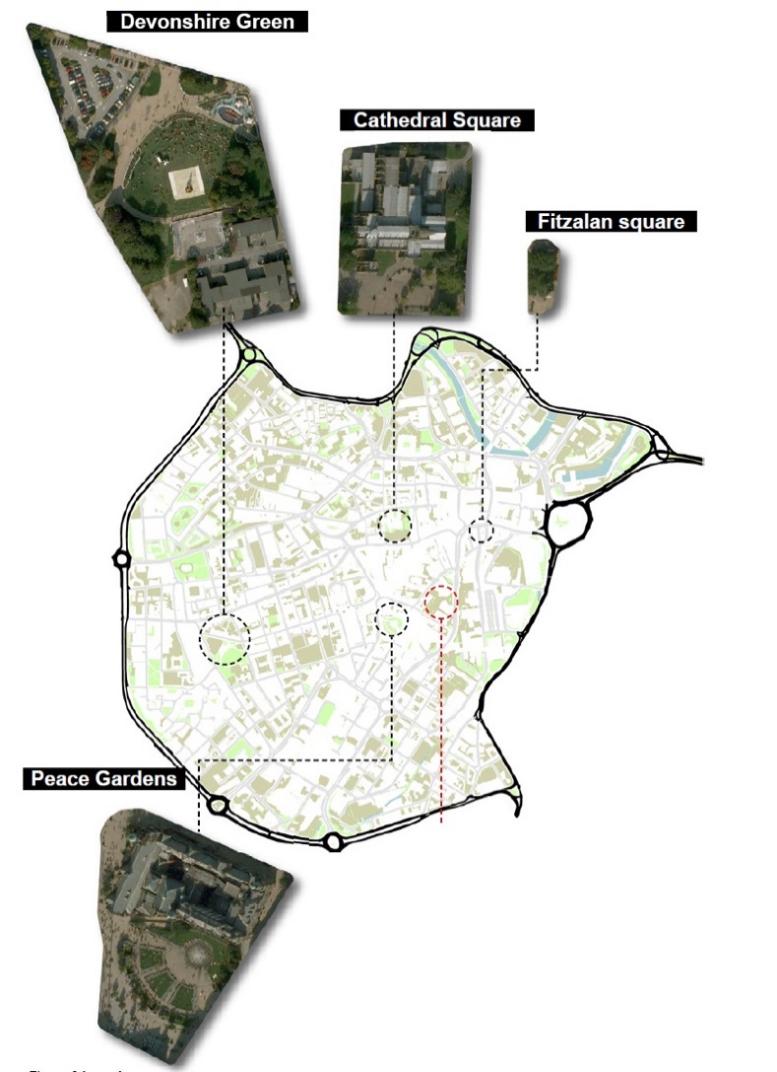
As illustrated in Figure 1, all four spaces are located in Sheffield’s city centre, but their proximity to key areas varies:
• Peace Gardens, Cathedral Square, and Fitzalan Square: Situated in the main retail district, these spaces benefit from spillover foot traffic from nearby shops (e.g., Sheffield’s Moor Market) and department stores.
• Devonshire Green: Situated in a residential/university area, with slightly lower foot traffic than retail-adjacent spaces.
The size of the spaces also influences their usability:
• Devonshire Green: The largest of the four (approximately 1.2 hectares), it accommodates diverse activities (e.g., skateboarding, outdoor concerts) without feeling overcrowded.
• Fitzalan Square: The smallest (approximately 0.3 hectares), it lacks capacity for more than a few users at a time, limiting its ability to support social activities.
3.1.2. Connectivity
Connectivity refers to how well each space is linked to other public spaces and urban functions. The four case study spaces are within 1-2 kilometres of each other, forming a network that users can navigate on foot. However, functional overlap (e.g., Peace Gardens and City Hall Square both offering similar recreational uses) highlights the importance of legibility (distinctive features) to avoid redundancy. For example, Cathedral Square’s historical Cathedral and Peace Gardens’ waterscape help them stand out, while Fitzalan Square’s lack of unique features makes it easily replaceable by other spaces.
3.1.3. Permeability
Permeability is a measure of how easy it is to access the space via multiple routes and public transport. It is a critical factor for vibrancy, as spaces that are difficult to reach have lower use:
• High Permeability:
- Peace Gardens: Connected to five main roads, with three bus stops within a 2-minute walk. Its central location also makes it accessible via Sheffield’s tram network (a 3-minute walk from the Cathedral tram stop).
- Devonshire Green: Connected to six main roads, with two bus stops directly adjacent. Its proximity to the University of Sheffield also means it is well-served by student buses.
- Cathedral Square: Connected to four main roads, with a tram stop (Cathedral stop) and four bus stops within a 3-minute walk.
• Low Permeability:
- Fitzalan Square: Connected to only three main roads, all of which are busy primary roads. Although near a bus stop, it is located on the opposite side of a busy road, making pedestrian access difficult.
Behavioural mapping confirms the impact of permeability: Peace Gardens and Devonshire Green had the highest number of users (average 85 users during the 30-minute observation period), while Fitzalan Square had the lowest (average 12 users).
3.1.4. Road systems
The type of roads surrounding a public space directly impacts user comfort, as primary roads generate more noise, pollution, and traffic hazards. The case studies illustrate this clearly:
• Peace Gardens: Surrounded by secondary roads, with a sunken design that creates a physical barrier to traffic. Noise levels are approximately 15 decibels lower than nearby primary roads, creating a more peaceful environment.
• Devonshire Green: Also surrounded by secondary roads, with a dense line of trees along its edges. These trees act as a 'green buffer,’ absorbing noise and pollution and creating a sense of separation from traffic.
• Cathedral Square: Its southern edge abuts a primary road (Church Street) with a tram line. There is no green buffer between the space and the road, leading to high noise levels and safety concerns. Behavioural mapping found that users avoided the southern edge of the square, with 80% of seating in that area unused.
• Fitzalan Square: Surrounded by three primary roads (Commercial Street, High Street, and Angel Street), creating a 'traffic island' effect. The constant flow of vehicles makes the space feel unwelcoming, and most people pass through quickly rather than lingering.
3.1.5. Geographical conclusion
The geographical analysis reveals three key findings for Sheffield:
• City Centre Location is Necessary but Not Sufficient: All vibrant spaces are in the city centre, but proximity to retail or residential areas (depending on the target user group) enhances use.
• High Permeability Drives Accessibility: Spaces with multiple connecting roads and strong public transport links attract more users.
• Traffic Mitigation is Critical: Secondary roads, green buffers, or unique designs (e.g., sunken plazas) reduce traffic impacts and improve comfort.
3.2. Physical factors
Physical factors shape the character and functionality of public spaces, influencing how users interact with the environment and each other. This section analyses six key physical attributes—grain, legibility, land use, building functions, interaction with surroundings, and detailed design—across the four case study spaces.
3.2.1. Grain
Grain refers to a space’s size and shape, which influence its usability and feel. All four case study spaces have distinct grain, but there is no direct correlation between grain and vibrancy; instead, grain interacts with other factors (e.g., seating placement) to shape use:
• Peace Gardens: Small (approximately 0.8 hectares) and irregularly shaped, with winding paths that create a sense of exploration. This design encourages users to wander and discover different areas.
• Cathedral Square: Small (approximately 0.5 hectares) and irregularly shaped, with the Cathedral dominating one edge. This shape creates a natural focal point, drawing users toward the building and the green space adjacent to it.
• Devonshire Green: Large (approximately 1.2 hectares) and regularly shaped (rectangular), with clear zones for different activities (e.g., skatepark in the northwest corner, grass in the centre). This layout makes the space easy to navigate and ensures activities do not conflict.
• Fitzalan Square: Small (approximately 0.3 hectares) and highly regular (square), with a statue in the centre. Its rigid shape and central statue leave little room for flexible use, and the space feels cramped even with a small number of users.
3.2.2. Legibility
Legibility refers to how easily users can recognise and navigate a space, often driven by distinctive landmarks and nodes (areas of concentrated activity). It is a critical factor for vibrancy, as spaces that feel 'familiar' and 'unique' are more likely to be used repeatedly:
• Peace Gardens: High legibility, driven by two key landmarks: a large fountain (in the centre) and the Town Hall (adjacent to the space). Nodes include several small green spaces and outdoor seating areas for cafés. The fountain, in particular, serves as a lively focal point—especially popular with children—enhancing the space’s identity and social appeal.
• Devonshire Green: High legibility, with landmarks including a large green space (the 'central lawn') and custom-designed seating (colourful, curved benches). Nodes include a skatepark and a bar adjacent to the space. These features attract diverse user groups—skateboarders to the skatepark, families to the lawn, and adults to the bar.
• Cathedral Square: High legibility, thanks to the Cathedral (a prominent historical landmark) and a statue of James Montgomery (a local poet) in the centre. The green space adjacent to the Cathedral acts as a node, attracting users who want to sit and relax in a quiet area.
• Fitzalan Square: Low legibility, with only one landmark (a statue of Lord Fitzalan) and no distinct nodes. The space lacks unique features to differentiate it from nearby plazas, and users often struggle to remember it by name (during surveys, 40% of users referred to it as 'the square near High Street’ rather than by its official name).
3.2.3. Land use
Land use refers to the types of activities that occur in the areas surrounding the space, and diverse land use is critical for sustaining activity at different times of day. The four case study spaces show clear differences in land use diversity:
• Devonshire Green: Highest diversity, with five main land uses: residential, industrial (small workshops), office, retail (small shops), and educational (university classrooms and libraries). This mix ensures the space is used throughout the day.
• Peace Gardens: Moderate diversity, with three main land uses: office (city centre businesses), retail (department stores and boutiques), and cultural (Town Hall). This mix supports daytime use (office workers, shoppers) but has limited nighttime activity (few residential areas nearby).
• Cathedral Square: Moderate diversity, with three main land uses: office (financial services), retail (bookstores, cafes), and cultural (Cathedral, art galleries). The Cathedral attracts visitors on weekends, while offices drive weekday use.
• Fitzalan Square: Lowest diversity, with only two main land uses: office (corporate headquarters) and retail (chain stores, lottery shops). This limited mix means the space is busy only during weekday office hours (9:00-17:00) and nearly empty on weekends and evenings.
3.2.4. Building functions
Building functions—the specific activities that occur in buildings adjacent to the space—complement land use by providing services and activities that draw users. Mixed building functions are essential for sustaining vibrancy, as they ensure the space is used at different times of day:
• Devonshire Green and Peace Gardens: Buildings surrounding both spaces show a high degree of mixed-use, including accommodation, bars, restaurants, retail and offices. These functions support day-night activity. The diverse user base also enhances security, as Whyte notes that 'people are good at policing themselves'—more users mean more 'eyes on the street' to deter crime [11].
• Cathedral Square: Moderate mixed-use, with buildings including a bar, cafes, cultural facilities, student accommodation, and offices. However, eating and drinking venues are set slightly away from the square, so the interaction between these buildings and the square is weak.
• Fitzalan Square: Low mixed-use, with buildings including offices (bank headquarters), retail, and one vacant building on the southern edge. The only food venue (KFC) attracts a small number of users at lunchtime, but the vacant building and lack of evening options mean the space is unused after work hours.
3.2.5. Interaction with surroundings
Interaction with surroundings refers to how well the space connects to adjacent buildings, primarily through entrances and frontages. Active frontages—entrances facing the space, large windows, or outdoor seating—encourage interaction between users of the space and the buildings, enhancing vibrancy:
• Devonshire Green: Strong interaction, with all adjacent buildings having entrances facing the space. Most buildings also have active frontages—cafés with outdoor seating, bars with open windows. These features create a 'feedback loop' of activity: users of the space are drawn to the buildings, and patrons of the buildings spill into the space.
• Peace Gardens: Strong interaction, with main entrances of adjacent buildings (e.g., Town Hall, Costa Coffee) facing the space. Active frontages (e.g., café terraces) enhance sociability, with Heffernan et al. noting that such features increase the 'sense of community' in public spaces [12].
• Cathedral Square: Moderate interaction, with most building entrances facing the space. However, the lack of food and drink venues with outdoor seating limits spillover activity. The Cathedral’s main entrance faces the square, but it is only open during service hours, limiting interaction.
• Fitzalan Square: Weak interaction, with building entrances dispersed between the square and surrounding roads. Many buildings have inactive frontages—small windows, blank walls, or closed doors—which make the space feel unwelcoming.
3.2.6. Detailed design
Detailed design encompasses the small-scale features that directly impact user comfort, including seating, materials, greenery, and pavement. These features are often overlooked but play a critical role in encouraging use:
• Seating:
- Peace Gardens and Devonshire Green: Diverse options, including fixed benches (with back support), movable chairs (for flexible group use), and grass (for casual sitting). This variety caters to all user groups—seniors prefer fixed benches, families prefer movable chairs, and young adults prefer grass. Behavioural mapping found that these spaces had the highest average length of stay (25 minutes).
- Cathedral Square: Limited options, including fixed benches and grass. While the grass is popular in summer, the lack of movable chairs limits flexible use—groups of more than 4 people often struggle to find seating together.
- Fitzalan Square: Only fixed benches, with no back support and narrow seats. These benches are uncomfortable for prolonged sitting; the average stay time was only 5 minutes.
• Green Infrastructure:
- Peace Gardens: A large waterscape (fountains and small pools) and several green spaces that attract users—especially children, who enjoy dabbling in the water. The waterscape also creates a soothing sound, masking traffic noise.
- Devonshire Green: A large central lawn and scattered trees that provide shade and a sense of nature. The lawn is popular for picnics, sunbathing, and outdoor games.
- Cathedral Square: The green infrastructure in Cathedral Square is a concentrated green space which can provide a comfortable resting environment.
- Fitzalan Square: No green infrastructure—only concrete pavement and a few neglected potted plants.
• Materials and Colour:
- Peace Gardens, Devonshire Green and Cathedral Square: Durable, colourful materials—red and yellow bricks, glass, and painted metal—that create a cheerful atmosphere. Mahnke notes that bright colours evoke positive emotions, and surveys found that 75% of users reported feeling 'happy' or 'relaxed' [13].
- Fitzalan Square: Dull materials—grey concrete, white paint, and weathered bricks—that create a sombre mood.
• Pavement:
- All four spaces have distinct pavement designs inside and outside the square, which helps define the space’s boundary and enhance legibility. For example, Peace Gardens uses coloured tiles inside the space and grey concrete outside, making it clear where the public space begins and ends.
3.2.7. Physical conclusion
The physical analysis highlights five key factors for vibrant public spaces in Sheffield:
1. High Legibility: Distinctive landmarks (e.g., waterscapes, historical buildings) and nodes (e.g., cafes, skateparks) that make the space unique and easy to navigate.
2. Diverse Land Use and Building Functions: A mix of retail, residential, cultural, and office uses to support activity at different times of day.
3. Active Frontages: Buildings with entrances facing the space and features (e.g., outdoor seating) that encourage interaction.
4. Diverse Seating: Options that cater to all user groups, from fixed benches for seniors to movable chairs for families.
5. Sensory Appeal: Greenery, water features, and colourful materials that enhance comfort and evoke positive emotions.
3.3. Psychological and sensual factors
Psychological and sensual factors focus on the 'human experience' of public space. By integrating demographic data and activity data of different user groups through on-site observations, this study constructs a Behavioural Map of public spaces to explore the behavioural preferences and perceptions of different groups when using public spaces.
3.3.1. Demographic patterns
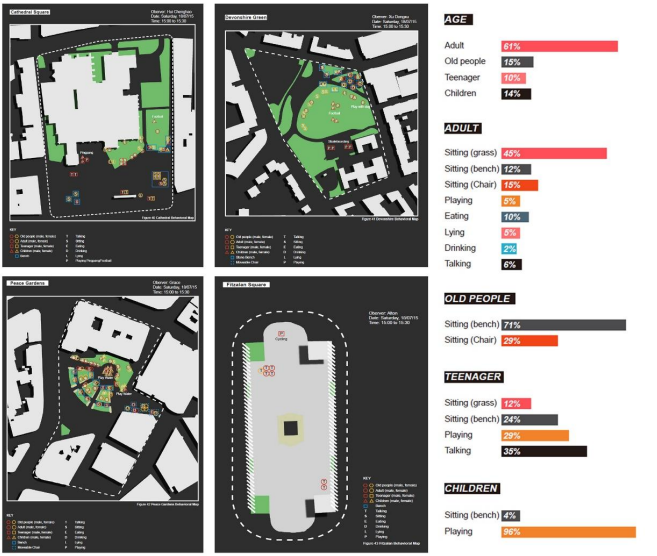
Behavioural mapping data (15:00-15:30, 18 July 2015) as shown in Figure 2 revealed consistent demographic patterns across the four case study spaces, with clear variations in user age and gender:
• Age Distribution:
- Adults (18-64): The largest group, accounting for 61% of all users. This reflects the city centre location, which attracts office workers, shoppers, and tourists.
- Seniors (65+): The second-largest group, accounting for 15% of users. Seniors were most common at Cathedral Square (22% of users) and Peace Gardens (18%), likely due to these spaces’ proximity to public transport and quiet seating areas.
- Children (0-17): The third-largest group, accounting for 14% of users. Children were most common at Peace Gardens (21% of users) and Devonshire Green (12%), drawn by the waterscape and large lawns, respectively.
- Teenagers (13-17): The smallest group, accounting for 10% of users. Teenagers were most common at Devonshire Green (18% of users), where the skatepark provides a dedicated activity space.
• Gender Distribution:
- Peace Gardens, Cathedral Square, and Devonshire Green: Balanced gender distribution (approximately 50:50), indicating these spaces feel inclusive to all genders.
- Fitzalan Square: Highly imbalanced, with 87% male users. Surveys revealed that female users avoided the space due to its 'unwelcoming' atmosphere (e.g., traffic noise, presence of vagrants) and lack of seating that felt safe (e.g., benches in well-lit, visible areas).
3.3.2. Activity patterns
Age-specific activity preferences emerged from the behavioural mapping data, highlighting the need for diverse design features to cater to all user groups:
• Adults:
- The most common activity was sitting on grass (45%), followed by sitting on movable chairs (15%) and eating (10%). This reflects adults’ desire for both casual relaxation (grass) and social interaction (movable chairs for group meals).
- Food and drink venues played a key role in sustaining activity: 25% of adults reported visiting the space specifically to eat or drink at adjacent cafés or bars, and they stayed an average of 30 minutes—twice as long as users who did not eat or drink.
• Seniors:
- The most common activity was sitting on backed benches (71%), followed by sitting on movable chairs (29%). Seniors preferred benches with back support for comfort and visibility (to watch passersby), and they often stayed for extended periods (average 40 minutes) to socialise with friends.
- Proximity to cafés was also important: 35% of seniors reported visiting the space to drink coffee at nearby cafés, and they valued the ability to sit outside while socialising.
• Children:
- The overwhelming majority (96%) engaged in active play (e.g., water play at Peace Gardens, football at Devonshire Green, or chasing each other at Cathedral Square). Only 4% of children sat with their parents.
- Water and green spaces were critical: children at Peace Gardens spent 75% of their time near the waterscape, while those at Devonshire Green spent 80% of their time on the central lawn.
• Teenagers:
- The most common activities were talking with friends (35%) and playing (29%, primarily skateboarding or cycling). Teenagers valued spaces where they could gather without feeling 'supervised'—hence their preference for Devonshire Green’s skatepark, which is located away from busy areas.
- Unlike other age groups, teenagers rarely used seating: only 24% sat on benches, and most preferred to stand or move around while interacting with friends.
3.3.3. Territoriality
Territoriality reflects users’ preference for specific areas within a space, often driven by a desire for comfort, security, and control. Observations revealed a consistent pattern across all four spaces: users preferred to sit or stay at the edges of the space rather than the centre.
This pattern was most pronounced at Devonshire Green, where 75% of users sat along the north edge (adjacent to trees and a bar) rather than the central lawn. Surveys found that users chose edge seating for two reasons:
1. Security: Edge seating allows users to see both the space and the surrounding area, reducing feelings of vulnerability. As Gehl notes, 'people feel safer when they can see and be seen' [3].
2. Comfort: Edges provide shade (from trees) or shelter (from buildings), making it more comfortable in variable weather.
This finding has important design implications: public spaces in Sheffield should prioritise edge seating, with a mix of options (backed benches, movable chairs) to cater to different user groups. The centre of the space can then be reserved for active uses (e.g., play, events) that do not require seating.
3.4. Managerial factors
Managerial factors are critical for sustaining vibrancy over time. A space with ideal geographical and physical attributes will still decline if it is unsafe or poorly maintained, as users avoid environments that feel threatening or neglected.
3.4.1. Security
Security in public spaces is often associated with formal measures like uniformed patrols or CCTV. However, scholars like Whyte and Gehl argue that 'informal security'—driven by diverse users and active frontages—is more effective [3, 11]. The four case study spaces illustrate this distinction:
• Devonshire Green and Peace Gardens:
- These spaces relied primarily on informal security, with high foot traffic (day) and nighttime activity (bars, restaurants) ensuring a constant presence of users. As Whyte notes, 'people are the best security guards'—more users mean more 'eyes on the street' to deter crime [11].
- Well-lit paths and clear visibility further enhanced security. Lighting was bright enough to feel safe but not so intense as to feel oppressive.
• Cathedral Square:
- This space had moderate informal security during the day (office workers, shoppers) but no nighttime activity (few bars or restaurants open after 18:00). Formal security measures (CCTV, occasional patrols) were in place, but users still felt unsafe after dark.
• Fitzalan Square:
- This space lacked both informal and effective formal security. Low foot traffic at all times meant few 'eyes on the street,' and fences surrounding the space blocked visibility from adjacent buildings. Many users reported feeling 'unsafe' or 'very unsafe,' and most passed through quickly rather than lingering.
Traditional security measures can also have negative impacts. Shaftoe criticises uniformed patrols for making users feel 'suspected' rather than protected, while Lyon notes that excessive CCTV can feel intrusive and humiliating [4, 14]. The most vibrant spaces—Devonshire Green and Peace Gardens—avoided these issues by prioritising informal security, which feels more natural and less oppressive.
3.4.2. Maintenance
Maintenance is the 'hidden backbone' of public space vibrancy, as even small signs of neglect (e.g., litter, overgrown grass) can deter users. The four case study spaces showed stark differences in maintenance quality:
• Peace Gardens:
- Well-maintained, with regular cleaning (litter removed hourly), trimmed grass, and functioning water features. The city council allocated dedicated funding for maintenance, recognising the space’s role as a tourist attraction.
- Surveys found that 90% of users cited 'cleanliness’ and 'well-kept facilities' as reasons for visiting.
• Devonshire Green:
- Moderately maintained, with regular cleaning but inconsistent upkeep of greenery. Flower beds were often neglected (many flowers died, exposing the soil), and the central lawn was replaced with green carpet in some areas due to overuse.
• Cathedral Square:
- Poorly maintained, with infrequent cleaning (cigarette butts and litter accumulated under benches) and overgrown greenery. The statue of James Montgomery was also covered in graffiti that remained for weeks.
• Fitzalan Square:
- Severely neglected, with no regular cleaning (litter piled up in corners), dead potted plants, and cracked pavement. The vacant building on the southern edge was also covered in graffiti, and broken glass was often present on the pavement.
The impact of maintenance on use was clear: Peace Gardens (well-maintained) had the highest user numbers, while Fitzalan Square (severely neglected) had the lowest. This underscores the importance of consistent, dedicated maintenance funding for public spaces.
4. Conclusion: constituents of vibrancy in Sheffield
Synthesising the analysis of geographical, physical, psychological and sensual, and managerial factors, the key constituents of vibrant public spaces in Sheffield can be organised into four interconnected dimensions. These are grounded in local user needs and context, making them specifically applicable to Sheffield’s urban environment.
4.1. Geographical constituents
City Centre Location: Vibrant spaces are located in the city centre, near key urban functions (retail for foot traffic, residential for consistent use, cultural for diverse activities).
High Permeability: Multiple connecting roads (4 or more) and good access to public transport (buses, trams) maximise accessibility.
Traffic Mitigation: Secondary roads or green buffers (trees, hedges) help reduce noise and pollution, or unique designs (e.g., sunken plazas) create a physical barrier from traffic.
4.2. Physical constituents
High Legibility: Distinctive landmarks (e.g., waterscapes, historical buildings) and nodes (e.g., cafés, skateparks) make spaces unique and easy to navigate.
Diverse Land Use and Mixed Building Functions: A mix of residential, office, retail, and cultural uses supports activity at different times of day.
Active Frontages: Building entrances facing the space and features like outdoor seating encourage interaction between the space and adjacent buildings.
Diverse Seating: Options include fixed benches (with back support for seniors), movable chairs (for flexible group use), and grass (for casual relaxation).
Sensory Appeal: Durable, colourful materials evoke positivity; green infrastructure (lawns, trees) provide shade and nature; and water features (fountains, pools) attract users and mask noise.
Clear Boundaries: Distinct pavement designs inside and outside the space define the public area and enhance legibility.
4.3. Psychological and sensual constituents
Age-Appropriate Features: Backed benches for seniors, green spaces for adults, waterscapes or playgrounds for children, and dedicated play areas (skateparks) for teenagers.
Food and Drink Venues: Nearby cafés or bars support prolonged stays and social interaction, especially for adults and seniors.
Edge Seating: Prioritisation of seating at the edges of the space enhances security and comfort.
Inclusivity: Design features that appeal to all genders (e.g., well-lit paths, balanced seating) and avoid creating environments that feel exclusive.
4.4. Managerial constituents
• Informal Security: Diverse users and active frontages create 'eyes on the street,' supplemented by unobtrusive formal measures (e.g., well-lit paths).
• 24-Hour Activity: Food and drink venues that stay open in the evening sustain night-time use and enhance security.
• Regular Maintenance: Consistent cleaning (litter removal, graffiti removal) and upkeep of greenery and facilities to prevent neglect and 'tipping.'
It is important to note that vibrant public spaces do not need to include all these constituents. Instead, they should prioritise those that align with their target user group and context. For example, a space designed for families may focus on water features and playgrounds, while a space designed for seniors may focus on backed benches and café access. However, the more constituents a space includes, the more likely it is to be vibrant and inclusive.
5. Discussion
This study set out to identify the factors that contribute to vibrant public spaces in Sheffield. The findings, based on analysis of four case study spaces (Peace Gardens, Cathedral Square, Devonshire Green, Fitzalan Square), provide a localised framework for vibrancy that can inform future public space design in the city. However, like all research, this study has limitations that should be considered when interpreting the findings.
Firstly, behavioural mapping was only conducted on a Sunday afternoon, which limits the representativeness of the results. To obtain more robust and comprehensive findings, observations should be carried out at different times of the day and different days of the week, such as weekdays and weekends. Secondly, the design of vibrant spaces should take into account the local weather conditions, including features that address the frequent rainfall and variable temperatures in Sheffield, such as sheltered seating, shade-providing trees, and waterscapes suitable for all seasons.
References
[1]. Carmona, M., & Tiesdell, S. (2006). Urban Design Reader. Architectural Press, Oxford.
[2]. Worpole, K., & Greenhalgh, L. (1996). The Freedom of the City. Demos, London.
[3]. Gehl, J. (2003). Life Between the Buildings: Using Public Space. Danish Architectural Press, Copenhagen.
[4]. Shaftoe, H. (2008). Convivial Urban Spaces: Creating Effective Public Places. Earthscan (in association with IIED), London.
[5]. National Heart Forum, Living Streets, & CABE. (2007). Building Health: Creating and Enhancing Places for Healthy, Active Lives. NHF, London.
[6]. Sheffield City Council. (2014). Peace Gardens Visitor Survey Report. Unpublished internal document.
[7]. Alexander, C. (1979). The Timeless Way of Building. Oxford University Press, New York.
[8]. Landry, C. (2006). The Art of City Making. Earthscan, London.
[9]. Tibbalds, F. (1992). Making People-friendly Towns. Longman, Harlow, Essex.
[10]. Bentley, I., et al. (1985). Responsive Environments: A Manual for Designers. Architectural Press, London.
[11]. Whyte, W. (2001). The Social Life of Small Urban Spaces. Project for Public Spaces, New York.
[12]. Heffernan, E., et al. (2013). The relationship between the quality of active frontages and public perceptions of public spaces.Urban Design International, 19, 92–102.
[13]. Mahnke, F. (1987). Color Environment and Human Response. Van Nostrand Reinhold, New York.
[14]. Lyon, D. (1993). An Electrical Panopticon? A social critique of surveillance theory.Sociological Review, 41(4), 653–678.
Cite this article
Xu,D. (2025). Creating vibrant public spaces in Sheffield. Advances in Social Behavior Research,16(8),25-35.
Data availability
The datasets used and/or analyzed during the current study will be available from the authors upon reasonable request.
Disclaimer/Publisher's Note
The statements, opinions and data contained in all publications are solely those of the individual author(s) and contributor(s) and not of EWA Publishing and/or the editor(s). EWA Publishing and/or the editor(s) disclaim responsibility for any injury to people or property resulting from any ideas, methods, instructions or products referred to in the content.
About volume
Journal:Advances in Social Behavior Research
© 2024 by the author(s). Licensee EWA Publishing, Oxford, UK. This article is an open access article distributed under the terms and
conditions of the Creative Commons Attribution (CC BY) license. Authors who
publish this series agree to the following terms:
1. Authors retain copyright and grant the series right of first publication with the work simultaneously licensed under a Creative Commons
Attribution License that allows others to share the work with an acknowledgment of the work's authorship and initial publication in this
series.
2. Authors are able to enter into separate, additional contractual arrangements for the non-exclusive distribution of the series's published
version of the work (e.g., post it to an institutional repository or publish it in a book), with an acknowledgment of its initial
publication in this series.
3. Authors are permitted and encouraged to post their work online (e.g., in institutional repositories or on their website) prior to and
during the submission process, as it can lead to productive exchanges, as well as earlier and greater citation of published work (See
Open access policy for details).
References
[1]. Carmona, M., & Tiesdell, S. (2006). Urban Design Reader. Architectural Press, Oxford.
[2]. Worpole, K., & Greenhalgh, L. (1996). The Freedom of the City. Demos, London.
[3]. Gehl, J. (2003). Life Between the Buildings: Using Public Space. Danish Architectural Press, Copenhagen.
[4]. Shaftoe, H. (2008). Convivial Urban Spaces: Creating Effective Public Places. Earthscan (in association with IIED), London.
[5]. National Heart Forum, Living Streets, & CABE. (2007). Building Health: Creating and Enhancing Places for Healthy, Active Lives. NHF, London.
[6]. Sheffield City Council. (2014). Peace Gardens Visitor Survey Report. Unpublished internal document.
[7]. Alexander, C. (1979). The Timeless Way of Building. Oxford University Press, New York.
[8]. Landry, C. (2006). The Art of City Making. Earthscan, London.
[9]. Tibbalds, F. (1992). Making People-friendly Towns. Longman, Harlow, Essex.
[10]. Bentley, I., et al. (1985). Responsive Environments: A Manual for Designers. Architectural Press, London.
[11]. Whyte, W. (2001). The Social Life of Small Urban Spaces. Project for Public Spaces, New York.
[12]. Heffernan, E., et al. (2013). The relationship between the quality of active frontages and public perceptions of public spaces.Urban Design International, 19, 92–102.
[13]. Mahnke, F. (1987). Color Environment and Human Response. Van Nostrand Reinhold, New York.
[14]. Lyon, D. (1993). An Electrical Panopticon? A social critique of surveillance theory.Sociological Review, 41(4), 653–678.