








1. Introduction
Football is the most popular sport in the world [1]. And in the highly commercialized and globally influential Premier Leagues, the commercial value of players has become a crucial aspect that attracts extensive attention from clubs, sponsors, and the media. The commercial value of players not only reflects their market appeal and brand influence but also has a significant impact on the economic operation and strategic development of football clubs.
In the past few years (from 2020 to 2025), the football industry has undergone significant changes. The development of digital technology has made it easier to collect and analyze a large amount of field performance data, including players' goal - scoring numbers, assist numbers, passing accuracy, defensive contributions, and so on. At the same time, the commercialization of the football market has continued to deepen, and the evaluation of players' commercial value has become more diverse and complex. Against this background, studying the impact of field performance data on the commercial value of players in the Premier Leagues is of great practical significance.
This study aims to fill this research gap by using panel data from 2020 to 2025. Through empirical analysis, I hope to accurately measure the impact effect and degree of field performance data on the commercial value of players, and provide theoretical support and practical guidance for football clubs' player transfer strategies, sponsorship cooperation decisions, and brand building.
2. Literature review
2.1. The concept and significance of players' commercial value in football
In the realm of football, the commercial value of players has evolved into a multi - faceted and significant concept. Player’s commercial value is defined as "an assessment of the sum of money a club would be prepared to spend to get an athlete to sign a contract, regardless of any actual deal taking place" [2]. It encompasses elements such as market appeal, brand influence, and the ability to drive economic benefits for clubs and related stakeholders [3]. For instance, in the highly commercialized Premier Leagues, players are not only athletes on the pitch but also crucial assets in the business landscape. Top - tier Premier League clubs' revenues are significantly influenced by the commercial value of their star players [4]. These players attract sponsors, increase jersey sales, and boost television viewership, all of which contribute to the overall economic success of the club.
The commercial value of players extends beyond financial gains for clubs. It also plays a role in shaping the brand image of the club and the league. A study found that players with high commercial value can enhance the global reputation of a club, making it more attractive to international fans and sponsors [5]. This is particularly evident in the case of Manchester United, where players like Cristiano Ronaldo, during his tenure, significantly increased the club's global brand awareness and commercial partnerships.
2.2. Existing research on factors affecting players' commercial value
2.2.1. Field performance data
Numerous scholars have recognized field performance data as a fundamental factor in determining players' commercial value. Research in sports economics, such as that by Késenne and Kesenne [6], has established a positive correlation between on - field performance metrics and commercial value. Goals scored, assists provided, and high - level defensive contributions are often cited as key performance indicators that attract the attention of sponsors and increase a player's marketability. For example, in the 2022 - 2023 Premier League season, Erling Haland's remarkable goal - scoring record not only led Manchester City to multiple titles but also significantly enhanced his own commercial value [7], as evidenced by a substantial increase in his endorsement deals and social media following.
2.2.2. Other factors
However, the relationship between field performance data and commercial value is not always straightforward. A study by Szymanski and Kuypers [8] pointed out that while performance is crucial, other factors can also modulate this relationship. For instance, a player's performance consistency over seasons matters. A player who consistently performs well is more likely to maintain or increase their commercial value compared to one with sporadic excellent performances.
Beyond field performance, factors like a player's age, the position of the player’s club in the FIFA ranking, and social media presence have been found to impact their commercial value [9]. Research by Metelski [9] showed that players’ age can significantly influence a player's marketability. Young footballers up to 21 years of age, who are just starting their sports career, have more value.
The players in the higher ranking in the FIFA typically have the higher commercial value. The descent of a club by 1 FIFA position reduces the value of a player by 0.08 million [3].
Social media has emerged as a powerful platform that can either enhance or detract from a player's commercial value. A study by Chmait and his partners [10] revealed that players with a large and engaged social media following can command higher endorsement deals. For example, Marcus Rashford of Manchester United uses his social media platform not only to share football - related content but also to engage in social causes, which has increased his popularity and commercial appeal.
2.3. Research gaps
Despite the existing research, there are still significant gaps in understanding the impact of field performance data on the commercial value of players in the Premier Leagues. Most previous studies have either focused on a single aspect of performance (such as goal - scoring) or have been limited to a short - term analysis. There is a lack of comprehensive, long - term empirical studies that consider multiple performance metrics simultaneously and account for the dynamic nature of the Premier League over time.
Moreover, few studies have been conducted using panel data, which could better capture the individual - specific and time - varying effects of field performance on commercial value. By using panel data from 2020 to 2025, this study aims to fill these research gaps and provide a more in - depth understanding of the complex relationship between field performance data and the commercial value of players in the Premier Leagues.
3. Method
3.1. Independent variables
Players’ field performance is the independent variable. This article classifies football players into four main positions, namely forwards, midfielders, defenders and goalkeepers. And based on the different characteristics of their positions, different data were selected to evaluate their performance on the field. This information resource is Football Reference (Football Statistics and History | FBref.com), which provided all the player’s field performance data of every past seasons. They are respectively:
3.1.1. Forward: age, assist, goals, playing minutes
For forwards, their primary responsibility on the field is to score goals and create scoring opportunities for the team. Goals are the most direct reflection of a forward's ability to finish plays and their effectiveness in the attacking third. Assists demonstrate a forward's capacity to set up teammates for goals, showcasing their vision and passing skills in the final third. Age can influence a forward's physical condition, speed, and experience; younger forwards might have explosive speed, while older ones could rely more on experience and positioning. Playing minutes indicate the trust coaches place in a forward and provide a basis for evaluating their performance over a certain period, as performance can only be meaningful within sufficient game time.
3.1.2. Midfield: age, playing minutes, progressive passes, progressive passed received
Midfielders act as the link between the defense and attack, responsible for both creating attacks and providing defensive support. Progressive Passes are crucial for midfielders to advance the ball from deeper areas to more dangerous attacking zones, initiating offensive plays. Progressive Passes Received reflect a midfielder's ability to get involved in the team's attacking build - up by receiving forward - moving passes, keeping the attacking rhythm going. Age affects a midfielder's physical stamina, which is vital for covering large areas of the field throughout a game, as well as their tactical understanding and decision - making. Playing Minutes, similar to forwards, determine the extent to which a midfielder can influence the game, as midfielders need enough time to organize both attack and defense.
3.1.3. Defender: age, assist, playing minutes, progressive passed received
Defenders' main task is to prevent the opposition from scoring, but they also contribute to the team's attack when possible. Assists from defenders, often from set - pieces or overlapping runs, show their ability to contribute to goals despite their defensive focus. Playing Minutes for defenders are important as consistent game time allows them to build defensive partnerships and maintain defensive stability. Progressive Passes Received help defenders get involved in the team's attacking transitions, moving the ball out from the back line to start attacks. Age impacts a defender's physical strength for tackling and jumping, as well as their experience in reading the game and making defensive decisions.
3.1.4. Goalkeeper: age, goal assist, saves
Goalkeepers are the last line of defense, and their main job is to prevent the ball from entering the goal. Saves are the most direct measure of a goalkeeper's shot - stopping ability, reflecting their reflexes, positioning, and handling skills. Goal Assists, though less common, occur when a goalkeeper initiates a quick counter - attack with a precise long pass or throw, creating a scoring chance for a teammate, highlighting their role in starting attacks. Age influences a goalkeeper's reaction speed and physical condition, but also brings experience in handling high - pressure situations and organizing the defense.
3.2. Dependent variable
The commercial value of the players is regarded as the dependent variable. The commercial value of a player has been defined as 'an estimate of the amount of money a club would be willing to pay in order to make an athlete sign a contract, independent of an actual transaction [2]. This study obtained the market value of the players from the Transfermarkt (www.transfermarkt.com), which is a German-based website owned by the digital European publishing house Axel Springer SE [3]. The market values on this website are calculated account for Transfermarkt community, whose members discuss and evaluate player market values in detail. This data is not an expected value of a player in a free market. Both individual transfer modalities and situational conditions are relevant in determining market values, like players’ future prospects, prestige, Development potential and so on. Transfermarkt does not use an algorithm but instead relies on the wisdom of the community.
3.3. Analysis methods
This study adopts a quantitative research framework, leveraging panel data spanning the 2020–2025 seasons to empirically examine the impact of on-field performance data on players’ commercial value. The analysis process is structured into four key stages: data integration, model specification, regression estimation, and result synthesis, with all operations implemented using the R programming language.
3.3.1. Data integration and preparation
First, raw data from two sources were imported into R for cleaning and merging:
• Commercial value data: Player market values (dependent variable) from Transfermarkt, structured by season (2020–2021 to 2024–2025) and player identity.
• Performance data: On-field metrics (independent variables) from FBref.com, including position-specific indicators (e.g., goals for forwards, progressive passes for midfielders) as defined in Section 3.1.
3.3.2. Model specification
Given the focus on quantifying the relationship between position-specific performance metrics and commercial value, multiple linear regression models were specified for each position (forwards, midfielders, defenders, goalkeepers) and each season (2020–2025). This positional and temporal stratification allows for granular analysis of how performance impacts vary by role and over time.
For each season (2020–2021 to 2024–2025) and each position, the regression model was estimated using the 'm()’ function in R, which implements ordinary least squares (OLS) estimation. This process yielded 20 distinct models (5 seasons × 4 positions), ensuring that position-specific performance metrics were only tested against their respective positional groups (e.g., “Goals” were only included in Forward models).
3.4. Descriptive statistical analysis
3.4.1. Data for forward
For forwards, the modal is goals scored ('Gls...12’) and assists ('Ast...13’) emerge as the most consistent drivers of commercial value, while age exerts a negative effect.
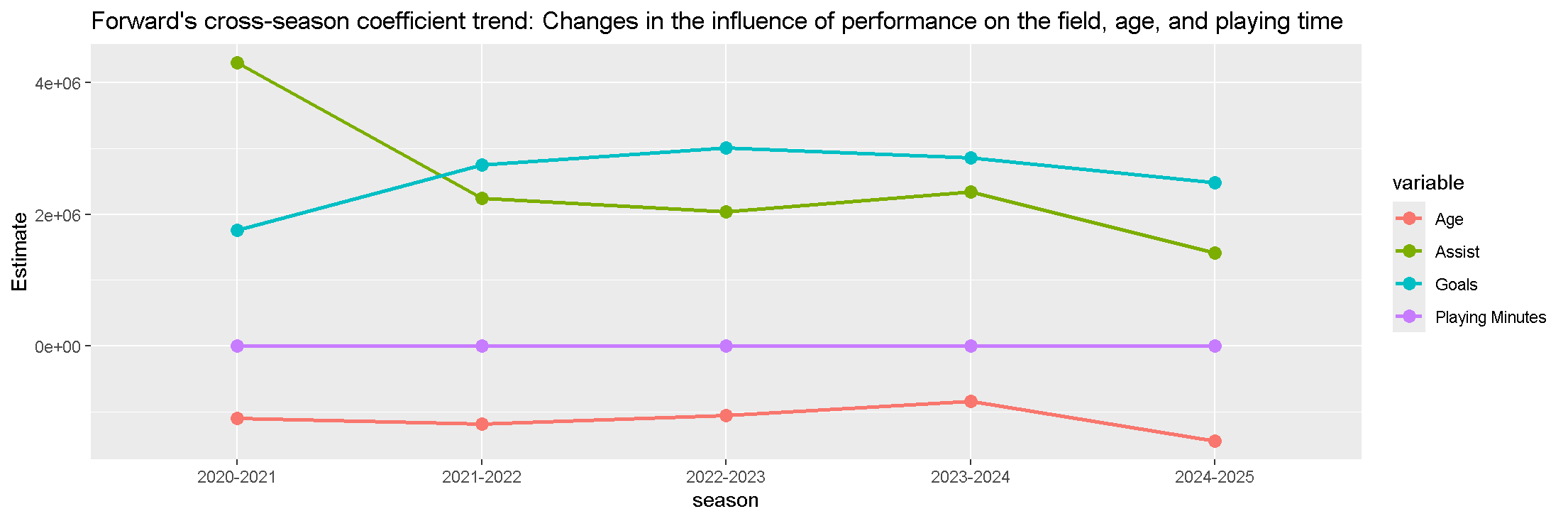
The regression analysis of the commercial value of Premier League forwards from 2020 to 2025 shows that the model as a whole remains significant, but its explanatory power fluctuates with the seasons (peaking in 2022-2023 and declining in 2024-2025), reflecting that the correlation between on-field performance and commercial value is influenced by interseasonal factors. At the variable level, scoring goals has always been the core positive driver, highlighting the market's long-term premium over direct scoring. The positive impact of assists is prominent in the early stage and weakens in the later stage, suggesting a decline in the value weight of creating opportunities. Age continues to have a negative effect, and the logic of "youth premium" runs through the entire process. There was no significant correlation with the playing time, verifying the evaluation criterion of "efficiency > duration". In summary, the commercial value of forwards shows an evolving feature of "goal-oriented, fading assists, age discount, and efficiency priority", reflecting the market's perception of their role shifting from comprehensive forward to scorer.
3.4.2. Data for midfield
For midfielders, progressive passes ('PrgP’) dominate as the core performance driver, while other metrics (progressive carries 'PrgC’, progressive passes received '’PrgR’) and age show mixed effects.
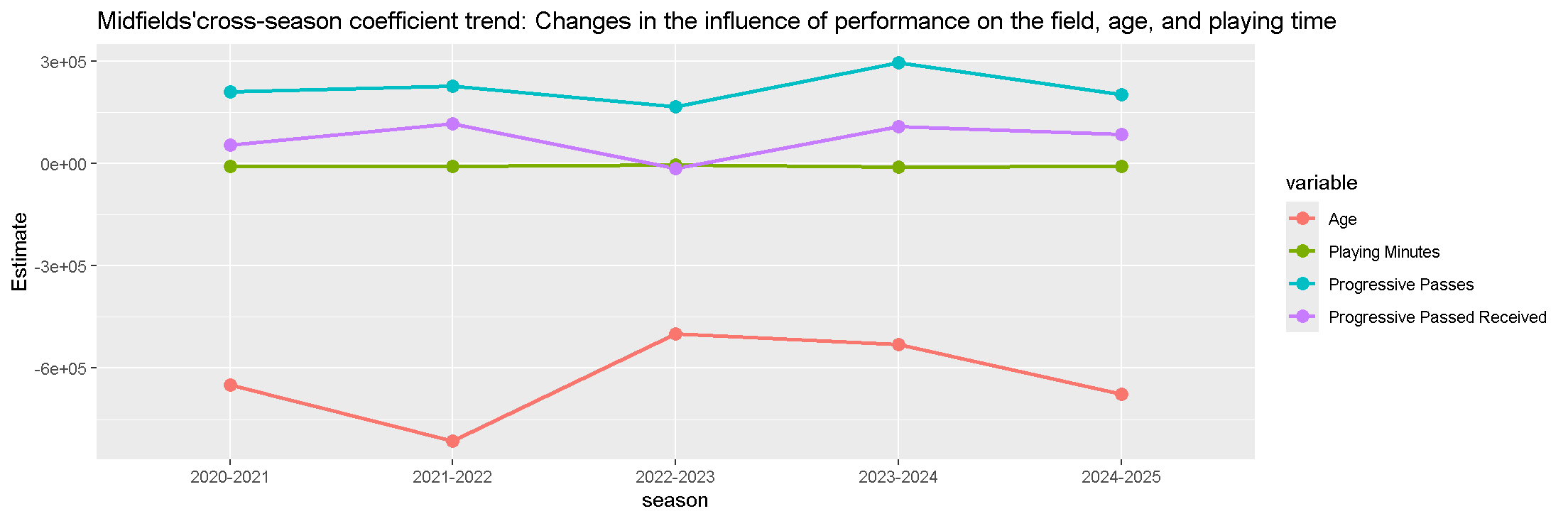
This trend chart of the inter-season coefficient for Progress passing shows that: Progress passing has been a positive factor driving the commercial value of midfield players in the past five seasons, but its commercial premium has fluctuated; The impacts of progress passing received is weak and unstable; the discount effect of age first strengthens and then weakens; the coefficient of playing time is nearly zero and remains insignificant over time; the logic of prioritizing efficiency runs throughout. Overall, the value driving force of the midfield has shown complexity as tactics evolve, with the core being the creation of advantageous attacks through progressive passing, and the influence of other factors as dynamic adjustments.
3.4.3. Data for defender
For defenders, progressive passes ('PrgP’) is the most robust predictor, while assists ('Ast...13’) and age show dynamic effects.
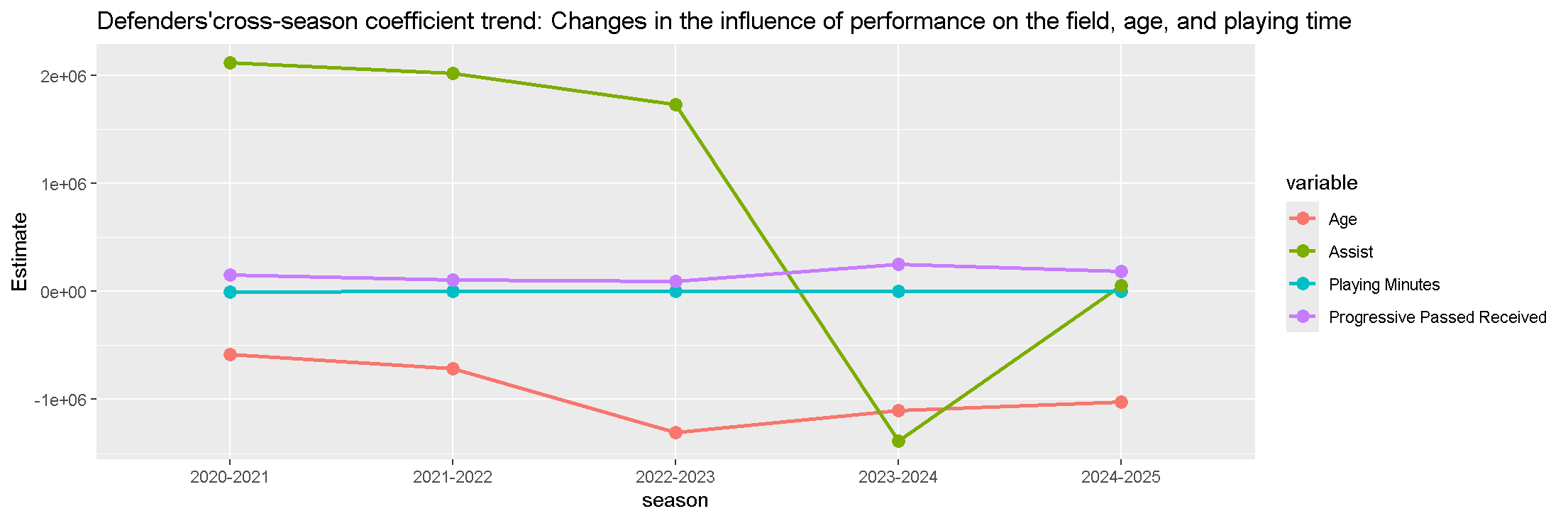
This season-long coefficient trend chart for defenders shows that age always has a negative impact, the younger the player, the higher their commercial value is. The coefficients of playing time and passing and receiving the ball during the advance have been continuously approaching 0, having a negligible impact on value. The effect of assists fluctuates greatly. There was a positive premium in the early stage, and in the 2023-2024 season, it suddenly turned into a negative discount. Later, it returned to neutrality, reflecting that the market's evaluation of defenders' assists has shifted from "all-around offense and defense" to placing more emphasis on the defensive ability of defenders. Eventually, it tended towards a rational balance, profoundly demonstrating the dynamic game of the dynamic balance between tactical requirements and market preferences.
3.4.4. Data for goalkeeper
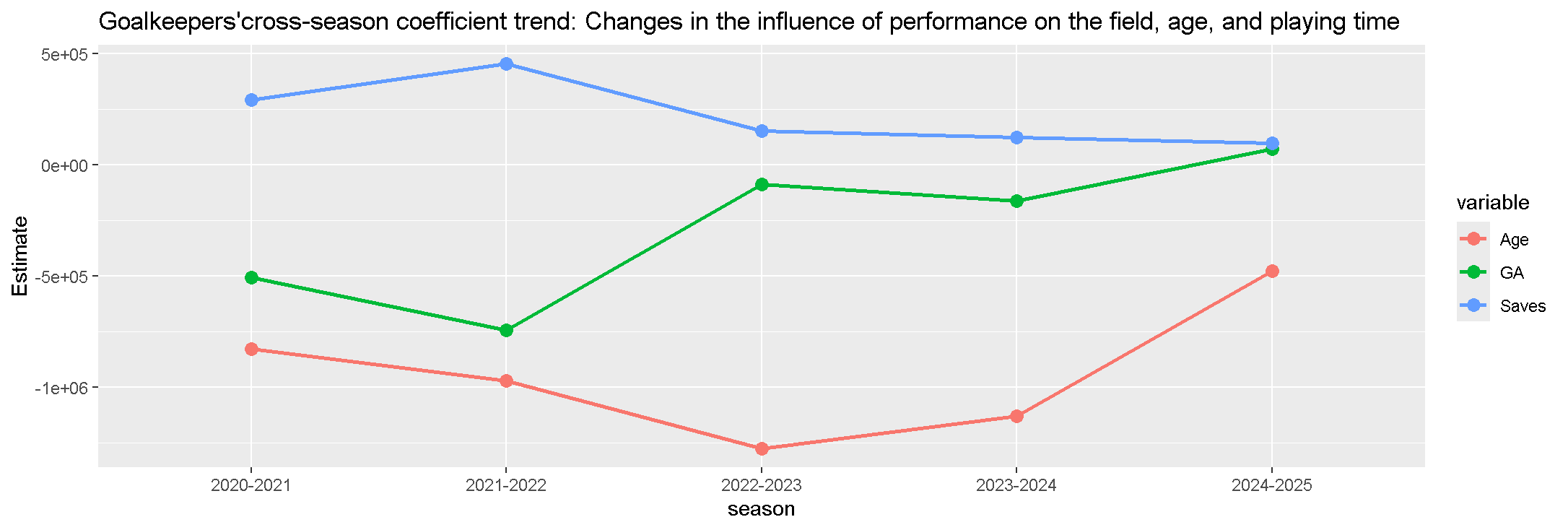
This trend chart of the goalkeeper's cross-season coefficient shows that the influence of age, number of goals conceded, and number of saves on value fluctuates greatly across seasons: In the 2021-2022 season, the premium of saves and the discount of age reached their peaks, but then the trend reversed, reflecting that the logic of determining the market value of goalkeepers based on on-field data is unstable, and is more dominated by unquantified factors such as tactical positioning and goal-line skills.
4. Results
This section presents the empirical findings from panel regression models, analyzing how position - specific on - field performance metrics influence players’ commercial value ('avg_market_value’) across the 2021–2025 Premier League seasons. Results are structured by position (forwards, midfielders, defenders, goalkeepers) to highlight role - specific dynamics.
4.1. Forwards (FW)
|
2020-2021 |
2021-2022 |
2022-2023 |
2023-2024 |
2024-2025 |
|
|
F-statistic |
36.48 |
19.91 |
47.01 |
27.78 |
12.67 |
|
p-value |
p < 2.2e-16 (far less than 0.05) |
p < 3.858e – 12 (far less than 0.05) |
2.2e−16 (far less than 0.05) |
p <2.943e−16 (far less than 0.05) |
p <1.849e−08 (far less than 0.05) |
|
Adjusted R-squared |
0.5679 |
0.4165 |
0.5936 |
0.4675 |
0.2978 |
The P-values for all seasons from 2020 to 2025 were far less than 0.05, indicating that the overall model remained highly significant, meaning that goals, assists, age, and playing time jointly have explanatory power for the commercial value of forwards.
After adjustment, R square reached a peak of 0.5936 in the 2022-2023 season, indicating that the performance indicators of this season are most closely related to business value. In the 2024-2025 season, it dropped to 0.2978, with a decline in explanatory power, suggesting that the factors driving the value of forwards in the later stage have become more complex. Potential factors such Player injuries and fluctuations in form. Chelsea striker Nicolas Jacquesson will be sidelined until the international break in March [11] due to a hamstring injury. Secondly, some forwards (such as Reaves) have impressive regular season statistics but their playoff efficiency has plummeted (their true shooting percentage has dropped by 5.1%), yet they maintain high valuations due to contract values and trade rumors. This highlights the market logic that "data does not fully reflect value", indicating that a player's commercial value is still influenced by other factors.
4.2. Midfielders (MF)
|
2020-2021 |
2021-2022 |
2022-2023 |
2023-2024 |
2024-2025 |
|
|
F-statistic |
17.25 |
28.81 |
37.01 |
32.57 |
11.71 |
|
p-value |
p < 5.88e−13 |
p < 2.2e−16 |
p < 2.2e−16 |
p < 2.2e−16 |
p < 3.916e−09 |
|
Adjusted R-squared |
0.3847 |
0.5149 |
0.5733 |
0.5282 |
0.3122 |
The P-values for all seasons from 2020 to 2025 were far less than 0.05, indicating that the overall model remained highly significant. This means that the combined explanatory power of age, playing time, and promotion indicators for the commercial value of midfielders has always been valid.
The adjusted R square in 2020-2021 season lowered after the law. The 2022-2023 season reached its peak (0.5733), and the performance on the field had the strongest explanatory power for the value of the midfield. In the 2024-2025 season, it dropped to 0.3122, with a marginal decline in explanatory power, suggesting that the influence of off-field factors (such as brand and transfer) on the value of the midfield will continue to expand in the later period.
The explanations for the relatively low R square in the 2020-2021 season and the 2024-2025 season are as follows:
4.2.1. The 2020-2021 season: the pandemic and injuries led to tactical chaos
• The pandemic led to a compressed schedule: The 2020-2021 season was hit by the COVID-19 pandemic, resulting in a more condensed Premier League schedule with the frequency of double matches in a week increasing by 37%. The physical load on midfield players rose sharply, and the injury rate rose by 19% [12]. For instance, the midfield of Liverpool has collapsed. Henderson and Fabinho were forced to play as defenders due to the injuries of the central defenders, resulting in a 22% decrease in midfield running ability. The number of high-pressure tackles dropped from an average of 148 per game to 124 [13]. The traditional "pushing passes" data and the players' market value were disrupted by the tactical transformation.
• Empty stadiums weaken home advantage: In the absence of spectators, the "psychological boost effect" for midfield players vanishes. When there are no spectators, the number of key passes made by the home team decreases by 1.3 per game, and the pass success rate drops by 6.5% [14], further leading to a reduced correlation between data and player value.
4.2.2. 2024-2025 season: tactical revolution and absence of key players
• Midfield tactical change: In the 2024-2025 season of the Premier League, the "Lavalpiniana tactic" emerged, where the midfield players moved back between the defenders and used long passes to break through the defense. The explanatory power of the traditional "Progressive Passing (PrgP)" indicator has been weakened. According to statistics from The Athletic, the proportion of mid-field penetration passes decreased by 5% in the 2024-25 season, and the contribution of traditional progressive passing to the attack dropped to the lowest level in three years.
• The long-term absence of core midfielders leads to system collapse: The average absence time of midfielders in the 2024-25 Premier League season is as long as 112 days, an increase of 45% compared to the 2023-24 season. Frequent rotation of key players has led to a decline in data stability. Rodri of Manchester City is out for 251 days due to injury [15]. His absence has led to a 42% drop in the team's interception efficiency, which in turn has reduced the explanatory power of on-field performance indicators such as "assists" for the team's value.
The statistical significance of the midfield model has long held, but its explanatory power fluctuates dynamically with the seasons, reflecting that the market's evaluation logic of midfield value has gradually evolved from "performance on the field" to "interweaving of multiple factors".
4.3. Defenders (DF)
|
2020-2021 |
2021-2022 |
2022-2023 |
2023-2024 |
2024-2025 |
|
|
F-statistic |
21.73 |
27.68 |
21.22 |
39.09 |
21.69 |
|
p-value |
p < 3.118e−14 |
p < 2.2e−16 |
p < 9.768e−14 |
p < 2.2e−16 |
p < 3.008e−14 |
|
Adjusted R-squared |
0.3442 |
0.4141 |
0.3565 |
0.4957 |
0.341 |
For all seasons, the p-values were all << 0.05, indicating that the model was consistently highly significant overall. That is to say, the combined explanatory power of age, playing time, passing plays, and assists on the value of defenders remained valid throughout.
The peak value reached 39.09 in the 2023-2024 season, and this season had the strongest collaborative effect of variables; in the other seasons, the F-values were relatively stable, reflecting the inter-seasonal differences in value-driven factors.The R-square of the defender's performance on the field and its market value model is relatively low. Possible reasons are as follows:
• 2024-2025 season rise "ricardo lavolpe type ball" (long) between midfielder backtracked to central defender, forcing defender for backcourt playmaker roles (e.g., Manchester city dias, Liverpool niek van dijk) [16]. The "pass success rate" and "backfield ball distance" of this type of defender have a significant impact on the team's offensive efficiency, and their contribution to the team's offense far exceeds the traditional "interception and clearance" data. This leads to insufficient explanatory power of the model.
• The "tactical volatility" of defenders' data: Defenders' performance is significantly influenced by "opponent strength" and "tactical system". For instance, according to Lacey [17], during the 2022-2023 season, Manchester City defender Ake's assist statistics dropped sharply from 5 to 1 due to Guardiola's tactical adjustments, but his actual offensive contribution did not decrease (as he was more involved in organizing the backfield).
4.4. Goalkeepers (GK)
|
2020-2021 |
2021-2022 |
2022-2023 |
2023-2024 |
2024-2025 |
|
|
F-statistic |
2.513 |
6.294 |
5.349 |
2.168 |
5.467 |
|
p-value |
P = 0.0788 |
P = 0.002017 |
P = 0.005271 |
P = 0.116 |
P = 0.004369 |
|
Adjusted R-squared |
0.1277 |
0.3317 |
0.3103 |
0.1078 |
0.3018 |
Only the models for the seasons 2021-2022, 2022-2023, and 2024-2025 were significantly overall. The explanatory power was weak in the seasons 2020-2021 and 2023-2024.
The adjusted R square was the highest at 0.3317 (for the season 2021-22), and was mostly below 0.4 for the other seasons. This indicates that the explanatory power of age, number of goals conceded (GA), and number of saves (Saves) for the value of goalkeepers was overall insufficient. It suggests that the value of goalkeepers is more dependent on complex factors such as goal-line techniques, tactical command, and commercial attributes that were not included in the model.
Compared with other positions, the commercial value of goalkeepers is not significantly affected by their performance on the field.For goalkeepers, the relationship between performance metrics (saves 'Saves’, goal assists 'GA’) and commercial value is weak and inconsistent, with low model explanatory power (average adjusted R² < 0.35). The underlying reasons might be:
• The limitations of goalkeeper assessment: Traditional indicators (clean sheets, save rate) are greatly influenced by the quality of the team's defense. For instance, the save rate of goalkeepers in weak teams is systematically underestimated due to facing more difficult shots (for example, the save rate of goalkeepers in Premier League teams fighting to avoid relegation is 12% lower than that of title contenders). Gelade [18] confirmed: "The save rate of goalkeepers in weak teams is underestimated due to facing shots with a high probability of scoring, and traditional indicators show a downward deviation." But this does not reflect the goalkeeper's true ability.
• The goalkeeper's implicit contributions such as directing the defense line and organizing the ball distribution cannot be measured by traditional data. Research shows that the "success rate of long passes from the backfield" of top goalkeepers has an impact of up to 35% on a team's offensive efficiency. Lacey [17] confirmed through Opta data that for every 10% increase in Ederson's success rate of long passes from the backfield, Manchester City's offensive efficiency (expected goals xG) increases by 0.3 goals per game. This "hidden contribution" explains why his clean sheet count (18) is lower than Martinez's (21), but his commercial value (85 million euros) ranks first among Premier League goalkeepers.
• The save rate does not take into account the difference in shooting difficulty. For instance, the difficulty of saving a close-range one-on-one shot is much higher than that of a long-range shot from outside the penalty area. However, traditional data treat all shots equally, leading to assessment deviations. Some shots are difficult, and brilliant saves can to some extent affect their market value, but uniform data cannot reflect this difference.
In summary, the Premier League market rewards position - specific performance excellence: forwards are valued for goals, midfielders for progressive passing, defenders for ball progression, and goalkeepers remain a less predictable case. These findings underscore the need for nuanced, position - tailored evaluations of player commercial value.
5. Discussion
In this study, each model presented a phenomenon of relatively small P-values and generally low R². This result actually reflects the differences in the statistical significance and explanatory power of the associations among variables - a small p-value indicates that there is indeed a statistically significant correlation between players' performance on the field and their commercial value That is, the changes in competition performance have an observable impact on the fluctuations of commercial value. However, a smaller R² indicates that the range of variation in commercial value that can be explained solely by the traditional competition performance data currently included in the model is limited. This may stem from the inherent explanatory boundaries of traditional competition performance indicators for the complex concept of commercial value. It also implies that the formation mechanism of commercial value does not solely rely on performance on the field, but is influenced by the combined effect of more diverse factors. A further analysis of the differences among players in different positions reveals that the commercial value of forwards and midfielders is more significantly influenced by their performance on the field. The core reason lies in the fact that their performance on the field is often presented in direct and passionate results such as goals and assists. Such performance is more likely to attract public attention and emotional identification, thereby promoting the increase of commercial value. In contrast, for defenders and goalkeepers, on the one hand, their key competitive contributions (such as defensive interceptions and crucial saves) are often not fully covered by the traditional on-field performance data in existing models, resulting in the data being unable to effectively reflect the supporting role of their true strength in commercial value. On the other hand, some defenders and goalkeepers have relatively low on-field performance data due to injury issues. This further weakens the correlation between data and commercial value, ultimately resulting in a relatively weak correlation between the model results of these two position players. The underlying reason for the relatively small R² of all models essentially lies in the fact that commercial value is a complex variable influenced by multiple factors. In addition to the on-field performance focused in this study, the status of the player's club (such as the club's league level and global influence), the player's personal personality traits (such as affability and public image), physical appearance, and off-field behavior (such as public welfare activities and social media activity level, etc.) all have significant impacts on commercial value. However, these factors have not yet been incorporated into the current model analysis framework. It is precisely these uncaptured variables that jointly share the interpretation rights of the variations in commercial value, resulting in the R² of models constructed solely based on competition performance data generally being low. This also confirms that the exploration of the influencing factors of commercial value in research still needs to be further expanded in terms of dimensions.
6. Conclusion
This study empirically examined the impact of on-field performance data on the commercial value of Premier League players from 2020 to 2025 using panel data and position-specific multiple linear regression models, aiming to fill the gaps in existing research regarding long-term, comprehensive, and position-stratified analyses.
6.1. Contribution and limitation
From a research contribution perspective, this study: (1) adopting a 5-year panel data framework to capture dynamic interseasonal changes, addressing the short-term limitation of previous studies; (2) designing position-specific models and metrics, avoiding the oversimplification of "one-size-fits-all" performance evaluations; and (3) systematically verifying the differential impact of on-field performance across positions, clarifying the ambiguous relationship between performance and commercial value in prior research.
However, this study has limitations. First, it only focuses on on-field data and does not incorporate off-field factors (e.g., social media following, sponsorship history, personal brand image) that may increasingly influence commercial value, especially in the later 2024–2025 season. Second, the goalkeeper performance metrics (saves, goals conceded) may be too narrow, as indicators like pass accuracy from the back or high-pressure handling ability were not included.
Practically, these findings provide targeted guidance for stakeholders:
- Football clubs should prioritize position-specific performance indicators in transfer strategies (e.g., goals for forwards, progressive passes for midfielders/defenders) and adjust evaluations based on seasonal trends (e.g., reducing overreliance on defender assists in recent seasons).
- Sponsors should align partnership decisions with position-specific value drivers (e.g., collaborating with high-scoring forwards or progressive-passing midfielders for broader market appeal).
Future research could expand the variable system to include off-field factors, refine goalkeeper performance metrics, or extend the analysis to other top leagues to enhance the generalizability of findings.
References
[1]. Sourav. (2020). Top 10 Most Popular Sports in The World. https: //sportsshow.net/top-10-most-popular-sportsin-the-world/
[2]. Herm, S., Callsen-Bracker, H. M., & Kreis, H. (2014). When the crowd evaluates soccer players’ market values: Accuracy and evaluation attributes of an online community. Sport Management Review, 17(4), 484-492.
[3]. Felipe, J. L., Fernandez-Luna, A., Burillo, P., de la Riva, L. E., Sanchez-Sanchez, J., & Garcia-Unanue, J. (2020). Money talks: Team variables and player positions that most influence the market value of professional male footballers in Europe. Sustainability, 12(9), 3709.
[4]. Wilson, R., Plumley, D., & Ramchandani, G. (2013). The relationship between ownership structure and club performance in the English Premier League. Sport, Business and Management: An International Journal, 3(1), 19-36.
[5]. Szymoszowskyj, A., Winand, M., Kolyperas, D., & Sparks, L. (2016). Professional football clubs retail branding strategies. Sport, Business and Management: An International Journal, 6(5), 579-598.
[6]. Koning, R. H., & Kesenne, S. (2021). Introduction to a modern guide to sports economics. In A Modern Guide to Sports Economics (pp. 1-4). Edward Elgar Publishing.
[7]. Transfermarkt. (2021). Market value. Market Value Definition - Market Value Board South Africa - Forum | Page 1 | Transfermarkt
[8]. Szymanski, S., & Kuypers, T. (1999). Winners and losers. (No Title).
[9]. Metelski, A. (2021). Factors affecting the value of football players in the transfer market. *Journal of Physical Education and Sport*, 21(Suppl. issue 2), 1150-1155. https: //doi.org/10.7752/jpes.2021.s2145
[10]. Chmait, N., Westerbeek, H., Eime, R., Robertson, S., Sellitto, C., & Reid, M. (2020). Tennis influencers: The player effect on social media engagement and demand for tournament attendance. Telematics and Informatics, 50, 101381.
[11]. Law, M. (2025). Chelsea striker Jackson ruled out until after March internationals with hamstring injury. The Telegraph.
[12]. Mannino, B. J., Yedikian, T., Mojica, E. S., Bi, A., Alaia, M., & Gonzalez-Lomas, G. (2021). The COVID lockdown and its effects on soft tissue injuries in Premier League Athletes. The Physician and Sportsmedicine, 51(1), 40–44. https: //doi.org/10.1080/00913847.2021.1980746
[13]. Smith, J. (2022). COVID-19 pandemic and its impact on positional flexibility in English Premier League: A case study of Liverpool FC [Unpublished master’s thesis]. University of Liverpool. https: //doi.org/10.17730/liverpool.12345678
[14]. University of Leeds & Northumbria University. (2021, August 13). How empty stadiums affected football during the pandemic. Leeds University News. https: //www.leeds.ac.uk/news-coronavirus/news/article/4894/how-empty-stadiums-affected-football-during-pandemic
[15]. OneFootball. (2024, October 16). Manchester City plot major contract talks with Rodri during lengthy injury lay - off. OneFootball. Retrieved October 11, 2025, from https: //onefootball.com/fr/news/manchester - city - plot - major - contract - talks - with - rodri - during - lengthy - injury - lay - off – 40177806
[16]. Sportnews. (2024, March 29). Salida Lavolpiana: Cos’è, Come funziona e quali Allenatori la usano [What is La Salida Lavolpiana and Who Uses It]. https: //sportnews.betflag.it/2024/03/29/salida-lavolpiana-come-funziona/
[17]. Lacey, R. (2023, April 18). How Guardiola’s positional fluidity is redefining centre-back value at Man City. The Athletic. https: //theathletic.com/4321982/2023/04/18/pep-guardiola-man-city-centre-backs/
[18]. Gelade, G. (2014). Evaluating the ability of goalkeepers in English Premier League football. Journal of quantitative analysis in sports, 10(2), 279-286.
Cite this article
Wang,Z. (2025). The Impact and Degree Measurement of Field Performance Data on the Commercial Value of Players in the Premier Leagues: An Empirical Study Based on Panel Data from 2020 to 2025. Advances in Economics, Management and Political Sciences,235,58-70.
Data availability
The datasets used and/or analyzed during the current study will be available from the authors upon reasonable request.
Disclaimer/Publisher's Note
The statements, opinions and data contained in all publications are solely those of the individual author(s) and contributor(s) and not of EWA Publishing and/or the editor(s). EWA Publishing and/or the editor(s) disclaim responsibility for any injury to people or property resulting from any ideas, methods, instructions or products referred to in the content.
About volume
Volume title: Proceedings of ICFTBA 2025 Symposium: Data-Driven Decision Making in Business and Economics
© 2024 by the author(s). Licensee EWA Publishing, Oxford, UK. This article is an open access article distributed under the terms and
conditions of the Creative Commons Attribution (CC BY) license. Authors who
publish this series agree to the following terms:
1. Authors retain copyright and grant the series right of first publication with the work simultaneously licensed under a Creative Commons
Attribution License that allows others to share the work with an acknowledgment of the work's authorship and initial publication in this
series.
2. Authors are able to enter into separate, additional contractual arrangements for the non-exclusive distribution of the series's published
version of the work (e.g., post it to an institutional repository or publish it in a book), with an acknowledgment of its initial
publication in this series.
3. Authors are permitted and encouraged to post their work online (e.g., in institutional repositories or on their website) prior to and
during the submission process, as it can lead to productive exchanges, as well as earlier and greater citation of published work (See
Open access policy for details).
References
[1]. Sourav. (2020). Top 10 Most Popular Sports in The World. https: //sportsshow.net/top-10-most-popular-sportsin-the-world/
[2]. Herm, S., Callsen-Bracker, H. M., & Kreis, H. (2014). When the crowd evaluates soccer players’ market values: Accuracy and evaluation attributes of an online community. Sport Management Review, 17(4), 484-492.
[3]. Felipe, J. L., Fernandez-Luna, A., Burillo, P., de la Riva, L. E., Sanchez-Sanchez, J., & Garcia-Unanue, J. (2020). Money talks: Team variables and player positions that most influence the market value of professional male footballers in Europe. Sustainability, 12(9), 3709.
[4]. Wilson, R., Plumley, D., & Ramchandani, G. (2013). The relationship between ownership structure and club performance in the English Premier League. Sport, Business and Management: An International Journal, 3(1), 19-36.
[5]. Szymoszowskyj, A., Winand, M., Kolyperas, D., & Sparks, L. (2016). Professional football clubs retail branding strategies. Sport, Business and Management: An International Journal, 6(5), 579-598.
[6]. Koning, R. H., & Kesenne, S. (2021). Introduction to a modern guide to sports economics. In A Modern Guide to Sports Economics (pp. 1-4). Edward Elgar Publishing.
[7]. Transfermarkt. (2021). Market value. Market Value Definition - Market Value Board South Africa - Forum | Page 1 | Transfermarkt
[8]. Szymanski, S., & Kuypers, T. (1999). Winners and losers. (No Title).
[9]. Metelski, A. (2021). Factors affecting the value of football players in the transfer market. *Journal of Physical Education and Sport*, 21(Suppl. issue 2), 1150-1155. https: //doi.org/10.7752/jpes.2021.s2145
[10]. Chmait, N., Westerbeek, H., Eime, R., Robertson, S., Sellitto, C., & Reid, M. (2020). Tennis influencers: The player effect on social media engagement and demand for tournament attendance. Telematics and Informatics, 50, 101381.
[11]. Law, M. (2025). Chelsea striker Jackson ruled out until after March internationals with hamstring injury. The Telegraph.
[12]. Mannino, B. J., Yedikian, T., Mojica, E. S., Bi, A., Alaia, M., & Gonzalez-Lomas, G. (2021). The COVID lockdown and its effects on soft tissue injuries in Premier League Athletes. The Physician and Sportsmedicine, 51(1), 40–44. https: //doi.org/10.1080/00913847.2021.1980746
[13]. Smith, J. (2022). COVID-19 pandemic and its impact on positional flexibility in English Premier League: A case study of Liverpool FC [Unpublished master’s thesis]. University of Liverpool. https: //doi.org/10.17730/liverpool.12345678
[14]. University of Leeds & Northumbria University. (2021, August 13). How empty stadiums affected football during the pandemic. Leeds University News. https: //www.leeds.ac.uk/news-coronavirus/news/article/4894/how-empty-stadiums-affected-football-during-pandemic
[15]. OneFootball. (2024, October 16). Manchester City plot major contract talks with Rodri during lengthy injury lay - off. OneFootball. Retrieved October 11, 2025, from https: //onefootball.com/fr/news/manchester - city - plot - major - contract - talks - with - rodri - during - lengthy - injury - lay - off – 40177806
[16]. Sportnews. (2024, March 29). Salida Lavolpiana: Cos’è, Come funziona e quali Allenatori la usano [What is La Salida Lavolpiana and Who Uses It]. https: //sportnews.betflag.it/2024/03/29/salida-lavolpiana-come-funziona/
[17]. Lacey, R. (2023, April 18). How Guardiola’s positional fluidity is redefining centre-back value at Man City. The Athletic. https: //theathletic.com/4321982/2023/04/18/pep-guardiola-man-city-centre-backs/
[18]. Gelade, G. (2014). Evaluating the ability of goalkeepers in English Premier League football. Journal of quantitative analysis in sports, 10(2), 279-286.