








1. Introduction
A Rube Goldberg device (or Rube Goldberg machine) is a device that achieves a simple function through a series of complex and absurd mechanisms. It is characterized by its weirdness and innovation [1]. In this device, each small design interconnects with the others. A single, unintentional step can trigger subsequent, unexpected steps, such as a ball flowing into a bottle, triggering a spring that ultimately opens a gear and a door lock. These components build upon each other, ultimately achieving their goal. Although its operation process seems absurd and inefficient, it is this unexpected situation that gives the Rube Goldberg machine its creativity and unique charm [2]. This concept was first proposed by American cartoonist Rube Goldberg in his works, but in modern society, it has been used to criticize the excessive mechanization, bureaucratic rigidity, and efficiency of modern society, as well as the lack of stability and novelty in design [3].
With the rapid advancement of globalization and the explosive growth of social media [4], the speed of cultural flow has begun to accelerate, and the culture and interpretation of Rube Goldberg machines have also quickly become known to the public. Short video platforms such as YouTube in the United States and Bilibili in China have now become the center of content consumption and creation in their respective fields. However, the dissemination of cultural symbols is influenced by the cultures of different countries and regions. In other words, the meaning expressed in the original context will be reinterpreted, absorbed, and reshaped in the new cultural context.When a symbol rooted in a particular cultural background enters a different cultural ecosystem, its original meaning may be diluted, distorted, or even endowed with entirely new connotations. Previous academic studies on Rube Goldberg machines have largely focused on their origins, development, and social critique in Western culture, with few systematic investigations into their representation and reception in non-Western contexts—particularly in China, whose massive user base and highly socialized media ecosystem make it uniquely significant. This research gap has limited our understanding of the localization mechanisms of cultural symbols in a globalized environment.
Therefore, this study aims to fill that academic void by conducting a qualitative case analysis of Rube Goldberg–related content on social media platforms in China and the United States, in order to explore how this cultural symbol mutates and is reconstructed in cross-cultural transmission. The central goal of this research is to answer the following key questions:
RQ: In what ways does the cultural symbol of the Rube Goldberg machine manifest differently in the context of Chinese social media compared with American social media?
By exploring these questions about attitudes towards different audiences, this study attempts to provide a new perspective to understand the communication mechanisms and responses to the same concept in different cultures, and to provide new empirical evidence for future research on cross-cultural communication.
2. Literature review
Some studies have conducted in-depth research on the cultural background and evolution of the Rube Goldberg device, viewing it as a combination of art and design. As Marzio points out, Rube Goldberg opened up a path to explore both art and technology through his ironic mechanical designs [3]. These devices criticize the pursuit of efficiency in industrialized society and embody the beautiful expectation of mankind to stimulate creativity. In some specific practical fields, such as education, Rube Goldberg devices are often used in teaching tasks in engineering, design and computer science, aiming to improve students' innovative thinking and engineering design capabilities.
Many studies in the field of education, such as Orr & Jordan [5], Graff et al. [6], and Acharya & Sirinterlikci [7], have shown that the establishment of such devices can effectively improve students' ability to solve complex problems and promote their reflection and innovation. Pearl's team even developed a virtual environment that allows students to intuitively present the functions and interactions between different algorithmic structures in the form of a "Rube Goldberg machine", making it easier for students to understand [8].
In fact, in addition to the fields of science and technology and education, the concept of the Rube Goldberg machine has also appeared in metaphors in some other fields. For instance, Caldararo [9] studied blockchain technology and believed that it has complex and circuitous mechanisms like a Rube Goldberg machine. Caffarra’s studied the knowledge related to media analysis and compared some complex negotiation methods to this machine [10].
While existing literature has extensively explored the multiple meanings of the Rube Goldberg device in Western culture and its applications across diverse disciplines, few studies have systematically compared the evolution of this particular cultural symbol within non-Western cultures, using it as a case study of cross-cultural communication. In the context of globalization and social media, the fluidity of cultural symbols is unprecedented. Therefore, this study aims to address this gap by analyzing the presentation and reception of the Rube Goldberg device on social media in diverse cultural contexts, particularly in China and the United States, providing a new empirical foundation for the study of the globalization and localization of cultural symbols.
3. Research methodology
This study employs a qualitative case study approach to conduct an in-depth examination of the spread of the Rube Goldberg device on Chinese and American social media. The research sample was systematically selected from mainstream short video platforms in both countries (YouTube and BiliBili). Sample selection criteria were based on high video views and high engagement, while also considering a diverse sample of creators, including individual creators, commercial brands, and educational institutions, to ensure a diverse and representative sample.
The specific research steps are as follows: First, this study collected samples through keyword searches (such as "Rube Goldberg machine," "weird device," and "Rube Goldberg") and collected comments from the most relevant videos.Secondly, this study used the inductive method in qualitative research to conduct content analysis on the comments under these videos. Furthermore, this study conducted natural language processing analysis of the comments section below the videos, extracting and sorting high-frequency words, analyzing comment types, and analyzing interaction patterns between users. Finally, by placing the content and interaction data in the specific sociocultural context of the two countries for in-depth interpretation, this study aims to reveal the deep meaning and communication logic of the Rube Goldberg device in different cultural contexts.
4. Results
4.1. YouTube video analysis results
The video used in the YouTube video is https://www.youtube.com/watch?v=9_6TUgWmP6I. Figure 1 shows an example of YouTube-related videos. This study extracted the texts of the first 45 first-level comments by default for content and sentiment analysis. The YouTube comments revolved around several key themes.
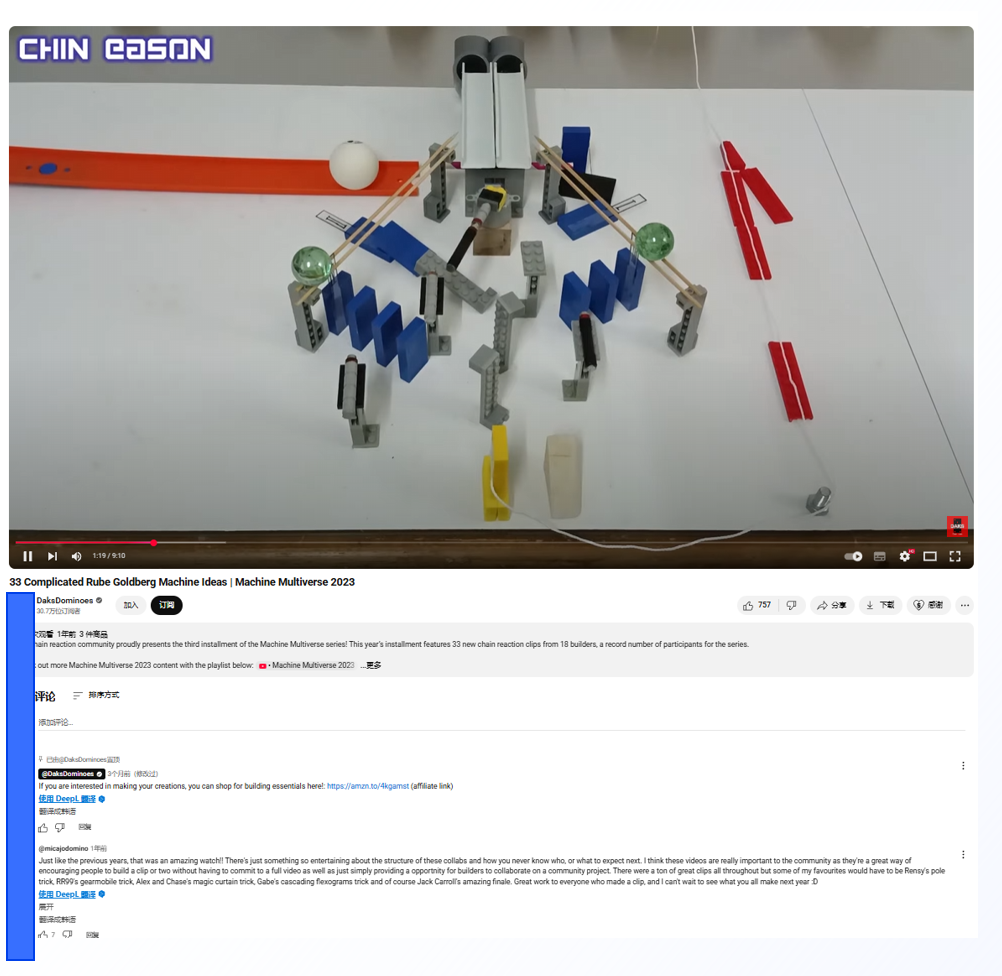
First, appreciation and admiration for creativity. The vast majority of comments expressed high praise for the creativity, ingenuity, and complexity of the Rube Goldberg contraptions depicted in the video. Commenters used words like "amazing," "creative," "clever," and "impressive" to describe the creations. Furthermore, some comments specifically mentioned the importance of these videos to the creator community. They saw them as a great way to collaborate, encouraging more people to participate without having to invest significant effort in completing the entire video. This collaborative spirit is considered a vital component of the Rube Goldberg community. Some commenters connected the video's content to personal experiences or emotions. For example, one commented that it reminded them of the time they spent building models with their son, feeling "very happy and inspired." Others compared the video to similar contraptions from the childhood book "I Spy," evoking a sense of nostalgia.
The comments also included technical discussions about the video itself. Some noted that certain parts of the video, such as the breakpoints, didn't meet the "one-take" requirement according to the definition of a "true" Rube Goldberg machine. Other commenters offered suggestions for the video's editing, noting that the long wait at the beginning could cause viewers to lose interest. This suggests that viewers care not only about the content but also about its presentation.
Table 1 shows the sentiment classification results of Youtube videos. Several comments expressed regret over the video's low number of views and likes, expressing the view that such high-quality work deserves more attention and recognition. This reflects viewers' desire for high-quality content to be properly rewarded and their support for the video's creators. A few comments sought specific information, such as the name of the background music or the identity of the creators.
|
Sentiment Polarity |
Comment Proportion (%) |
Typical Sentiment Vector (Vocabulary) |
Associated Themes |
|
Positive |
85.50% |
amazing, creative, well done, happy, inspired |
Creativity, Technology, Emotion, Community |
|
Neutral |
12.00% |
cut, loop, break, who, what, song |
Technical Details, Information Seeking |
|
Negative |
2.50% |
no, doesn't, miss |
Purism, Regret |
Overall, the sentiment of these comments was overwhelmingly positive, expressing strong admiration and emotional resonance. The comments section was overwhelmingly positive, with viewers using numerous positive adjectives such as "amazing watch," "well done," "spectacular," "very cool," and "job well done." This positive sentiment not only praised the video but also encouraged and supported the creators. Furthermore, a small number of comments were neutral or constructive in nature. For example, there's a discussion about the "one-take" approach and suggestions for editing the beginning of a video. These comments aren't generally meant to disparage the video, but rather stem from a love for the work and a desire for improvement. There's little overt negativity in the comments. Even criticism is offered in a relatively mild and constructive manner, devoid of malice or personal attacks. For example, the comment "Aren't these Rube Goldberg steps?" is more rooted in a "purist" perspective than a simple dismissal.
4.2. Bilibili video analysis results
The video selected for this study is bilibili.com/video/BV1Qb41157dt/?spm_id_from=333.337.search-card.all.click. Similarly, this study extracted the default 45 pieces of data to ensure consistency. The vast majority of comments expressed positive feedback for the video. Commentators used direct language such as "awesome," "nb (awesome)," and "incredible" to praise the creator's ingenuity and execution. Many found it "very clever and shocking," exclaiming, "I never knew there was such a thing." This reflects the novelty of the Rube Goldberg contraption among Chinese audiences.
Many comments indicate that viewers learned about the "Rube Goldberg" contraption through other channels (such as "rankings," "Detective Conan," "Tom and Jerry," and "entertainment fiction") and subsequently came to watch it. This suggests that this concept isn't widely known in China, relying instead on secondary creation and cross-platform, cross-disciplinary knowledge dissemination. Some commentators even mentioned a similar device designed by Tom in "Tom and Jerry," creating a unique cultural connection.
Similar to YouTube comments, many Bilibili viewers expressed confusion and regret over the video's low play and engagement rates. They commented, "Such a good video, so few people are watching it," and actively explored reasons such as the video title's "difficult to attract a general audience" or the sentiment that "good videos require careful searching." This sentiment suggests that viewers believe the video's quality doesn't match its popularity and hope for wider exposure.
The most significant difference from YouTube comments lies in emotional projection and resonance: Chinese viewers are more likely to connect the video's content to their own daily lives or social phenomena. For example, comments like "It's just like my code—robust and elegant, but useless" and "burning the boats and slashing the boats" project the device's "twice the effort, half the result" and "inefficiency" onto their own learning, work, and daily lives, creating a humorous, self-deprecating resonance. Comments also exhibit a significant amount of "traffic diversion," with viewers sharing links to other videos (e.g., "YouTube craft masters have arrived at Bilibili"), asking each other for sources, or @ing other friends. This strong social and sharing nature is a key hallmark of Bilibili community interaction.
Overall, the sentiment of these comments is also predominantly positive, but differs from YouTube comments in terms of expression and underlying emotions. Comments are filled with praise and appreciation for the video content itself. From "I've found a treasure" to "What a fun video," viewers express surprise and delight at discovering high-quality content. This sentiment is similar to YouTube comments.
Emotions related to neutral/constructive criticism are primarily reflected in discussions about the video's effectiveness. For example, comments like "This title really doesn't appeal to the average audience" and "Remember to add spaces next time you post a video" are criticisms, but their motivation is to increase the video's visibility rather than simply disapproving.
Furthermore, Chinese media commentary is unique in its mixed emotions: comments like "twice the effort for half the result," "inefficient work," and "it looks just like my code." These aren't purely negative sentiments, but rather a complex blend of humor, self-deprecation, and resignation. This sentiment reflects both an awareness of the device's inherent uselessness and, through analogies with personal experiences, a unique, collective resonance. This emotional expression is uncommon in YouTube comments, reflecting the unique cultural reflections of Chinese audiences on "efficiency" and "usefulness."
5. Discussion
A comprehensive analysis of comments on YouTube and Bilibili (Site B) clearly reveals the cross-cultural differences in the Rube Goldberg installation's dissemination. While audiences in both countries expressed admiration for the video's creativity and technical prowess, significant differences existed in its core communication purpose, audience interaction patterns, and emotional projection.
The YouTube comment ecosystem leans more towards the "Pure Appreciator" model. The Goldberg installation video is viewed as a standalone artwork or engineering challenge. Audience interaction primarily revolves around technical details, the creative process, and recognition of community collaboration. Commentary language is direct and highly functional, reflecting a focus on the "thing itself" and a respect for "technical elites." Even when criticism exists, it often stems from a pursuit of the "purity" of the art form and remains, at its core, part of a technical discussion. This aligns with Western culture's emphasis on individualism, professionalism, and craftsmanship [11].
In contrast, Bilibili's comment ecosystem leans more towards the "Emotional Projector" model [12]. The Goldberg installation video has been rapidly "localized," becoming a cultural container capable of carrying diverse social emotions. Audiences not only praised the creativity but also tended to connect it to personal experiences ("It's just like my code") and social phenomena ("Twice the effort, half the result"), expressing complex emotions through humor and self-deprecation. This interactive model involves both appreciation for creativity and reinterpretation and emotional investment through individual cultural mapping.
This study explores the differences in understanding the concept of the rube goldberg machine across different cultural contexts, highlighting the importance of culturally relevant conceptual communication. In this study, American viewers generally appreciated the universal value of this design aesthetic, leaving many comments expressing their feelings with direct expressions such as "This is awesome." However, comments on Chinese social media platforms have undergone a secondary cultural transformation of the rube goldberg machine, imbuing it with new meanings and connotations. For example, they see it as full of unpredictability, much like his life.
In addition, this study acknowledges some methodological limitations. First, the video comments in this study were limited to first-level comments on the same video across various platforms. While this small sample size allows for exploratory findings, it may not fully capture cultural differences across social media platforms, potentially limiting the generalizability of the findings. Future research will focus solely on text-based comments, but will also collect multimodal information such as likes, shares, and other forms of information. Comprehensive analysis of this multimodal information will provide a more precise empirical case for understanding attitudes toward concepts across cultures.
6. Conclusion
This study employed a comment analysis method to examine attitudes and reactions to the cultural concept of the rube goldberg machine on social media platforms in China and the United States, aiming to reveal differences in understanding across different cultural backgrounds. The study found that audiences from different cultures experience different understandings of the same concept. They connected the ironic nature of the machines to their own experiences, using them as a tool for social and emotional sharing. The results of this study reveal a phenomenon in the flow of cultural symbols under the rapid development of social media: cultural symbols are rarely preserved intact during cross-border communication. Instead, they are absorbed by local cultures and transformed into new cultural contexts to adapt to the values and emotional needs of local audiences. Future research will further explore how these cross-cultural symbols integrate and evolve step by step, and provide richer empirical support for the paths of cross-cultural communication.
References
[1]. M. F. Wolfe and R. Goldberg, Rube Goldberg: Inventions! Simon and Schuster, 2000.
[2]. D. Olsen and M. J. Nelson, "The narrative logic of rube goldberg machines, " in International Conference on Interactive Digital Storytelling, 2017: Springer, pp. 104-116.
[3]. P. C. Marzio, "Art, technology and satire: The legacy of Rube Goldberg, " Leonardo, pp. 315-324, 1972.
[4]. T. Liu et al., "The Impact of Social Media on Children’s Mental Health: A Systematic Scoping Review, " in Healthcare, 2024, vol. 12, no. 23: MDPI, p. 2391.
[5]. M. K. Orr and S. S. Jordan, "A Rube Goldberg Approach to Teaching Dynamics of Machine Elements, " Advances in Engineering Education, 2019.
[6]. W. Graff, P. R. Leiffer, M. G. Green, and J. Koblich, "Thirty Years of Rube Goldberg Projects: a Student-Driven Learning Laboratory for Innovation, " in 2011 ASEE Annual Conference & Exposition, 2011, pp. 22.1522. 1-22.1522. 28.
[7]. S. Acharya and A. Sirinterlikci, "Introducing Engineering Design through an Intelligent Rube Goldberg Implementation, " Journal of Technology Studies, vol. 36, no. 2, pp. 63-72, 2010.
[8]. H. Pearl, S. Arrants, H. Swanson, and D. Trninic, "The AL Goldberg machine: a virtual environment for engaging learners in algorithmic practices, " in Proceedings of the 2020 ACM Interaction Design and Children Conference: Extended Abstracts, 2020, pp. 211-216.
[9]. N. Caldararo, "Bitcoin: Rube Goldberg Machine, Antique Throwback, Gigantic Distraction, Entertainment, Ripoff or New Money?, " Interdisciplinary Description of Complex Systems: INDECS, vol. 16, no. 3-B, pp. 427-445, 2018.
[10]. C. Caffarra, G. S. Crawford, and H. Weeds, "Kabuki dances or rube goldberg machines? Vertical analyses of media mergers, " CPI Antitrust Chronicle, vol. 1, no. 2, pp. 7-14, 2018.
[11]. L. MuJin and K. Saichai, "Art and Environment Management within the Context of Installation Art in Thailand and the People's Republic of China, " Journal of Roi Kaensarn Academi, vol. 9, no. 8, pp. 575-589, 2024.
[12]. D. Cohen and A. Gunz, "As seen by the other…: Perspectives on the self in the memories and emotional perceptions of Easterners and Westerners, " Psychological Science, vol. 13, no. 1, pp. 55-59, 2002.
Cite this article
Guo,Q. (2025). Cross-Cultural Analysis of Rube Goldberg Machines in Social Media Communication: A Case Study of the US and China. Communications in Humanities Research,91,19-26.
Data availability
The datasets used and/or analyzed during the current study will be available from the authors upon reasonable request.
Disclaimer/Publisher's Note
The statements, opinions and data contained in all publications are solely those of the individual author(s) and contributor(s) and not of EWA Publishing and/or the editor(s). EWA Publishing and/or the editor(s) disclaim responsibility for any injury to people or property resulting from any ideas, methods, instructions or products referred to in the content.
About volume
Volume title: Proceedings of ICIHCS 2025 Symposium: Literature as a Reflection and Catalyst of Socio-cultural Change
© 2024 by the author(s). Licensee EWA Publishing, Oxford, UK. This article is an open access article distributed under the terms and
conditions of the Creative Commons Attribution (CC BY) license. Authors who
publish this series agree to the following terms:
1. Authors retain copyright and grant the series right of first publication with the work simultaneously licensed under a Creative Commons
Attribution License that allows others to share the work with an acknowledgment of the work's authorship and initial publication in this
series.
2. Authors are able to enter into separate, additional contractual arrangements for the non-exclusive distribution of the series's published
version of the work (e.g., post it to an institutional repository or publish it in a book), with an acknowledgment of its initial
publication in this series.
3. Authors are permitted and encouraged to post their work online (e.g., in institutional repositories or on their website) prior to and
during the submission process, as it can lead to productive exchanges, as well as earlier and greater citation of published work (See
Open access policy for details).
References
[1]. M. F. Wolfe and R. Goldberg, Rube Goldberg: Inventions! Simon and Schuster, 2000.
[2]. D. Olsen and M. J. Nelson, "The narrative logic of rube goldberg machines, " in International Conference on Interactive Digital Storytelling, 2017: Springer, pp. 104-116.
[3]. P. C. Marzio, "Art, technology and satire: The legacy of Rube Goldberg, " Leonardo, pp. 315-324, 1972.
[4]. T. Liu et al., "The Impact of Social Media on Children’s Mental Health: A Systematic Scoping Review, " in Healthcare, 2024, vol. 12, no. 23: MDPI, p. 2391.
[5]. M. K. Orr and S. S. Jordan, "A Rube Goldberg Approach to Teaching Dynamics of Machine Elements, " Advances in Engineering Education, 2019.
[6]. W. Graff, P. R. Leiffer, M. G. Green, and J. Koblich, "Thirty Years of Rube Goldberg Projects: a Student-Driven Learning Laboratory for Innovation, " in 2011 ASEE Annual Conference & Exposition, 2011, pp. 22.1522. 1-22.1522. 28.
[7]. S. Acharya and A. Sirinterlikci, "Introducing Engineering Design through an Intelligent Rube Goldberg Implementation, " Journal of Technology Studies, vol. 36, no. 2, pp. 63-72, 2010.
[8]. H. Pearl, S. Arrants, H. Swanson, and D. Trninic, "The AL Goldberg machine: a virtual environment for engaging learners in algorithmic practices, " in Proceedings of the 2020 ACM Interaction Design and Children Conference: Extended Abstracts, 2020, pp. 211-216.
[9]. N. Caldararo, "Bitcoin: Rube Goldberg Machine, Antique Throwback, Gigantic Distraction, Entertainment, Ripoff or New Money?, " Interdisciplinary Description of Complex Systems: INDECS, vol. 16, no. 3-B, pp. 427-445, 2018.
[10]. C. Caffarra, G. S. Crawford, and H. Weeds, "Kabuki dances or rube goldberg machines? Vertical analyses of media mergers, " CPI Antitrust Chronicle, vol. 1, no. 2, pp. 7-14, 2018.
[11]. L. MuJin and K. Saichai, "Art and Environment Management within the Context of Installation Art in Thailand and the People's Republic of China, " Journal of Roi Kaensarn Academi, vol. 9, no. 8, pp. 575-589, 2024.
[12]. D. Cohen and A. Gunz, "As seen by the other…: Perspectives on the self in the memories and emotional perceptions of Easterners and Westerners, " Psychological Science, vol. 13, no. 1, pp. 55-59, 2002.