








1. Introduction
With the long process of history, the female discipline was always a crucial character in the different periods of women; even in modern era, the discipline still appears. Due to the technology development, the female discipline transferred to the online platform by the public forming an aesthetic canon for young women: women should be skinny and fit. The aesthetic canon causes females to become homogenized and objectify themselves. As globalization developed, females in the online community expressed their perspectives of the aesthetic canon. The subjectivity has existed. The female subjectivity is expressed by women’s online self-expression and political consumerism. Females use self-expression by creating hashtags and sharing personal anecdotes; for political consumerism, women will refuse to buy some stigmatized products. The article mainly discusses how the standard of female bodies is constructed and reproduced in the online space; it uses multi-modal content analysis to analyze the hashtags and comments and thematic analysis. This research addresses the core issues of "how society regulates the body" and "how women assert their subjectivity through digital media". The social background of the research is beauty standards, consumerism, and neo-feminism. This research uses the discipline theory created by Michel Foucault and the self-expression theory created by Erving Goffman, so as to shine some lights for improving females’ recognition and cultivation.
2. The existence and evolution of female discipline
2.1. The definition of female discipline
Female discipline is the discipline that is imposed on women; in other words, it is a combination of “discipline” and “female”, so the definition of “discipline” is significant for understanding what female discipline is. Discipline is a strategy to control a group of people, to make them follow the rules [1]. Combined with female, woman is one of the target objects in the discipline; in women’s daily lives, the discipline will control them by using fashion and beauty, which will generate female temperament [2]. However, female discipline will bring negative impact. In panopticism, females will achieve the watcher’s expectation by self-restriction [3]. Panopticism is a concept created by Bentham. A tower has a big window; at the center of the tower sits a supervisor, and different people are put into each cell of the tower. By the effect of the backlight, everyone can observe the others in the tower; we can see each cell as a cage or small stage, and the personality of every “actor” is revealed clearly. Michel Foucault claims that the model used in panopticism is a fundamental of prison and school, and the surveillance will create similarity for everyone [4]. Consequently, it will lead to consistency, which means everyone is the same; people or females have the same body size, make-up style, and appearance.
2.2. History of female discipline
The history of female discipline can display different time periods in ancient China. Foot-binding is a well-known female custom all over the world. Ancient Chinese females were required to bind their feet when they were only 5 or 6 years old. The process of foot-binding is brutal, but in ancient China, even some of the greatest female figures also needed to experience this custom. Ancient Chinese believe this is a symbol of beauty and chastity [5]. Furthermore, the concept of chastity was always surrounding the Chinese female. The reason for the emergence of female chastity is because of Chinese masculinity. Ancient Chinese found the importance of masculinity, and they thought it was useful to enhance their masculinity by regulating female sexual practices. Chastity is not only revealed in sexual practices but also in a female’s body and movement. Ancient Chinese define “a good woman” as a woman who should stay in the feminized place and must obey her parents, parents-in-law, and husband [6].
The discipline has evolved from the rule-based discipline, where the policy or law forces people to become disciplined, such as school policy, to the covert discipline [1]. The advancement of social media and the internet promotes the discipline into the daily life of everyone, including online and offline. The content producers on social media will post their thoughts, which will influence the public’s thoughts of some event. For instance, one female content producer thinks black skin is the hottest skin color in the world and explains the reason for her claim, The reason might convince some audience members, and they will begin to follow the context, which they will pursuit as a tan. After more and more people follow it, the beauty standard is formed.
2.3. Female discipline in the context of the internet
As the article mentions before, following the advancement of technology and social media, the female discipline not only switches from offline to online, but also brings the online movement or behavior to offline; the online aesthetic context influences women’s standard of aesthetics. For example, some female content producers will display their body size on social media, which will bring a lot of anxiety, because some female producers who are seeking to achieve the abnormal aesthetic canon resort to some extreme methods, such as liposuction and induced vomiting. Online users are using comments and various videos to shape a beauty standard for a woman. The beauty standard includes several different aspects. Seeking the perfect body size is one of the most popular topics among the girl groups. The development of social media created the concept of “thinness”, which redefined the appearance of beautiful girls in females’ minds. The longing for a perfect body creates females’ dissatisfaction with their own body and anxiety. As more and more people use social media to share their ideal thin body images, they will begin to compare their body size with the ideal body, which will create anxiety. They will create a sense of “not in line with societal aesthetic expression” [7].
Furthermore, the social media era not only brings the self-anxiety to females, but also causes women to always receive the view or judgement from other people, such as the online users, in order to meet the other people’s expectations and avoid the bad comments. This is the self-objectification, and the female’s body becomes a consumable product, or what we called as prosumption. Prosumption is defined as “the interrelated process of production and consumption” [8], in which individuals simultaneously play the role of producers and consumers, not one or the other [9]. When females use the cosmetics, clothing, hairstyle, or other female self-care, they will become a product on social media [7]. For example, as we all know, there are thousands of female content producers on social media, and they will use their bodies to display the clothes and outfits for earning profit.
3. The societal function of social media
3.1. Disciplinary function
The vulnerability is human’s basic condition, different groups of people or individuals will have different kinds of experiences of vulnerability. As the internet advanced, people began to feel vulnerability in their online social life. However, we cannot define the vulnerability as damage; it will limit our apprehension of the online individual and people group. The social media buildup is by the interaction of the users; it will impact people’s behavior on social media, such as self-expression, identity visibility, privacy, and disclosure decision-making [10].
The disciplinary function is one of the societal functions of social media platforms. According to Schoenebeck and Blackwell’s description, the social media platform might be the source of vulnerability or sometimes the platform is the cause of the vulnerability [11]. Platform-enabled vulnerability: people discover that most of the online users believe they will have a vulnerable period when they are using social media, but the internet composition and connection mechanisms directly influence people’s perceptions of vulnerability. The main causation of vulnerability is the openness of some social media [9]. In the social media era, women are keen to share their lives on social media platforms, which includes make-up sharing, outfit sharing, or some other personal information, and because of the openness of social media, female content producers will attract a lot of interactions with other users, which will create vulnerability; everyone can make a comment on your sharing. The comment could be both positive and negative.
The comparison will create female homogenization. Michel Foucault believed in the paradoxical condition of the simultaneous presence of corporeal visibility and invisibility accompanied by salient political value [12]. For the invisibility side, it will be along with an extraordinary inversely proportionate manner when a female body is a material object for judging, observing, rejecting, and modifying, which is for the sake of serving. Dolezal had commented that although females have lower subjective status, a female’s appearance is always suffering the stringent judgement; a female is always requested to maintain a perfect appearance, otherwise they will be stigmatized and lose their social capital [13]. The homogenization, or in other words, the aesthetic canon of female corporeity, emphasizes that females should be white and young, with fine facial features and unwrinkled skin, fit and well-toned and especially slim, as perfect as a Barbie doll. This aesthetic standard has already become so rooted in the public’s mind; because of this public belief, people begin to think this body size represents beauty, which causes the female body homogenization. Furthermore, as the algorithm promotes the aesthetic canon of female, more and more young ladies see the representatives of females on the media, and they view them as the paragon of the female group. Meanwhile, females also see the information of imposing conformity to these models. The promotion of media, such as newspapers, TV shows, and other media, constantly displays the female with the same body size, and also this abnormal aesthetic canon is beautified by some famous singers and actors. When this abnormal pattern is taken in by the public, it will become a cultural norm. Nonetheless, because of the aesthetic canon, the limitation of appearance becomes unacceptable to women [14].
Moreover, the social media allows users to observe other’s interactions, it will provide the possibility to affect or control how individuals perceive their vulnerability because the users have a chance to manage what context of vulnerability that other viewers can see on their social media page. Erving Goffman’s research about self-expression, which is separated into backstage and front stage. Goffman believes that everyone every day is on a stage; we are all actors. “Front Stage” means when someone expresses themselves in a given way solely in order to give a certain kind of impression to others [15]. “Back stage” is when you display the true self. In other words, although social media will produce vulnerability, this vulnerability is in the user’s control zone; they can both passively and subjectively suffer the vulnerability. The content that user’s control is the front stage, what they want others to see, the backstage is what you actually act like.
3.2. Subjectivity function
The social media platform provides a place for females to conduct reflection and express their opinions. Women use hashtags and body narratives to attract public attention to their movement.
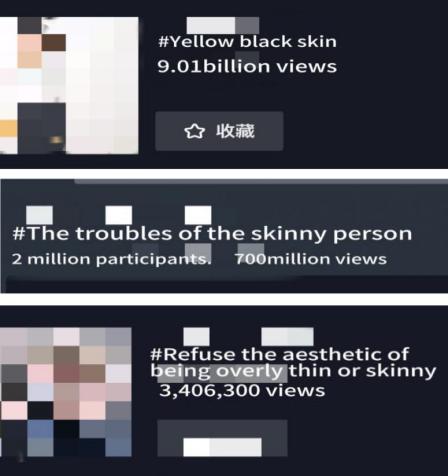
Figure 1 shows that three hashtags in the image are from the famous Chinese social media platform Douyin. Douyin is a short video platform where everyone can share their life and thoughts. Douyin does not restrict the different social class, and it has a high spreadability. Figure 1 displays the protesting of the Chinese aesthetic canon (overly thin or skinny), the people with yellow-black skin sharing their lives (the public always pursuits white skin) on social media, and the elimination of the stereotype of the skinny person, representing three different types of females’ anxieties respectively. Females use hashtags to generate views and attract the public for their movement. Obviously, we can see the number of views on Figure 1; they are all nearly surpassing 100 million views. It brings a lot of attention to their movement; many females find a sense of belonging from the movement, and women find a lot of agreement under the comments, which creates the female consensus. Then they use hashtags to attract and influence more female participants to the hashtag movement.
3.3. The driving force of fashion trends
The function of social media not only includes emphasizing female vulnerability, but also offering a platform for females to develop their subjectivity and take action to protest the aesthetic canon. When we are scrolling the social media page, we can see many female influencers design a post for sharing their life. This is the way that users and influencers interact on social media. The influencers will aim to create a more intimate relationship with their fans, such as calling their fans “sister” or “babe”. The bloggers will draw on the fans’ stickness to sell their products. However, in some way, creating fans stickness will benefit the establishment of subjectivity of females. The fans will follow what influencers do. For example, they will buy the same product as the influencer buys and remember the words that influencer says, which make the influencer become a female representative [16].
The female characteristics that the popular influencers on social media platforms demonstrate are confidence, bravery, and a focus on self-care, but all these characteristics lack a suspicious attitude toward traditional feminism and self-empowerment; they do not deeply discover the reason for gender inequality and ignore any collective political activity [16]. This is what we call post-feminism. Post-feminism increases female subjectivity by consumption, such as the confidence that the bloggers demonstrate established on the basis of consumption, which turns the feminism into consumerism [17]. In consumerism, the female subjectivity is well-established by all the female influencers, which means that the female’s social power is determined by her purchasing power, which limits the behavior of subjectivity. In contrast, the liberal of various consumption patterns is endowed with the challenge to the traditional female characteristics and let ladies go beyond the stereotype. For instance, wearing some specific style of clothes or listening to some specific style of music can be a strong communication way, which can emphasize the freedom and the subjectivity [16]. However, female consumers also can use their purchasing power to reveal the subjectivity. Women can reject buying some products to achieve their protesting. For example, the advertisement of a cosmetic brand objectifies females, a myriad of people refuses to buy any products of this brand; and finally, the sales of this brand face a plummet. Consequently, consumption is a way that women can be subjective [18].
4. Fashion movement
4.1. Causation
Digital movement or activism means that we are promoting a political activity by digital platform; social media has become a vital place for digital feminism [15]. Globalization let the protesting method of foreign feminists spread to China. Nowadays, Chinese feminists also begin to use body narratives and hashtags to let more people understand digital feminism and let females have more unity by sharing personal anecdotes, which is similar to what foreign digital feminists do. This action let some females generate the sense of belonging and presence [19]. Also, the digital activism is a new form of the core of political consumerism; the traditional method, such as protesting, changes to rely on using consumers’ purchasing power to promote the revolution. This action creates “discourse political consumerism”, it shows when mobilize individual consumer to participate in a collective activity and utilizing the advantage of market vulnerabilities to exert moral pressure on capitalism to do better [20].
Whereas, contemporary global digital feminism appears in an era of patriarchal misogyny, sexual minority violence, and implicit racism [21]. China has very strict management of the digital political environment and prohibits the young people from discussing and taking actions to some topics, such as #MeToo. The government did not allow the online social movement to turn into offline activity, which is the main reason why China set a restriction on some online political expression [18]. This causes the majority of the feminism activity to only attract the public’s attention and raise public awareness; Chinese feminists cannot solve the exact problem. As time passes, the attention of the event will decline, there are no continuous actions to push the social revolution. Moreover, because the initial way is to use personal anecdote to attract the public, it will be more subjective if there is no assessment, and it will affect feminism to building up its power. Furthermore, there is a problem popularizing the feminism activity in China. The minority group and marginalized group are in the status of “invisibility”. There is a large gap in the digital media space occupied between Chinese university female students and Chinese rural women. In other words, the feminism activity is less likely to be implemented in low-income counties. Nonetheless, the social media platform seems like it provides a platform for people to fairly express their opinions and thoughts, but actually the algorithm of the platform being able to control the heat of one event. As well as the language is one of the troublesome problems, when the content is translated from Chinese to English, it will create bias to feminism [18].
4.2. The relationship between fashion movement and female subjectivity
Females begin to display themselves forwardly and take action to reject the aesthetic canon that was mentioned at the front. Females begin to accept all the “limitations” they have, such as black skin, short height, and different body size, this “limitation” means some traits that do not follow the aesthetic canon. They develop the “limitations” into their characteristics. This fashion movement attracts many females to follow and gradually develop their subjectivity to show their “limitations”.
Nowadays, a new term is created by some fatshion people, called “fatshionista”, this term is full of pride. And there are more and more fatshion bloggers sharing their lives on social media; their motivation comes from the rejection of stigma and acceptance various comments [22]. In Butler’s words, "when one freely exercises the right to be who one already is, and one asserts a social category for the purposes of describing that mode of being, then one is, in fact, making freedom part of that very social category, discursively changing the very ontology in question” [23]. What Butler says that the subjectivity is that, everyone shows what they already are; they are displaying themselves, which, without the impact from the fatshion trend, such as the thinness, represents the beauty. The fatshion bloggers create a hashtag called “fatshionista” which represents the plus-size women with fatshionable stylish; they reuse the word “fat” and distinguish themselves and reject the demand of bodily changes. Throughout this process, they become an active and empowered subjects [22].
5. The female strategic response and self-expression
5.1. Self-expression aggregate to form social movements through the internet
Self-expression is a form of speaker meaning, in order to show our thoughts, feelings, moods, and experimental states [24]. Put the words online, it will become “online self-expression”, which is when people use online platforms to express their thoughts, feelings, moods, and experimental states. Social movement is a key force of social change in the modern world; some social movements represent the efforts of citizens and fight for a just and equitable world [25]. From the definition of self-expression and social movement, it can be revealed that self-expression is a component of social movement. People express their thoughts on some events or issues; after more and more people have the same opinions and form a group of people, if they begin to protest or fight for their rights, the social movement exists [26].
More and more females express their thoughts of body anxiety on social media. Thousands of posts, such as those where females express their thoughts on aesthetic canons and refuse the anxiety, create a hashtag with a large number of views. The comments under the post include the supporters and the protesters; the supporters and protesters will group together to fight for their thoughts. Then the social movement exists. Females use social media as a carrier of their movement.
5.2. The strategic practice
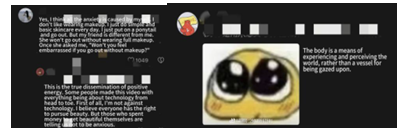
The comments all come from the Chinese social media platform, Douyin (Figure 2). From the hashtag of refute female traditional aesthetic canon, there are thousands of posts, the comments of the posts are significant, and it can reveal that the reaction of the public to the hashtag movement. In the first image, the commentator believes that the females’ anxieties come from themselves; in other words, people watch the video posted by the “beautiful lady”. The “beautiful lady” represents the females who have become more attractive through plastic surgery, and inside the video, the “beautiful lady” expresses their thoughts of not having anxiety, which causes the public or females to create dissatisfaction with themselves, because the bloggers who express these ideas are too perfect and beautiful. The comment on the right side of Figure 2 expresses that the body is for feeling and experiencing the world, not for the carrier of gaze. The commentator believes that females should not always feel anxious and seek to have an overly thin or skinny body, the body can grow up to different sizes it wants, not be restricted in the frame of aesthetic canon.
6. Conclusion
This article defines the meaning of female discipline and retrospects the history of female discipline in ancient China to provide enough background information to transition to online female discipline. This article focuses on one specific aspect of female discipline: aesthetic canon. By identifying the function of social media platform, they have both pros and cons. The social media will develop the vulnerability of females; however, the vulnerability can be controlled by the users, which develops the subjectivity, the pros of social media. It also associates with neo-feminism, which appears after the social media development and globalization. As the culture and information flow more, the people will follow the popular trend from the internet, which will affect their online and offline behaviors. Neo-feminism takes advantage of social media to attract more females to participate in the protest of the abnormal aesthetic canon; the female users create hashtags and post videos to express their own feelings. This article picks one popular social media platform in China, Douyin, for analyzing how the online protesting movement of Chinese cyber citizens is going.
This article still has some limitations: it uses many theories created by foreign theorists; the content of the theories may not be suitable for Chinese females, and it will create some deviation in the analysis. This article can add more Chinese theorists’ theories and Chinese data to make the article more fulfilling and it can eliminate the deviations. Furthermore, the article also mentions that the online movement will influence how people behave in real life, this point lacks argumentation.
References
[1]. Foucoult, M. (1975). Discipline and punish. A. Sheridan, Tr., Paris, FR, Gallimard.
[2]. King, Angela (2004). The Prisoner of Gender: Foucault and the Disciplining of the Female Body. Journal of International Women's Studies, 5(2), 29-39.
[3]. Manokha, I. (2018). Surveillance, panopticism, and self-discipline in the digital age. Surveillance and Society, 16(2).
[4]. Foucault, M. (2008). panopticism from discipline & punish: The birth of the prison. Race/Ethnicity: multidisciplinary global contexts, 2(1), 1-12.
[5]. Foreman, A. (2015). Why footbinding persisted in China for a millennium. Smithsonian Magazine.
[6]. Hinsch, B. (2011). Male honor and female chastity in early China. Nan nü, 13(2), 169-204.
[7]. Yi, B., & Huang, J. (2024). Exploration of the Reasons for Contemporary Young Women's Body Anxiety under the Background of New Consumerism. Academic Journal of Humanities & Social Sciences, 7(6), 219-225.
[8]. Ritzer G. (2015) Hospitality and prosumption. Research in Hospitality Management, 5(1): 9–17.
[9]. Yamamoto, M., Nah, S., & Bae, S. Y. (2020). Social media prosumption and online political participation: An examination of online communication processes. New media & society, 22(10), 1885-1902.
[10]. Barta, K., Pyle, C., & Andalibi, N. (2023). Toward a feminist social media vulnerability taxonomy. Proceedings of the ACM on Human-Computer Interaction, 7(CSCW1), 1-37.
[11]. Schoenebeck, S., & Blackwell, L. (2020). Reimagining social media governance: Harm, accountability, and repair. Yale JL & Tech., 23, 113.
[12]. Foucault, M. (1980). Power/Knowledge: Selected interviews and other writings, 1972-1977, (Ed.) Colin Gordon, trans. Colin Gordon, Leo Marshall, John Mepham, and Kate Soper, Brighton: Harvester Press.
[13]. Dolezal, L. (2010). The (in)visible body: Feminism, phenomenology, and the case of cosmetic surgery. Hypatia 25(2), 357-375.
[14]. Ponterotto, D. (2016). Resisting the male gaze: feminist responses to the "normatization" of the female body in Western culture. Journal of international women's studies, 17(1), 133-151.
[15]. Goffman, E. (2023). The presentation of self in everyday life. In Social theory re-wired. Routledge, pp. 450-459.
[16]. Roberti, G. (2022). Female influencers: Analyzing the social media representation of female subjectivity in Italy. Frontiers in sociology, 7, 1024043.
[17]. Wilkes, K. (2015). Colluding with neo-liberalism: Postfeminist subjectivities, whiteness and expressions of entitlement. Feminist review, 110(1), 18-33.
[18]. Lee, M. S., Fernandez, K. V., & Hyman, M. R. (2009). Anti-consumption: An overview and research agenda. Journal of Business Research, 62(2), 145-147.
[19]. Horton, K., & Street, P. (2021). This hashtag is just my style: Popular feminism & digital fashion activism. Continuum, 35(6), 883-896.
[20]. Cavalcante, A. (2018). Struggling for Ordinary: Media and Transgender Belonging in Everyday Life. New York, USA: New York University Press.
[21]. He, Y. (2024) Body Narratives Video: Exploring a New Discourse on Gender Power in Mainland China-A Case Study of the# FreeTheChokingGirl Hashtag Action on TikTok.
[22]. Micheletti, Michelle, and Dietlind Stolle. (2008) Fashioning Social Justice Through Political Consumerism, Capitalism, and the Internet. Cultural Studies 22 (5): 749-769.
[23]. Harju, A. A., & Huovinen, A. (2015). Fashionably voluptuous: Normative femininity and resistant performative tactics in fatshion blogs. Journal of Marketing Management, 31(15-16), 1602-1625.
[24]. Butler, J. (2011). Bodies in alliance and the politics of the street. Lecture held in Venice. 7 September 2011. The State of Things, organized by the Office for Contemporary Art Norway (OCA). Retrieved from http: //eipcp.net/transversal/ 1011/butler/en/#_ftnref2
[25]. Green, M. S. (2007). Self-expression. Oxford University Press.
[26]. Johnston, H. (2014). What is a social movement? John Wiley & Sons.
Cite this article
Liu,W. (2025). From Body Discipline to Online Movement: Forming the Chinese Female Digital Self-expression. Communications in Humanities Research,91,27-35.
Data availability
The datasets used and/or analyzed during the current study will be available from the authors upon reasonable request.
Disclaimer/Publisher's Note
The statements, opinions and data contained in all publications are solely those of the individual author(s) and contributor(s) and not of EWA Publishing and/or the editor(s). EWA Publishing and/or the editor(s) disclaim responsibility for any injury to people or property resulting from any ideas, methods, instructions or products referred to in the content.
About volume
Volume title: Proceedings of ICIHCS 2025 Symposium: Literature as a Reflection and Catalyst of Socio-cultural Change
© 2024 by the author(s). Licensee EWA Publishing, Oxford, UK. This article is an open access article distributed under the terms and
conditions of the Creative Commons Attribution (CC BY) license. Authors who
publish this series agree to the following terms:
1. Authors retain copyright and grant the series right of first publication with the work simultaneously licensed under a Creative Commons
Attribution License that allows others to share the work with an acknowledgment of the work's authorship and initial publication in this
series.
2. Authors are able to enter into separate, additional contractual arrangements for the non-exclusive distribution of the series's published
version of the work (e.g., post it to an institutional repository or publish it in a book), with an acknowledgment of its initial
publication in this series.
3. Authors are permitted and encouraged to post their work online (e.g., in institutional repositories or on their website) prior to and
during the submission process, as it can lead to productive exchanges, as well as earlier and greater citation of published work (See
Open access policy for details).
References
[1]. Foucoult, M. (1975). Discipline and punish. A. Sheridan, Tr., Paris, FR, Gallimard.
[2]. King, Angela (2004). The Prisoner of Gender: Foucault and the Disciplining of the Female Body. Journal of International Women's Studies, 5(2), 29-39.
[3]. Manokha, I. (2018). Surveillance, panopticism, and self-discipline in the digital age. Surveillance and Society, 16(2).
[4]. Foucault, M. (2008). panopticism from discipline & punish: The birth of the prison. Race/Ethnicity: multidisciplinary global contexts, 2(1), 1-12.
[5]. Foreman, A. (2015). Why footbinding persisted in China for a millennium. Smithsonian Magazine.
[6]. Hinsch, B. (2011). Male honor and female chastity in early China. Nan nü, 13(2), 169-204.
[7]. Yi, B., & Huang, J. (2024). Exploration of the Reasons for Contemporary Young Women's Body Anxiety under the Background of New Consumerism. Academic Journal of Humanities & Social Sciences, 7(6), 219-225.
[8]. Ritzer G. (2015) Hospitality and prosumption. Research in Hospitality Management, 5(1): 9–17.
[9]. Yamamoto, M., Nah, S., & Bae, S. Y. (2020). Social media prosumption and online political participation: An examination of online communication processes. New media & society, 22(10), 1885-1902.
[10]. Barta, K., Pyle, C., & Andalibi, N. (2023). Toward a feminist social media vulnerability taxonomy. Proceedings of the ACM on Human-Computer Interaction, 7(CSCW1), 1-37.
[11]. Schoenebeck, S., & Blackwell, L. (2020). Reimagining social media governance: Harm, accountability, and repair. Yale JL & Tech., 23, 113.
[12]. Foucault, M. (1980). Power/Knowledge: Selected interviews and other writings, 1972-1977, (Ed.) Colin Gordon, trans. Colin Gordon, Leo Marshall, John Mepham, and Kate Soper, Brighton: Harvester Press.
[13]. Dolezal, L. (2010). The (in)visible body: Feminism, phenomenology, and the case of cosmetic surgery. Hypatia 25(2), 357-375.
[14]. Ponterotto, D. (2016). Resisting the male gaze: feminist responses to the "normatization" of the female body in Western culture. Journal of international women's studies, 17(1), 133-151.
[15]. Goffman, E. (2023). The presentation of self in everyday life. In Social theory re-wired. Routledge, pp. 450-459.
[16]. Roberti, G. (2022). Female influencers: Analyzing the social media representation of female subjectivity in Italy. Frontiers in sociology, 7, 1024043.
[17]. Wilkes, K. (2015). Colluding with neo-liberalism: Postfeminist subjectivities, whiteness and expressions of entitlement. Feminist review, 110(1), 18-33.
[18]. Lee, M. S., Fernandez, K. V., & Hyman, M. R. (2009). Anti-consumption: An overview and research agenda. Journal of Business Research, 62(2), 145-147.
[19]. Horton, K., & Street, P. (2021). This hashtag is just my style: Popular feminism & digital fashion activism. Continuum, 35(6), 883-896.
[20]. Cavalcante, A. (2018). Struggling for Ordinary: Media and Transgender Belonging in Everyday Life. New York, USA: New York University Press.
[21]. He, Y. (2024) Body Narratives Video: Exploring a New Discourse on Gender Power in Mainland China-A Case Study of the# FreeTheChokingGirl Hashtag Action on TikTok.
[22]. Micheletti, Michelle, and Dietlind Stolle. (2008) Fashioning Social Justice Through Political Consumerism, Capitalism, and the Internet. Cultural Studies 22 (5): 749-769.
[23]. Harju, A. A., & Huovinen, A. (2015). Fashionably voluptuous: Normative femininity and resistant performative tactics in fatshion blogs. Journal of Marketing Management, 31(15-16), 1602-1625.
[24]. Butler, J. (2011). Bodies in alliance and the politics of the street. Lecture held in Venice. 7 September 2011. The State of Things, organized by the Office for Contemporary Art Norway (OCA). Retrieved from http: //eipcp.net/transversal/ 1011/butler/en/#_ftnref2
[25]. Green, M. S. (2007). Self-expression. Oxford University Press.
[26]. Johnston, H. (2014). What is a social movement? John Wiley & Sons.