








1. Introduction
With the rapid development of the internet, its influence has gradually permeated people's lives. Electronic payments, online transactions, and internet investments have become increasingly popular choices, revealing business opportunities to many. However, the legal regulations governing these activities have failed to keep pace with the ever-evolving, fast-paced nature of the digital world. Terms like “cloud farming,” “cloud cultivation,” and “proxy farming” have entered public discourse in recent years. Leveraging internet technology to expand diverse consumption scenarios, the new “cloud farming economy” has rapidly emerged. Yet, while the cloud farming economy was intended to inject new momentum into agricultural transformation and urban-rural integration, unscrupulous individuals have exploited it as a cover. They fabricate fictitious farming and cultivation projects or lure the public with promises of “guaranteed profits” and “high returns” to invest funds. Concurrently, China lacks comprehensive regulatory policies for the “cloud farming economy,” resulting in high incidence of illegal activities within this sector. Fraudsters exploit the guise of agricultural development to perpetrate scams, severely infringing upon public interests and significantly undermining the healthy growth of the agricultural industry. This paper will conduct an in-depth study on the criminal regulation of online “cloud farming economy” activities, clarify the nature of related behaviors, and explore effective criminal regulatory countermeasures. This is an intrinsic requirement for curbing illegal activities in the “cloud farming economy” and a practical necessity for safeguarding the transformation, upgrading, and further development of the agricultural industry.
2. “Cloud farming economy” activities in the internet context
2.1. Characteristics of online “cloud farming economy” activities
“Cloud farming” and “proxy farming” initially emerged as novel online farming methods where owners of animals or plants participate remotely via the internet without direct contact. The commercial activities of the online “cloud farming economy” represent a new business model that leverages internet technology to digitize traditional agricultural practices or emotional consumption behaviors. In this sense, the online “cloud farming economy” represents a new consumption format jointly explored by merchants and consumers within the digital landscape, constituting a legitimate form of online interests. In reality, however, the truly harmful online “cloud farming economy” activities involve using virtual farming as a gimmick to promise low-cost, high-return schemes, maliciously absorbing public funds [1]. For example, in the 2025 “Virtual Fish Farming Case,” victims purchased fish fry via an app for cloud farming, expecting to sell them at a premium to earn money while playing. However, “farming tasks” became increasingly difficult, large sums of funds became impossible to withdraw, ultimately resulting in millions in economic losses [2]. Such schemes, which solely use “cloud farming” as a gimmick to maliciously absorb public funds, constitute a severe infringement of legal rights and represent a new form of cybercrime. These activities exhibit four key characteristics, as outlined in Table 1.
|
Characteristics |
Specific Manifestations |
|
Conceptual Hype |
Online “cloud farming economy” activities often use “agriculture + technology” as a gimmick, packaging themselves by hyping up trendy concepts like pastoral living, organic ecology, and smart agriculture, while fabricating or exaggerating production scenarios. |
|
High Returns |
Online “cloud farming economy” activities frequently lure participants with false claims of “low risk, high returns,” promising dividends or agricultural product returns. However, their actual business models cannot sustain these profit commitments. |
|
Strong Online Nature |
These activities operate exclusively through internet platforms and mobile applications, using online payment tools for fund transfers. They exhibit broad reach and rapid dissemination. |
|
Divergence from Agricultural Industry Characteristics |
Agriculture features long production cycles and limited profit margins, creating a clear logical contradiction with promises of “short-term windfall profits.” |
2.2. Types of online “cloud farming economy” activities
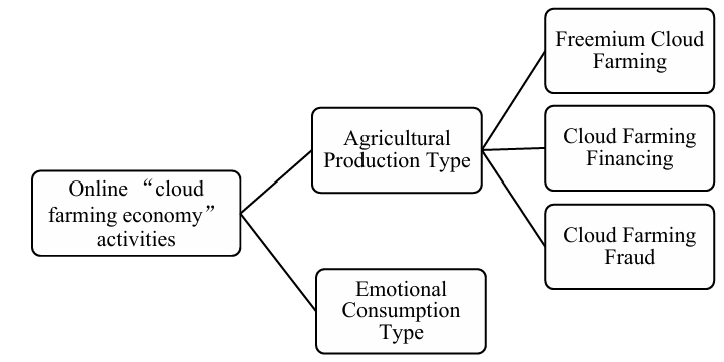
The types of online “cloud farming economy” activities directly determine the precision of criminal regulations. The core of these activities lies in enabling remote participation through digital means. Broadly, they fall into two categories: First, Agricultural Production Type, where users adopt agricultural products (such as livestock, poultry, tea plants, etc.) via online platforms. Utilizing IoT technology, they remotely monitor growth processes and ultimately receive physical goods or profit dividends [5]. The second category is Emotional Consumption Type, primarily offering virtual nurturing services (like online pet ownership or tree planting) to fulfill users' emotional companionship needs, unrelated to physical production. Agricultural activities exhibit more complex behavioral patterns than emotional consumption, warranting further analysis.
Further subdividing the first category yields three types: First, free cloud-raising models require no monetary investment for virtual animals/plants. Participants typically earn cloud-raising access through tasks, aiming to attract purchases of associated agricultural products. The second type is “cloud farming financing”, which may involve actual farms or merely serve as a gimmick. Through engaging activities—such as purchasing fish fry for cloud-based raising and subsequent sale—the objective is to construct a novel financing and investment environment to attract public investment. The third type constitutes cloud-based fraud, often promoted as “low-cost, high-return” ventures. Perpetrators exploit this online “cloud-rearing” format to defraud the public of their money. The overall structure is shown in Figure 1.
2.3. The legal nature of online “cloud farming economy” activities
The second category of Emotional Consumption Type involves consumers seeking emotional support or solace, typically not involving criminal offenses but potentially leading to civil contract disputes. The focus lies on the first category—Agricultural Production Type—whose three subcategories require careful analysis.
The legal nature of the first type and the third type of the first category is relatively clear. The first type—Freemium Cloud Farming—serves primarily as a user attraction tactic aimed at stimulating consumption, similar to live-streamed e-commerce. Generally, it does not constitute civil infringement or criminal offenses, though it may involve civil disputes in transactional contexts. The third type—Cloud Farming Fraud—is a classic form of telecommunications fraud, executed using “cloud farming” or “proxy farming” as bait.
The second category, Cloud Farming Financing, warrants focused analysis to determine whether they represent personalized investment opportunities or illegal fundraising activities. The key lies in whether the perpetrator caused actual financial harm to the public. This determines whether it is a civil financing dispute or a criminal offense. Such schemes often operate within a legal gray area, masquerading as legitimate agricultural projects. However, their design raises legal controversies—for instance, excessive profit promises may violate Article 176 (Illegal Absorption of Public Deposits) and Article 192 (Fund Fraud) of the Criminal Law of the People's Republic of China.
3. Challenges in the criminal regulation of “cloud farming economy” activities online
3.1. Controversies in fact-finding of criminal activities in the “cloud farming economy” online
In cloud-based financing activities, determining whether conduct reaches the threshold of criminality is both the key focus and the greatest challenge. Specifically, distinguishing between legitimate financing and illegal fundraising requires examining the actual conditions of the financial market at the time of contract formation and commitment issuance, as well as the circumstances when harm occurs. This involves assessing whether the activity exhibits the “four characteristics” of illegal fundraising: illegality, public solicitation, profit inducement, and social impact. The scope of the crime of illegal public deposit absorption should not be expanded to serve as a catch-all provision that blurs the boundary between civil and criminal liability [6]. Financing activities within the “cloud farming economy” promising high returns with low risk may highly likely involve criminal conduct. However, further assessment of the perpetrator's intent is required. Typically, when participants in “cloud farming economy” activities promise short-term windfall profits, they intent to attract public funds, which can be recognized as criminal behavior.
The identification of virtual assets also poses challenges in factual determination. In “cloud farming economy” activities, how virtual assets are obtained or converted within mini-programs or apps correspond to real currency, which impacts the characterization of conduct and the assessment of criminal liability. This necessitates establishing corresponding functional supervision and tiered legal classification systems, a tiered approach to determining their legal attributes [7].
3.2. The debate on the distinction between illegal public deposit absorption and fundraising fraud
Despite numerous challenges in investigating, gathering evidence, and establishing facts in cases involving online “cloud farming economy” activities, the most difficult aspect remains determining the legal classification. The greatest divergence in practice lies in the debate over whether such activities constitute the crime of illegally absorbing public deposits or the crime of fundraising fraud.
Analyzing the distinction between these two crimes within the context of online “cloud farming economy” activities, judicial practice focuses on whether there exists a subjective intent to illegally appropriate funds and whether objective fraudulent methods were employed. Concurrently, from an academic perspective and within the financial system framework, the assessment centers on whether the conduct undermines the financial trust mechanism and the nature of the trust breached. This distinction lies between investor trust in the character of the fund-raiser versus market participants' trust in the established rules governing financial market interest rates. The former constitutes fundraising fraud, while the latter falls under illegal public deposit absorption [8]. From the perspective of the essence of legal interests, the crime of illegally absorbing public deposits constitutes a breach of systemic trust, primarily harming collective legal interests. The crime of fundraising fraud infringes upon the systemic trust mechanism. Unlike traditional fraud, it causes dual harm to both individual and collective legal interests by undermining trust [9]. Applying this to cases involving online “cloud farming economy” activities, one can examine whether the perpetrator actually participated in the activity themselves and the basis of the victims' belief.
3.3. The identification of participant status is complex
Online “cloud-based investment schemes” often target the general public. To attract more funds, some schemes assign participants the task of “headhunting system.” Individuals blinded by high returns may recruit new victims in pursuit of greater rewards or “commissions.” When a significant number of victims are recruited, it becomes difficult to determine whether the recruiter is a perpetrator or a victim, creating challenges in establishing criminal liability for participants. In judicial practice, the key lies in assessing the perpetrator's intent to determine whether it constitutes joint criminal activity. If an individual knowingly participates despite being aware of the problematic nature of the gains and continues to recruit others even when unable to obtain the promised benefits, it undoubtedly bears criminal responsibility. Traditional joint crime recognition often adopts the subjective consensus doctrine, where shared criminal intent serves as the standard for establishing liability. However, in online “cloud farming” schemes, participants lack direct contact, and actions exhibit trans-temporal and chain-like characteristics. Relying solely on subjective intent thus proves inadequate for liability determination. The objective joint conduct doctrine proves more applicable: participants can be deemed accomplices if their actions demonstrate a common purpose in the criminal activity and contribute to the criminal outcome [10]. For instance, in the aforementioned 2025 “virtual fish farming case,” the charges against Shi Mou Hua and Shi Mou Dong did not focus on their subjective intent. Instead, the court examined their shared intent in the criminal activity. Based on the profits gained and damages caused by their actions, it was determined that they played only a secondary, auxiliary role. Consequently, they were convicted of the crime of illegal absorption of public deposits.
4. Criminal legal countermeasures for online “cloud farming economy” activities
Criminal activities in the online “cloud farming economy” present significant challenges in factual determination, evidence collection, and classification, with complex legal application issues arising. There is an urgent need for criminal policy to play an active role in regulating this new form of cybercrime. First, advocate a criminal policy of “strict prevention, strict control, and strict suppression.” In the realm of online “cloud farming economy” activities, different agencies require strictly control over, the development of activities using “cloud farming” or “cloud cultivation” as gimmicks. Promptly crack down on any signs of illegality upon discovery, preventing such criminal activities from undermining genuine exploration and innovation beneficial to the transformation and development of the agricultural industry. Second, relevant departments—such as the Ministry of Agriculture and Rural Affairs, the National Financial Regulatory Administration, and the State Administration for Market Regulation—should jointly define legitimate business models for online cloud farming activities. This would educate investors about legitimate participation channels while restricting speculative operations, thereby reducing opportunities for criminals to exploit the “cloud farming economy” at its source.
Regarding criminal activities within the online “cloud farming economy,” the current criminal law system exhibits lagging provisions in applicable offenses and constitutive elements, necessitating legislative refinement for precise regulation. Considerations should include refining existing offenses or creating a new “financial fraud” crime. For these online “cloud-based animal care economy” crimes, add behavioral pattern elements to relevant offenses, focusing on regulating high-return promises lacking genuine business support, while strengthening the criminal evaluation of participants' risk characteristics.
5. Conclusion
As an emerging business model integrating the digital economy with agriculture, the online “cloud farming economy” provides innovative pathways for agricultural transformation and upgrading while also fostering risks of illegal activities due to lagging regulation. By analyzing the characteristics, types, and legal nature of “cloud farming economy” activities, this paper reveals the core challenges in its criminal regulation: first, disputes over the factual determination of online “cloud farming economy” criminal activities; second, divergent interpretations between illegal absorption of public deposits and fundraising fraud. Based on the financial trust legal interest theory, this paper recommends refining the criminal offense classification system at the legislative level to strengthen regulation of behavioral patterns such as “high-return promises without genuine business support.” It also advocates for cross-departmental collaborative governance to balance innovation incentives with risk prevention. Future efforts should further refine adjudication standards in conjunction with judicial practice to establish a legal framework for the healthy development of the cloud farming economy.
References
[1]. Ministry of Agriculture and Rural Affairs of the People's Republic of China, National Financial Regulatory Administration, Ministry of Public Security of the People's Republic of China, State Administration for Market Regulation. (2025) Enhancing Fraud Risk Prevention and Management in the “Cloud Farming Economy”. Yunnan Agriculture 39(06), 9-10
[2]. Procuratorial Daily Jcrb.com, https: //news.jcrb.com/jsxw/2025/202507/t20250729_7065713.html, last accessed 2025/10/07.
[3]. The Supreme People's Procuratorate of the People's Republic of China, https: //www.spp.gov.cn/zdgz/202507/t20250718_701643.shtml, last accessed 2025/10/07.
[4]. Suhu.com, https: //www.sohu.com/a/909927629_122435066, last accessed 2025/10/07.
[5]. Ministry of Agriculture and Rural Affairs of the People's Republic of China, National Financial Regulatory Administration, Ministry of Public Security of the People's Republic of China, State Administration for Market Regulation. (2025, April 22). Strengthening the prevention and disposal of fraud risks in the "cloud farming economy" field (Nong Ban Ji Cai [2025] No. 3). Retrieved from https: //www.gov.cn/zhengce/zhengceku/202504/content_7020890.htm
[6]. Wang Xin. (2021) Criminal Legal Risk Boundaries of Private Financing. Contemporary Law Review 35(01), 9-10.
[7]. Zhou Xin., Miao Qiuyue. (2025) On the Disposition of Virtual Assets Involved in Criminal Cases On the Disposition of Virtual Assets Involved in Criminal Cases. Social Sciences in Guangdong, 1-13.
[8]. Lan Xueyou. (2021) Systematic Distinction between the Crime of Fraud in Fund Raising and the Crime of Illegally Absorbing Public Deposits: Two Types of Trust Based on Financial System. Journal of Southwest University of Political Science & Law 23(05), 112-128.
[9]. Liang Yiru. (2021) The Distinction and Application between the Crime of Illegally Absorbing Public Deposits and the Crime of Fund-raising Fraud: Based on Trust as Law Interests. Hebei Law Science 39(08), 169-185.
[10]. Wang Xiao. (2025) The Determination of Responsibility of Each Co-offender in the Joint Crime of Online Pyramid Schemes. Journal of Political Science and Law (04), 170-184.
Cite this article
Gao,H. (2025). Criminal Regulation of Online “Cloud Farming Economy” Activities. Lecture Notes in Education Psychology and Public Media,115,27-32.
Data availability
The datasets used and/or analyzed during the current study will be available from the authors upon reasonable request.
Disclaimer/Publisher's Note
The statements, opinions and data contained in all publications are solely those of the individual author(s) and contributor(s) and not of EWA Publishing and/or the editor(s). EWA Publishing and/or the editor(s) disclaim responsibility for any injury to people or property resulting from any ideas, methods, instructions or products referred to in the content.
About volume
Volume title: Proceedings of ICILLP 2025 Symposium: Property Law and Blockchain Applications in International Law and Legal Policy
© 2024 by the author(s). Licensee EWA Publishing, Oxford, UK. This article is an open access article distributed under the terms and
conditions of the Creative Commons Attribution (CC BY) license. Authors who
publish this series agree to the following terms:
1. Authors retain copyright and grant the series right of first publication with the work simultaneously licensed under a Creative Commons
Attribution License that allows others to share the work with an acknowledgment of the work's authorship and initial publication in this
series.
2. Authors are able to enter into separate, additional contractual arrangements for the non-exclusive distribution of the series's published
version of the work (e.g., post it to an institutional repository or publish it in a book), with an acknowledgment of its initial
publication in this series.
3. Authors are permitted and encouraged to post their work online (e.g., in institutional repositories or on their website) prior to and
during the submission process, as it can lead to productive exchanges, as well as earlier and greater citation of published work (See
Open access policy for details).
References
[1]. Ministry of Agriculture and Rural Affairs of the People's Republic of China, National Financial Regulatory Administration, Ministry of Public Security of the People's Republic of China, State Administration for Market Regulation. (2025) Enhancing Fraud Risk Prevention and Management in the “Cloud Farming Economy”. Yunnan Agriculture 39(06), 9-10
[2]. Procuratorial Daily Jcrb.com, https: //news.jcrb.com/jsxw/2025/202507/t20250729_7065713.html, last accessed 2025/10/07.
[3]. The Supreme People's Procuratorate of the People's Republic of China, https: //www.spp.gov.cn/zdgz/202507/t20250718_701643.shtml, last accessed 2025/10/07.
[4]. Suhu.com, https: //www.sohu.com/a/909927629_122435066, last accessed 2025/10/07.
[5]. Ministry of Agriculture and Rural Affairs of the People's Republic of China, National Financial Regulatory Administration, Ministry of Public Security of the People's Republic of China, State Administration for Market Regulation. (2025, April 22). Strengthening the prevention and disposal of fraud risks in the "cloud farming economy" field (Nong Ban Ji Cai [2025] No. 3). Retrieved from https: //www.gov.cn/zhengce/zhengceku/202504/content_7020890.htm
[6]. Wang Xin. (2021) Criminal Legal Risk Boundaries of Private Financing. Contemporary Law Review 35(01), 9-10.
[7]. Zhou Xin., Miao Qiuyue. (2025) On the Disposition of Virtual Assets Involved in Criminal Cases On the Disposition of Virtual Assets Involved in Criminal Cases. Social Sciences in Guangdong, 1-13.
[8]. Lan Xueyou. (2021) Systematic Distinction between the Crime of Fraud in Fund Raising and the Crime of Illegally Absorbing Public Deposits: Two Types of Trust Based on Financial System. Journal of Southwest University of Political Science & Law 23(05), 112-128.
[9]. Liang Yiru. (2021) The Distinction and Application between the Crime of Illegally Absorbing Public Deposits and the Crime of Fund-raising Fraud: Based on Trust as Law Interests. Hebei Law Science 39(08), 169-185.
[10]. Wang Xiao. (2025) The Determination of Responsibility of Each Co-offender in the Joint Crime of Online Pyramid Schemes. Journal of Political Science and Law (04), 170-184.