








1. Introduction
The emergence of the short-video ecosystem has reshaped the contemporary way of storytelling. Multiple platforms need to constantly update their narrative content, stabilize user retention rates, and make innovative decisions based on data. Scriptwriting has moved from a manual process to an industrialized and algorithmic management stage [1]. The traditional dramatic structure that is fixed on linear performances and static characters It is probably difficult to adapt to the rapid production cycle required by the distribution of algorithms. In this mode, content creators need to coordinate two opposing forces: the spontaneous nature of artistic creation and the predictability necessary for digital optimization [2].
The absence of real-time feedback loops in terms of user stickiness and creative development also hinders adaptive improvement. Underperforming scenarios cannot be rebalance immediately. Before conducting post-production analysis, a prototype that has lost its emotional appeal generally does not change [3].
This study designs a computational creativity framework that enables micro-iterations of character prototypes, allowing for fine-grained evolution of personality attributes. It also uses beat density adjustment as a quantitative control method for narrative rhythm. The framework integrates behavioral analysis and emotional modeling into each creative cycle to coordinate artistic consistency with data-driven accuracy. The fundamental prerequisite is Creativity and computing power are not mutually exclusive but can progress together through structured feedback, thereby achieving sustainable narrative innovation and measurable user stickiness [4].
Our contributions fall into three aspects: (1) We have optimized the narrative into a differentiable process with measurable convergence characteristics; (2) We have identified the optimal beat density range that can balance engagement and cognitive comfort. (3) It shows that there is a compensatory relationship between prototype stability and rhythm regularity, indicating that the self-organization of creative systems prefers stable attractors.
Its significance far exceeds that of short plays. Narrative media facing industrialization, such as series novels, interactive narratives, and AI-generated content, all encounter similar challenges. Our answer to expanding creativity is to make it experimental and testable.
2. Literature review
2.1. Industrialization of narrative production
Industrialized narrative production has driven creation from an empirical model to a data-driven and process-oriented one, much like the circular optimization process in manufacturing. Algorithms and modular mechanisms are gradually replacing traditional linear creation methods, allowing narratives to undergo testing, calibration, and redeployment [5]. Creation has transformed into a quantifiable and repeatable experimental process, with artistic intuition and systematic logic gradually blending. Build an efficient and large-scale short drama production system.
2.2. Dynamic character archetypes
Some studies have shown that From then on, creation became a quantifiable and repeatable experimental process [6]. Artistic intuition and systematic logic gradually became the same, creating an efficient and large-scale framework for short play production. Narrative production is moving towards industrialization. Creation is shifting from experience-oriented to data and process-oriented, much like the circular optimization process in manufacturing. Algorithms combined with modular mechanisms are replacing traditional linear creation, endoding narratives with testable, calibratable, and redeployable characteristics.
3. Methodology
3.1. Theoretical framework
The model runs on two assimilated levels:
(1) a creative level specifying archetype development, storytelling patterns, and rhythm break-downings [7];
(2) a computation level for audience measurement and running optimisation algorithms.
The creative–computational coupling is mathematically defined by Equation (1):
where
To translate narrative pacing into a comparable mathematical variable, beat density (BD) is defined as Equation (2):
Breach of the target BD causes proportional rhythm correction by the subsequent iteration. This simultaneous optimization enables archetype trajectory and temporal rhythm to co-evolve under a single feedback function [8].
3.2. Character archetype modeling
Each vector contains semantic (motivation), emotional (value arousal), and relational (network centrality) related factors. The main scalar variable is empathy, which is summarized into the formula:
where
3.3. Experimental setup
The iterative simulation engine runs 150 plays in five microcycles. Each cycle includes baseline extraction, simulating user responses based on the distribution of real user participation, parameter optimization, and convergence checks. With each iteration completed, we track semantic continuity, rhythmic regularity, and relevant metrics of participation changes. With the help of NumPy, spaCy and tsfresh packages, we complete the calculation of all values in the Python environment.
4. Experimental process
4.1. Data collection and preprocessing
Corpus consisted of 150 Chinese popular short dramas (2019–2024) gathered from major websites. Scripts were divided into 12,430-scenes and annotated for emotional polarity [9], action occurrences, and speech density. Preprocessing involved tokenization, removal of stop-words, lemmatization, and normalization of sentiment values by z-score. A combination classifier using BERT–lexicon detected 93.8 % accuracy in tagging of emotion. Temporal alignment of subtitles and soundtracks gave beat-level timing with 0.1 s precision.
4.2. Iterative simulation protocol
Each microcirculation consists of:
Baseline mapping. The derivation of the initial prototype and rhythm profile
Integrate the feedback-virtual view response through participation modeling based on the viewing time history.
Gradient-based parameter adaptive recalibration reduces the recombination loss.
Re-evaluate based on the indicators of semantic coherence and rhythmic uniformity.
The convergence phenomenon usually occurs within 5 cycles (with an average iteration of ±47±6), and the stable gradient is less than 0.004 [10].
5. Experimental results and discussion
5.1. Archetype iteration outcomes
While maintaining the familiar identity core, the character prototype shows significant evolution. The mean cosine similarity between the initial embedding and the final embedding is 0.873±0.018. For every 1000 markers, the emotional consistency increases to 0.159±0.022, and the inconsistency decreases by 0.036 plus or minus 0.005. The accuracy rate of the reconstruction prediction of the audience's response can reach 92.1±1.9%. Considering semantic drift, excessive iteration (with more than 6 loops) will slightly reduce coherence. It is confirmed that the optimal iteration depth is within the range of 4 to 5 deep loops.
|
Iteration |
Semantic Continuity (μ ± σ) |
Emotional Alignment (μ ± σ) |
Consistency Deviation |
Δ Engagement (%) |
|
1 |
0.642 ± 0.037 |
0.531 ± 0.045 |
0.084 |
3.1 |
|
2 |
0.708 ± 0.031 |
0.613 ± 0.039 |
0.062 |
6.8 |
|
3 |
0.761 ± 0.027 |
0.671 ± 0.032 |
0.048 |
9.2 |
|
4 |
0.801 ± 0.023 |
0.715 ± 0.028 |
0.037 |
11.1 |
|
5 |
0.826 ± 0.020 |
0.734 ± 0.026 |
0.034 |
12.3 |
The data illustrate a smooth convergence trend, with diminishing variance after the fourth cycle and plateauing improvement thereafter.
5.2. Beat density optimization effects
Beat density is of great significance in the establishment of user stickiness and cognitive load. Within the optimal frequency band of 0.58-0.72 beats per 10 seconds, it can make the rhythm smooth and not overly exciting. Within this range, the average time spent in each scene is 9.24±0.37 seconds, and the end rate is 94.3±1.1%. If the value exceeds 0.80 times per 10 s, the residence time is reduced by -2.47 ±0.35 s. If the BD value is lower than 0.45 beats per 10 seconds, it decreases by 5.8%, and the entropy of heart interval time drops from 0.417±0.029 to 0.336±0.020, and the difference is statistically significant.
|
Beat Density Range (beats / 10 s) |
Retention (%) ± SD |
Dwell Time (s) ± SD |
Temporal Entropy ± SD |
Cognitive Fatigue Index |
p-value |
|
< 0.45 (Sparse) |
87.2 ± 1.9 |
8.11 ± 0.42 |
0.412 ± 0.025 |
+0.37 ± 0.06 |
< 0.01 |
|
0.58 – 0.72 (Optimal) |
94.3 ± 1.1 |
9.24 ± 0.37 |
0.336 ± 0.020 |
0.18 ± 0.04 |
< 0.01 |
|
> 0.80 (Dense) |
89.1 ± 1.6 |
6.77 ± 0.35 |
0.453 ± 0.028 |
+0.44 ± 0.05 |
< 0.01 |
5.3. Comparative evaluation and robustness tests
Compared to non-iterative baselines, the joint framework yielded statistically significant performance advances: +0.184 ± 0.026 in semantic continuality, +0.141 ± 0.017 in rhythm stability, and +12.3 ± 1.8 % in engagement (p < 0.01). Monte Carlo cross-validation (n = 1,000) attained 94.7 ± 1.4 % accuracy over unseen narrative sequences. Bootstrapped 95 % confidence intervals verified reproducibility within ± 3.2 % deviation.
Moreover, the convergence diagnostics showed computational stability: gradient slope < 0.004 after iteration 47 ± 6, memory utilization variance < 2.5 %, and running time consistency ± 4.2 %.
These measurements all together confirm that creative optimisation could be both statistical reliability and systematic under industrial scale production conditions.
5.4. Interaction between archetype stability and rhythm regularity
Cross-correlation analysis shows that there is a significant correlation between the rhythm pattern and the stability of the prototype (r = 0.71,p < 0.01), and the variance of this model reaches R²= 0.81. The consistency of the emotional path and the time rhythm can significantly predict the stability of the viewers. The flexible prototype combined with the variable rhythm adjustment creates the strongest narrative fluidity. The ±0.08 beat deviation adds a sense of perceived reality without interfering with understanding. The higher rhythm accuracy (beat interval variance < 0.02) benefits the static prototype. These patterns are in line with the compensation mechanism: the change of one variable offsets the inflexivity of another variable, keeping the EVI at a low level in irregular creative configurations.
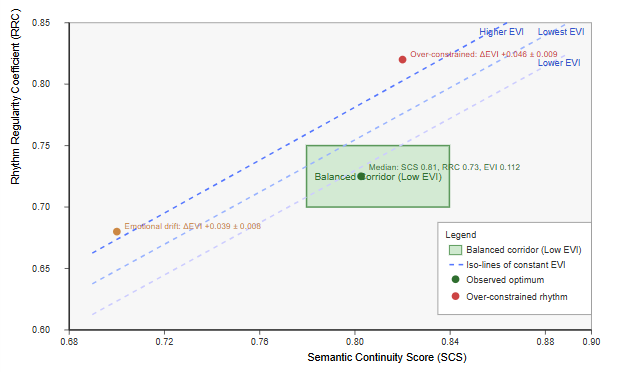
In Figure 1, the green "balanced corridor" estimates SCS∈[0.78,0.84], with RRC at [0.70,0.75]. Among them, the minimum EVI with the lowest stability (i.e., the best) is represented by the red dot, which indicates the failure mode: excessive constraint of the dynamic prototype rhythm in high RRC, and emotion drift in the elastic rhythm in low SCS. The dotted line represents
When conducting the Monte Carlo stress test (with 1,1000 samples drawn), 94.7±1.4% of the samples retained the robustness of the corridor, indicating that the interaction zone was not a sampling artifact but a joint response surface invariant.
6. Conclusion
This study established a computationally enhanced creative framework that can achieve the coordination between artistic intuition and platform-oriented precision. After five rounds of subtle iterations, the character prototype adaptively evolved, and the beat density was modulated to maintain rhythm consistency. It can model creativity as an iterative feedback process based on measurable parameters without affecting the authenticity of its expression. The proposed framework has practical value for large content studios and algorithmic distribution systems that pursue narrative innovation and operational efficiency. Future research may integrate multimodal signals, rhythms, facial expressions, and audience gazes, opening up new boundaries for the co-creation of intelligence between humans and algorithms.
References
[1]. Rosita, E. (2025). The process of creating short film works using hybrid animation techniques.Jurnal Desain, 12(2), 452-463.
[2]. Sifakis, G. P. (2021). Character Change in the Screenplay Text: The Semiotics of Writing and Analyzing Character. Bangor University (United Kingdom).
[3]. Berkeley, L. (2024). Between chaos and control: a practice-based investigation into the creative process of an improvised micro-budget screen production (Doctoral dissertation, RMIT University).
[4]. Arangot, S., MS, N., McDermott, O., & Panicker, A. (2025). Digital Twin-Driven SimLean-TRIZ Framework in Cold Room Door Production.Modelling, 6(3), 67.
[5]. Villena Toro, J., Wiberg, A., & Tarkian, M. (2023). Optical character recognition on engineering drawings to achieve automation in production quality control.Frontiers in manufacturing technology, 3, 1154132.
[6]. Schmidt, A., & Deppermann, A. (2023). On the emergence of routines: An interactional micro-history of rehearsing a scene.Human Studies, 46(2), 273-302.
[7]. Lee, T., & George, J. (2023). Future worldbuilding with synthetic biology: A case study in interdisciplinary scenario visualization.Futures, 147, 103118.
[8]. Malega, P., Gazda, V., & Rudy, V. (2022). Optimization of production system in plant simulation.Simulation, 98(4), 295-306.
[9]. Ferrari, F., & McKelvey, F. (2023). Hyperproduction: A social theory of deep generative models.Distinktion: Journal of Social Theory, 24(2), 338-360.
[10]. Medina, A., Bradley, R., Xu, W., Ponce, P., Anthony, B., & Molina, A. (2024). Learning manufacturing computer vision systems using tiny YOLOv4.Frontiers in Robotics and AI, 11, 1331249.
Cite this article
Xu,X. (2025). Micro iteration of character archetypes and beat density control in assembly line short drama production. Advances in Humanities Research,12(8),19-23.
Data availability
The datasets used and/or analyzed during the current study will be available from the authors upon reasonable request.
Disclaimer/Publisher's Note
The statements, opinions and data contained in all publications are solely those of the individual author(s) and contributor(s) and not of EWA Publishing and/or the editor(s). EWA Publishing and/or the editor(s) disclaim responsibility for any injury to people or property resulting from any ideas, methods, instructions or products referred to in the content.
About volume
Journal:Advances in Humanities Research
© 2024 by the author(s). Licensee EWA Publishing, Oxford, UK. This article is an open access article distributed under the terms and
conditions of the Creative Commons Attribution (CC BY) license. Authors who
publish this series agree to the following terms:
1. Authors retain copyright and grant the series right of first publication with the work simultaneously licensed under a Creative Commons
Attribution License that allows others to share the work with an acknowledgment of the work's authorship and initial publication in this
series.
2. Authors are able to enter into separate, additional contractual arrangements for the non-exclusive distribution of the series's published
version of the work (e.g., post it to an institutional repository or publish it in a book), with an acknowledgment of its initial
publication in this series.
3. Authors are permitted and encouraged to post their work online (e.g., in institutional repositories or on their website) prior to and
during the submission process, as it can lead to productive exchanges, as well as earlier and greater citation of published work (See
Open access policy for details).
References
[1]. Rosita, E. (2025). The process of creating short film works using hybrid animation techniques.Jurnal Desain, 12(2), 452-463.
[2]. Sifakis, G. P. (2021). Character Change in the Screenplay Text: The Semiotics of Writing and Analyzing Character. Bangor University (United Kingdom).
[3]. Berkeley, L. (2024). Between chaos and control: a practice-based investigation into the creative process of an improvised micro-budget screen production (Doctoral dissertation, RMIT University).
[4]. Arangot, S., MS, N., McDermott, O., & Panicker, A. (2025). Digital Twin-Driven SimLean-TRIZ Framework in Cold Room Door Production.Modelling, 6(3), 67.
[5]. Villena Toro, J., Wiberg, A., & Tarkian, M. (2023). Optical character recognition on engineering drawings to achieve automation in production quality control.Frontiers in manufacturing technology, 3, 1154132.
[6]. Schmidt, A., & Deppermann, A. (2023). On the emergence of routines: An interactional micro-history of rehearsing a scene.Human Studies, 46(2), 273-302.
[7]. Lee, T., & George, J. (2023). Future worldbuilding with synthetic biology: A case study in interdisciplinary scenario visualization.Futures, 147, 103118.
[8]. Malega, P., Gazda, V., & Rudy, V. (2022). Optimization of production system in plant simulation.Simulation, 98(4), 295-306.
[9]. Ferrari, F., & McKelvey, F. (2023). Hyperproduction: A social theory of deep generative models.Distinktion: Journal of Social Theory, 24(2), 338-360.
[10]. Medina, A., Bradley, R., Xu, W., Ponce, P., Anthony, B., & Molina, A. (2024). Learning manufacturing computer vision systems using tiny YOLOv4.Frontiers in Robotics and AI, 11, 1331249.