







1. Introduction
1.1. Background information
Historic towns generally refer to settlements with a history of more than one hundred years. In China, many such towns with profound historical and cultural heritage can be found across the country. These towns are physical manifestations of the urban identity, and their historical and social values manifest themselves as a form of unique spatial texture and architectural environment. These material elements constitute of traditional historic and cultural features and they breed unique identity characteristics and societal cultures. In these towns, people can touch history that have already passed away.
Protecting and preserving historic towns has far-reaching significance. in terms of cultural protection, a historic town is a living embodiment that showcases the development of civilization. To protect a historic town means to protect the creativity and talents from the last thousands of years – it means to protect the culture of these historic towns. Secondly, protection is a requirement for heritage conservation. As Shan Jixiang, Director of the State Administration of Cultural Heritage of China said, "For cultural heritage, protection is not an end, utilization is not an end. The real purpose is heritage." From the perspective of the local economy, protecting historic towns can optimize and adjust the structure of historic towns, broaden their functions, extend the industrial chain, and ultimately, improve the quality of life for remaining residents.
In China, the following principles are followed for the protection and renewal of historic towns: First, is authenticity. Liao [8] pointed out that in order to ensure the authenticity of culture and to protect the local spatial pattern, built environment, etc., one cannot subjectively create material spaces that do not belong to the place. Second, integrity. Gao and Ren [3] explained that integrity refers to the protection of traditional culture and the protection of spatial elements, which include natural features, patterns, streets and lanes of a historic town, as well as individual buildings. Third, continuity, Gao and Ren [3] emphasized that sustainability requires that protection and renewal measures conform to the expansion pattern of a historic town. New changes must focus on protecting its residents and maintain the original natural living state through protection and renewal. It is contingent on this, that a historic town can then meet the new needs of residents for their future life.
Although the protection of historic towns in China got a late start, many gains have been made thanks to continuous advancements with construction technology. As both central and local governments pouring financial support, many towns’ infrastructure have improved, as have the residential living environments. In this process, changes have been made to protect historic wooden buildings, improve street environments, the quality of town life, as well as promoting tourism, reports the Oriental Morning Post. At the same time however, there are also many disadvantages. At present, many historic towns are facing the risk of damage caused by over-development. Yang [17] noted that the rapid development of tourism in historic towns have brought unprecedented pressure on historic towns, largely manifesting in the oversaturation of tourism, over-visualization, and over-commercialization. In short, many cities regard the development of tourism services as an opportunity for economic growth. As a result, the number of commercial outlets has increased significantly, causing traditional styles to fade as new developments destroy existing spaces. One classic example is of the famous Lijiang historic town. Thanks to commercial over-development, the original historic town's atmosphere has been destroyed. As Zhang [21] said, using a blind approach when looking at the quantity, historical value, and revolutionary significance of protecting cultural relics, will end in the ignorance of the other values of the historic city. This mindset will lead to the obliteration of many unique features
This article chose to focus on the historical town of Anju as an example in the discussion of the protection and development of the public spaces in this heritage. As a historic town located in southwestern China, Anju has a long history, but it is still inhabited. Many residents still live here, and the site buildings are well-preserved. After a series of protective developments, Anju remains open to the public, attracting many tourists. The article will first discuss and summarize the development process, the significance and direction of China's public space as well as existing problems to be solved. Then, the article will analyze the status quo and existing protection methods implemented in the Anju Historical Town. We address these combined with on-site questionnaire surveys, and finally, explore ways to reasonably protect and develop the current public space of the historic town.
1.2. Research aim
The aim of this research is to discuss how to protect and develop the public spaces of historic town in the context of current historic towns protection in China.
1.3. Research questions
This research will focus on two main questions among public spaces in historic towns in china:
1. In China, what is the significance of the development of public spaces to the residents and tourists?
2. What are the missing parts in the public space development of Anju HistoricTown? How can it be designed and developed?
2. Literature review
Introduction
This chapter will introduce existing strategies of protection and development for historic towns in China and discuss the contradictions and conflicts that occur when balancing these strategies and the maintenance of the historic towns' original features. Then, we focus on the strategy employed for public space protection in the WuLongPu Historic Town in Yunnan Province as an example to discuss existing models for public space protection and development of historic towns.
2.1. The protection of historic towns in China
2.1.1. The strategies for protection and development of historic towns in China
The Regulations on the Protection of Famous Historical and Cultural Cities and Famous Villages as promulgated by the State Council posits that the protection of historic towns should follow the principles of scientific planning and strict protection, maintain and continue their traditional patterns and historical features, and maintain the authenticity and integrity of historical and cultural heritage [3].
Strategies for the protection of historic towns in China are largely centered on the protecting historic town dwellings and the physical context. These historic buildings can reflect not only the way people used to live and the artistic preferences of that time but also signify an important marker of a certain era’s civilization and culture. Today, many of China’s remaining historic residential buildings are privately still in use. The majority are changed or renovated at will due to the lack of systematic guidance. As a result, many 'protected’ historic houses are just superficial imitations, losing their original historical features [1]. Therefore the protection of historic Chinese dwellings should focus on retention of authenticity and restoration of details and scales. Generally, the restorations should focus on the following rules: (1) Protecting “Inheritance”: A building’s traditional culture should be retained and protected, studied and evaluated. (2) Restoring details to the greatest extent and preserve the building’s authentic historical atmosphere. (3) Using targeted plans for protection and restoration of each historic house, and formulate restoration methods based on the degree of preservation of each building. (4) Improving relevant policies and regulations on the protection of historic homes. (5) Enhancing citizen awareness on the importance of protecting historic residential buildings and inheriting/passing on traditional culture [11].
At this time, the government is also employing different strategies for the protection of the physical context. These include context integration, context juxtaposition, and context continuity [14]. The “context” here referred to is of urban forms such as streets, alleys, archways, religious holy sites, and other spaces that were formed in history as a complete expression of architecture and urban imagery [16]. Future such strategies should strengthen the excavation and research aspect of historic towns and their strongly embedded value systems in traditional culture. Ultimately, these strategies should focus on combining the protection of physical contexts for display purposes and to pass on down to future generations.
Existing strategies for development of historic towns are mainly focused on the development of tourism and the protection of historic towns' residential and cultural heritage. These have laid a good foundation for the development of tourism. In this sense, the overarching strategies are as follows: (1) To cultivate the natural environment such that it integrates into the historic town's scenery and citizen life. (2) To optimize the design of existing land-use layouts and rationally work towards clear spatial viewing corridors. (3) To retain the residents' living and working patterns. (4) To fully explore the connotation of historical context and create a strong scenic atmosphere [10].
2.1.2. Existing problems in the protection of historic towns in China
At present, there are still many problems with the way historic towns are protected. (1) There is too much of a focus on protecting as many heritage as possible, removing limitations on the scope of what buildings are protected. Many restrictions focus on limiting building height, size, and architectural style. (2) Developers hold contempt for protecting cultural heritage, especially when considering its customs and surrounding environmental protection methods. (3) The growth of historic town tourism has also brought about many adverse effects, such as destructive development and construction. Heritage differs from tourism in that it is non-renewable. In only considering economic interests as an end goal, the priorities are instead pinned on tourism as opposed to heritage protection. Commercialization caused by the excessive pursuit of developing tourist attractions has led to the loss of traditional lifestyles and customs native to historic towns. (4) Historic towns do not exhibit any form of local characteristics nor a unique “business card”, likely due to a lack of overall reasonable assessment of the towns themselves. (5) There is no implementation of tourism management. Some historic towns place no restrictions on tourism and fail to control tourist behavior, leading to severe damage to cultural heritage.
2.2. The protection and development of public space in Chinese historic towns
2.2.1. The protection status of public space in historic towns in China
No unified standards or norms exist for the protection and development of public spaces in historic towns in China. Take WuLongPu Historic Town for example. This traditional Chinese town in Yunnan Province in Southwest China, focused the development of its public space around the locals’ daily life needs. The town focused repairs on addressing the issues of over-fragmented areas and improperly-used public spaces. As a result, renovations were centered on digging out and rebuilding the entire street layout that was established on the daily routine of local residents. Demands in tourism naturally assisted in the continued development as needs evolved, making it such that public areas, green spaces, bodies of water and leisure spaces also meet the needs for tourist sightseeing and resting purposes. This has also encouraged residents to participate more in activities in the public space, increased their use of space, and helped foster a culturally-rich public space [7].
2.2.2. Existing strategic problems
Existing protection strategies for the public space of historic towns are focused largely on balancing the protection and development of towns whilst meeting the needs of residents and tourists. However, this form of protection is relatively one-sided, often lacking deeper integration into the local fabric. As a space with a relatively high utilization rate, public space can handle a greater variety of functions for residents and tourists alike. For example, using its public platform, the space can be amply used to spread cultural awareness of the town’s customs, lifestyle and cultural heritage of local residents to curious tourists. At the same time, this space can also act as a communication platform between residents and tourists. Visitors can feel and experience life in the historic town from the perspective of its residents.
3. Public space in China
Introduction
This chapter will introduce the history of the evolution of public space in China. Through this section, we highlight the importance of public space for residents and tourists as well as the functions and responsibilities that public spaces in historic towns can undertake in the protection and development of their spaces.
3.1. The evolution of public space in China
The spatial formation of any human settlement will inevitably be affected by the time's political, economic, and cultural aspects. Before the Song Dynasty, both the government and the masses lacked an overarching management of public space. The populace typically lived in large family settings with part of that space being divided into public spaces for familial purposes. These spaces were formed to satisfy various family activities such as gatherings and sacrificial rites. Meanwhile, the rest of this public space often formed in a spontaneous fashion: a meeting place established spontaneously by residents through conventions, or a space where people could exchange information and materials. Wu [15] showed that the Song Dynasty was the period when urban public space reached a finalized form in China. As the economy developed, people's material needs increased, and they were no longer satisfied with simply family-based internal activities. At that time, the government allowed residents to set up shops and businesses. As a result, private spaces along the street were opened to the masses, resulting in the formation of shops. The rate of utilization and multiple street functions allowed these spaces to rapidly become the main location for public space. At the same time, open areas such as riverside spaces and temple squares became open areas aimed at meeting resident needs for transactions, communication, leisure, and entertainment.
After the founding of the People's Republic of China, the government began to conduct a more standardized management of all regions. Zhang [20] concluded that as the economy developed and Western design concepts took root, the government increased investment in the construction of public green spaces and squares to improve the living conditions of its residents. During this period, the mobility of the population had also vastly increased. People no longer lived in groups fully dictated by family. As family-based activities lessened, the demands for family-centered public space weakened. In time, the government improved in its awareness of standardized control of space and began to create public spaces with communities as base units. Thus, public space and their functions have increasingly become more diverse.
Generally speaking, China's public space grew from essentially not existing, to gradually transforming from spontaneous composition into orderly, rational planning. People are slowly beginning to pay attention to the quality and function of public space. This same shift and change can be seen in the public spaces of historic towns. Wei et al. [13] stated that the shift from a focus on private space to the increased demand for public space is a sign that the modern small family model has replaced the traditional family model. The public space not only carries the original functions, but also inherits the functions transferred from the private space.
3.2. The importance of public space
As the German social theorist Hamabeth once mentioned: "The purpose of public space is to establish an order." The existence of the public space in a historic town offers the systemic functions of exchange, guidance, power, and passage. Li [6] explained that The market mainly represents a public space used for exchange. It is an important space for this function – changing the original chaotic channels into an orderly and fair space, that can facilitate the exchanging of information and goods. Public spaces that play a guiding function, as represented by gathering places, allow individual behaviors in large activities to become more organized, restrictive, and guided. The public space, as a symbol of power, is more representative. It allows the class in power the authority to restrict other classes and is an important space to maintain social order. The function of the transit space is most closely related to people's lives and establishes the order of the public need to travel. In conclusion, once a public space is established, order will enforce its regulation and maintenance.
3.3. Significance of the development of public space in historic towns
Having inherited the traditional family gathering system, the original function and scale of public space cannot fully adapt to the requirements of modern societal life. As a result, it is particularly crucial to look closely when planning the development of public spaces in historic towns. Li [6] concluded that the formation of historic town functions is a dynamic process that continuously adapts to people's changing needs for public space and social order construction. As such, it follows that the development of public space in historic towns should also follow this rule - seeking a balance between the humanization of space and orderliness. At present, the historic town not only serves the function of being a residence for its locals, but also has another vital role as a tourism resource. Therefore, a reasonable development of public space must look both at avoiding affecting the residents’ activity space but also work the public space such that it might guide tourists. Ideally, renovations should allow tourists to become more integrated into the historic town, experience its vibrant town life, and enhance the sense of interaction between residents and tourists. One way to assist in this process is to actively implement modern technology.
This will not only facilitate the daily life of the residents and the travel experience of tourists but also set a precedent for the long-term maintenance of the historic town. Developing and protecting historic towns and their public spaces can help the entire town adjust and optimize its layout/structure, broaden town functions, extend the industrial chain of the local economy, and increase the income of local residents. It can also promote the collaboration of, and increase interaction between urban and rural areas. Tourists from the city espouse political, economic, cultural, and consciousness information of the modern city to the historic town. In this exchange, local residents can choose to accept concepts of modern consciousness and customs without having to leave their towns and improve the quality of their town. Such developments can also lead to the excavation, protection and inheritance of town culture. This would allow for the uplifting, development and conscious action to promote the historic town and contribute to local cultural camaraderie.
4. Anju Town – case study
Introduction
In the following section, the content elaborate on this through an overview of the town by covering its historical background, distinctive culture, and current status of its public space. Using a questionnaire survey run on residents and tourists about their views on the town itself and its use of public space, gaining a clearer understanding of Anju`s planned direction of development for public space.
4.1. Brief overview
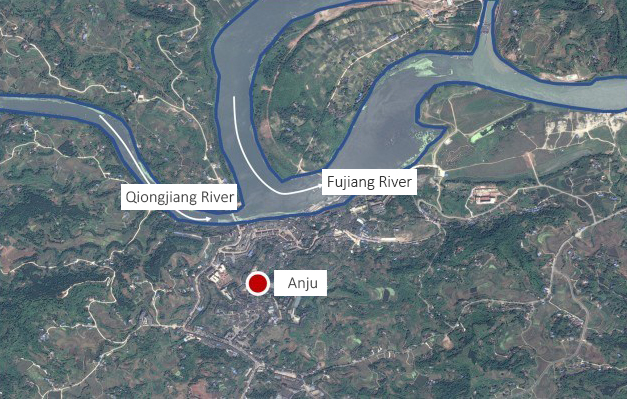
Anju historic town is a famous historic and cultural town in China, rated a national AAAA-level scenic spot which is the second most important level in a five-level grading scale of tourist attractions in China. Anju has a permanent population of 12,000, with an area of about 1.5 square kilometers in size. The town is situated sixty kilometers away from Chongqing City, and located on the southern banks of where both the Qiongjiang River and Fujiang River meet. Thanks to convenient land and water transportation, there are many tourists on holiday that swarm the area (see Figure 1 for the location map). The historic streets and lanes in the Old Town district – some of which are more than 1,000 meters long – are mainly divided into three sections, with two or three-storied high traditional wooden structures on both sides (built of wooden structures and blue tiled roofs). At present, the ground floors are
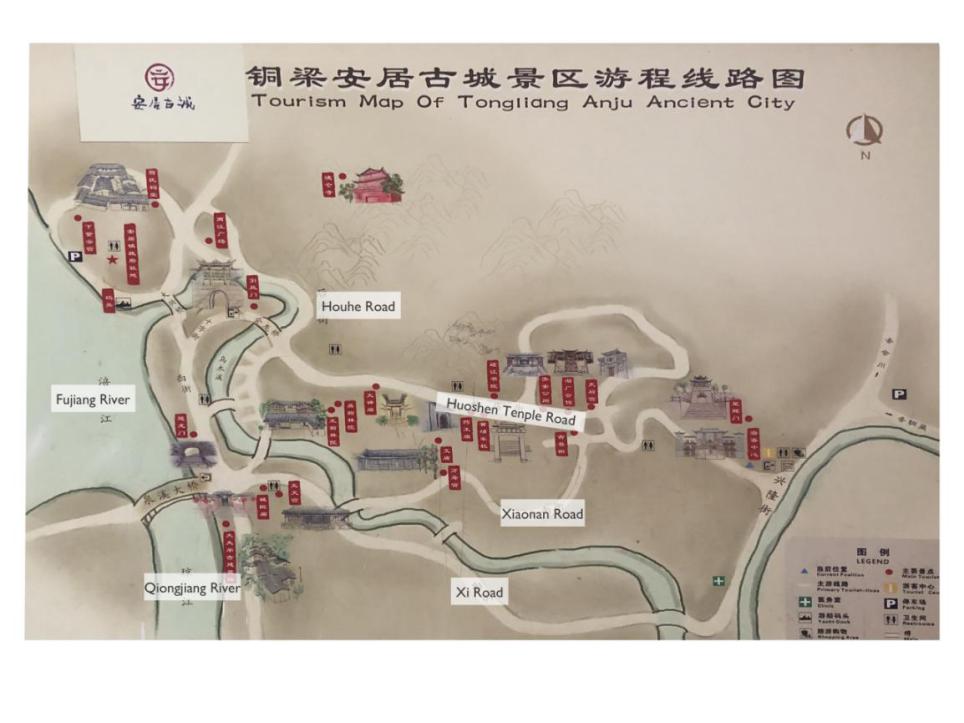
largely used for shops, while the second and third floors are living spaces. One particular section of the street faces the river with an open view. The relatively well-preserved old streets are located in Huilong Street, Huoshen Temple, and Danan Street (see Figure 2 for the plan of Anju). The houses, temples, and ancestral halls on both sides were built in accordance to the mountainous terrain. Besides these, there are two residents' activity squares in town, where a series of activities are often held during traditional festivals.
4.2. Historical background
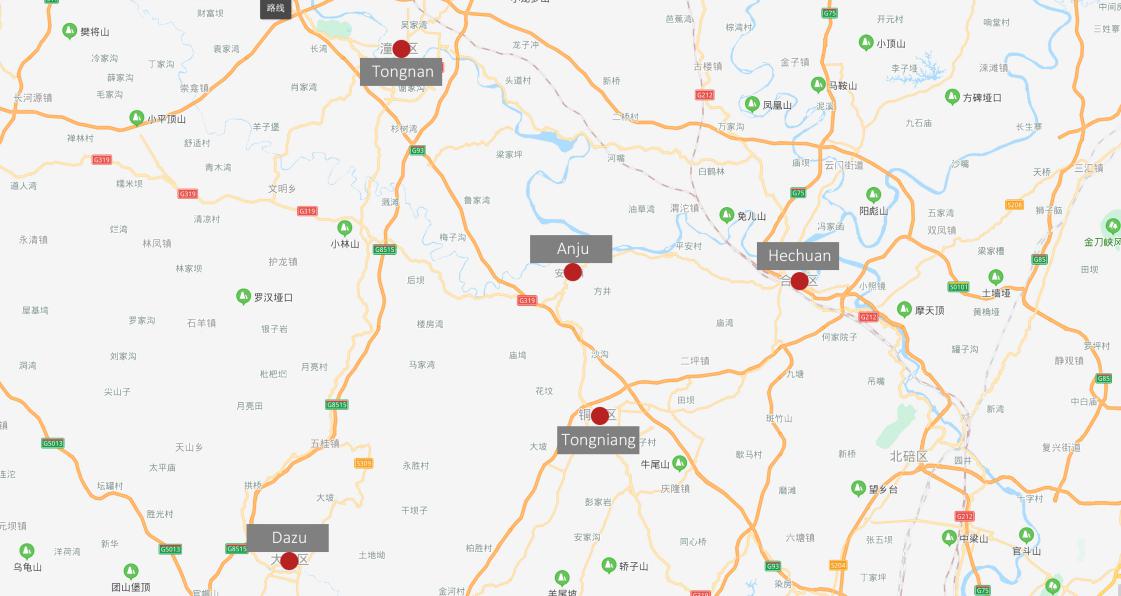
The first human settlements at the site of Anju were developed as early as 4,000 years ago. Anju Town, as it is known today, was founded in 504 AD. In the magazine Hongyan Spring and Autumn, He [5] introduced the town as the material distribution center for the Tongliang, Dazu, Tongnan, and Hechuan districts in the early Ming Dynasty, as shown in Figure 3. Silk, rice, linen, and sugar produced by Anju were transported by waterways and sold in eastern Sichuan Province and in other coastal areas. In the Qing Dynasty, merchants from historic towns gathered in Anju, making the city an important commercial hub with a prosperous economy. Merchants and immigrants from all over the country built halls in the city. At the time, these guild halls were used as public buildings and for the gathering of migrant residents. One such case, was the Huguang Guild Hall. This theater building hosted a stage inside and was fitted with grandstand seating on three sides. The whole hall was spacious enough to accommodate more than a thousand people in a meeting setting. Thanks to a bustling and varied religious scene in Anju, large numbers of palaces and temples were also constructed. In the past, it was not easy for the historic town to have 9 palaces and 8 temples. But Anju has 9 palaces and 18 temples , making it an architectural miracle in a historic town.
4.3. Features of Anju Historic Town
4.3.1. Folk customs/cultural characteristics
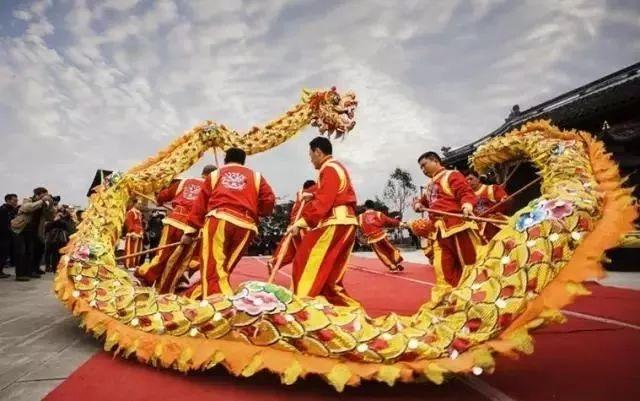
Historically, Anju was a center of merchant activity, and had a prospering economy. In the thick of it, many local customs and cultural heritages were formed. In Yang’s [18] telling of local history, Anju saw a wave of major in-migration when Huguang residents moved to Chongqing in Sichuan Province during the Qing Dynasty. Migrant culture and local culture collided and merged, forming unique festivals, local dances, unique farming techniques, a culture of water transportation, and various religious cultures. This rich and diverse cultural heritage was passed onto future generations. Today, Anju Historic Town still hosts various activities for a great variety of traditional festivals and holidays including but not limited to the Dragon Boat Festival, Temple Fair, Guanyin Fair, City God Fair and more,as shown in Figure 4. The locals celebrate festivals and pray for a happy life.
4.3.2. Intangible cultural heritage
In addition to its local folk customs, Anju Historic Town is also home to various intangible cultural customs including colorful festivals, folk music, folk dances, and folk handicrafts. Fu [2] explained that from the perspective of tourism development, Anju Historic Town can organize its intangible cultural resources into categories as shown in Table 1. Some of these are performing arts-based, such as: dragon boat, dragon dance, Sichuan opera, Fujiang horns, and other similar performances. Others are folk handicraft activities that tourists can participate in, such as bamboo weaving, embroidery, and carving.
4.3.3. Architectural characteristics
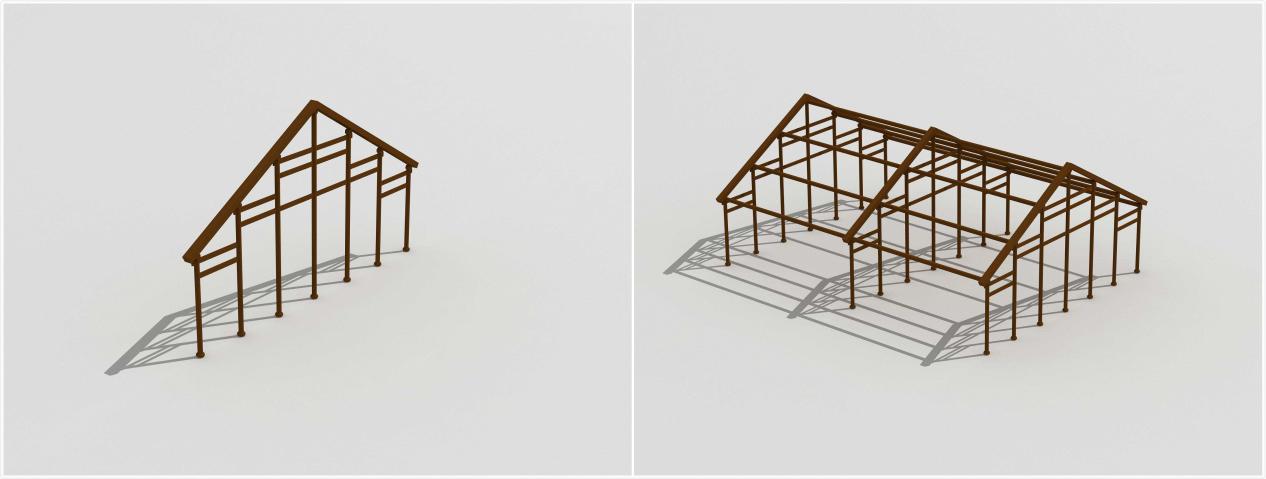
The western Sichuan-style of architecture dominates residential design in this historic town. This can be best summarized as a style composed of wooden buildings with sloped roofing and a unique “bucket-style” structural characteristic. Wang and Xu [12] showed that this combination of architecture and Sichuan’s unique topography is emphasized in the site selection layout compared to other traditional “broad, large, straight” types of structures elsewhere in the country. This unique “bucket-style” building characteristic refers to a row of columns erected along the length of the house, where each column is equipped with a purlin and rafter. The weight load from the roof is thus distributed from the purlin onto the column. Finally, a frame is formed through an addition of horizontal rows. Doufang and xianzi are then used to connect to the frame to establish the home’s spatial structure. This can be seen in Figure 5. The roof is composed of a blue-tiled sloping structure, which is adapted to the local humid and rainy climate. Here, the “historic” aspect of the town’s cultural heritage can be profoundly observed through its unique architectural structures.
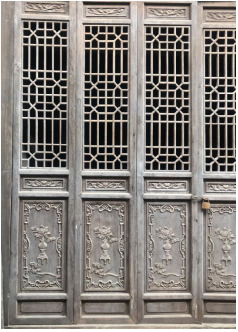
When walking down the streets of Anju Historic Town, it is clear that many homes share very similar architectural structures. However, their door panels are frequently different, as shown in Figure 6. This is because in Anju, the door is a symbol of family wealth. Many families pay special attention to the carving of their home’s door panels and taken pains to carefully preserve them. Some of these door panels are reflective of religious beliefs, family symbols and stories. Historically, the local demand for highly diverse iterations of door panels was the impetus for the birth of local woodcarving techniques. Today, we can see its effects through the different patterns on each door.
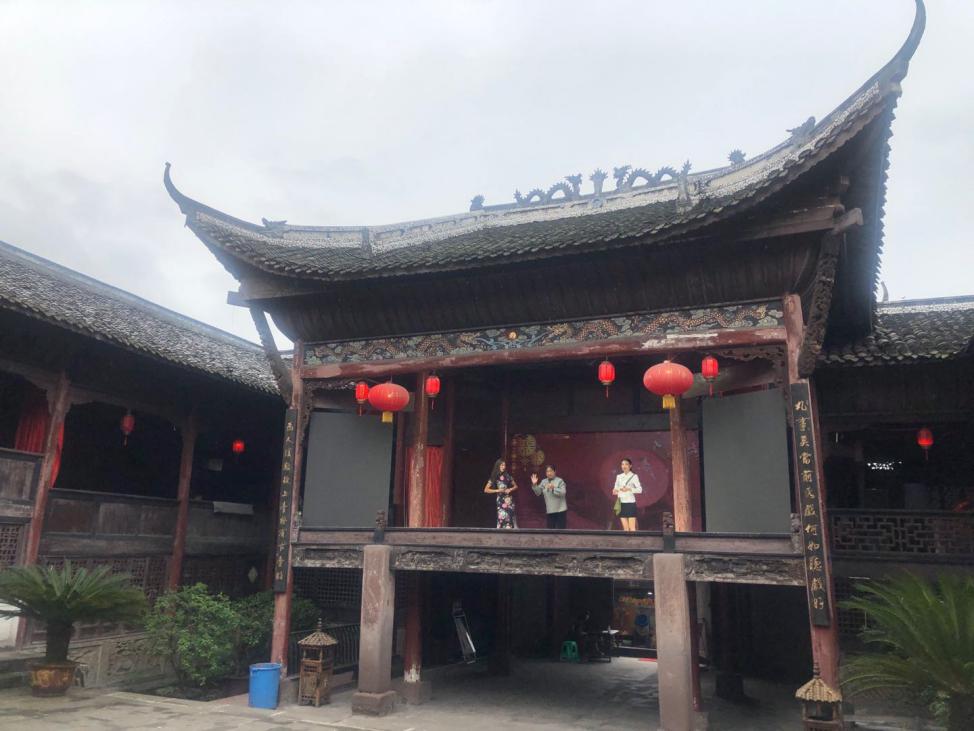
The inflow of new culture brought by an immigrants historically is not only reflected in Anju’s customs but also in its rich architecture. This is most prominent when observing the "Nine Palaces and Eighteen Temples". These palaces and temples are not only a form of architecture but also the embodiment of folk culture. One example is the Huguang Guild Hall, located along Huoshen Temple Road (see Figure 7 for Huguang Guild Hall). Built in the middle of the Ming Dynasty, this hall underwent reconstruction and repairs after destruction from wars and fires. It is a well-preserved
form of historical heritage. In the hall today, there is a renovated stage where the stage once stood that is used for performances by local actors. There is also a replica of a teahouse that is used as a venue for tourists to consume. Through this, we can observe that Anju’s rich and distinctive historical heritage can be both preserved and partially used as an attraction for tourism after being protected or repaired.
|
Category |
Content |
|
Performing Arts |
Dragon dance, Sichuan opera, Pingshu |
|
Arts and Crafts |
colourful craft, Wood carving,stone carving, bamboo weaving |
|
Folklore |
County magistrate tour, rowing dragon boats, Chinesetraditional festival activities,make rice dumplings |
Note. Fu Kunlun. An Analysis ofthe Development Strategy of Cultural Tourism in historic towns--Taking Tongliang as an Example [J. Journal of Chongqing University of Science and Technology (Social Science Edition), 2015, 000(010):P.100-103
4.4. The status quo of public spaces and their protection strategies
Originally, the public spaces of Anju Historic Town were vibrant. In addition to the streets and squares, there were also various halls for residents' activities. However, as tourism overtook the historic town of Anju, these guild halls were gradually transformed into places for tourist consumption. Many spaces were transformed into teahouses and restaurants, causing residents to shift their gathering spaces to the outdoor squares. At present, the town’s public space mainly undertakes the two functions of passage and gathering. Passage-functioning spaces are closely related to local residents' daily activities as well as tourist routes. The roads of the historic town of Anju are largely in good condition, being mostly made up of stone pavement. Anju has three main streets in its historic district, which link up with the historically rich buildings of the area. This too, helps in the proliferation of tourism. Gathering spaces here are mainly composed of two squares in the historic town, which undertake the crucial functions of acting as a space for resident community activities and tourists immersing themselves in the historic district’s traditional projects.
The protection strategy for Anju Historic Town is the same as that for Chinese historic town, focuses largely on building protection and tourism development. However, the protection strategy regarding public space is far from perfect. The strategy focuses on dividing the passage-functioning space and regulating the size and function for businesses. The stores typically sell local snacks, specialty products and cultural, creative products. Restaurants and hotels are re-centralized with larger shops on Anju’s West Street. Resident and tourist activities spontaneously form the function allocation of the town’s square. In Anju, it is not uncommon for tourists experiencing the town ending up as an interference to residents’ daily activities. As a result, there is a lack of orderly management of the public space.
4.5. Data collection
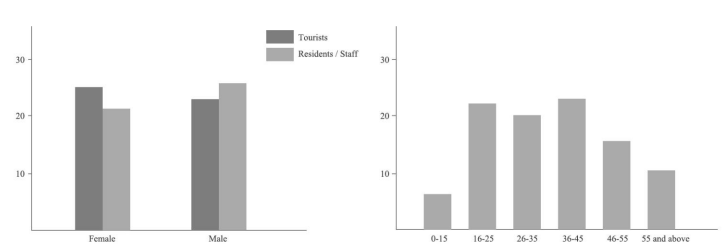
To better understand the different opinions of tourists, residents, and employed staff on the life and use of public space in Anju Historic Town, adopting a questionnaire survey. The questionnaire was randomly distributed to tourists, residents, and staff throughout August of 2020. For information about the sample questionnaire, please refer to Table 2, Part of the scanned copy of the questionnaire is translated in the appendix.
The general idea of the questionnaire survey was to divide the respondents into two categories: tourists and residents or employed staff. Using multiple-choice questions as the main form of questioning, collectiong their overall impression and dissatisfaction with the state of historic towns in China, and their impression of Anju as a historic town. Other questions aimed to capture experiences, opinions, as well as the activities participants typically conducted in the public space and finally, their opinions on how to improve the status quo use of the public space. Using findings from the questionnaire survey, summarizing the thoughts of tourists, residents, and employed staff about historic towns in China and specifically regarding Anju as well as their public spaces. Finally, providing ideas for the potential ways to improve protection and the development of the public space of Anju Historic Town.
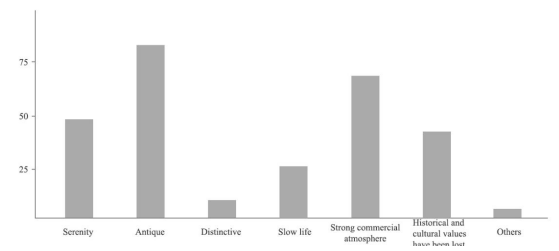
1. The over-commercialization of historic Chinese towns has led to the loss of their characteristics, leading to tourists developing a relatively singular overall impression of historic towns as a whole. Nearly 85% of the interviewees agreed with this statement, as shown in Table 3. It is worth noting that nearly 70% of them, however, also chose the option of having a strong commercial atmosphere and destroying the original atmosphere of the historic town. In response to the question of what is unsatisfactory about the development of historic towns (Table 4), 75% of respondents chose "over-commercialization, opening a large number of shops, restaurants, hotels, and bars". At the same time, nearly 60% of people find that there is no way to
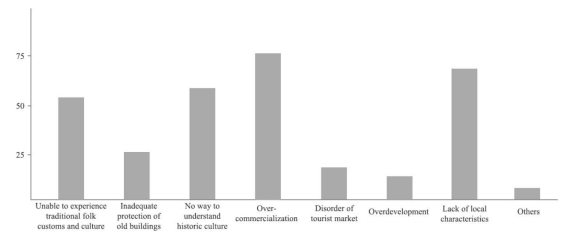
understand the history of tourism's historic town. Nearly 55% of survey-takers also believe that there is a lack of experience in traditional folk customs, culture and other characteristics. In recent years, tourism in historic towns have boomed as they became popular spots for short-distance travel. The development of historic towns across the country tend toward the development of commerce, focusing on attracting tourists to consume and drive the local economy. However, they have neglected to protect the towns’ local characteristics and lack thought on the development and dissemination of distinctive local culture. This gradually ends with the overall impression that "historic towns are all the same" to the public – something very detrimental to the long-term development for tourism of historic town.
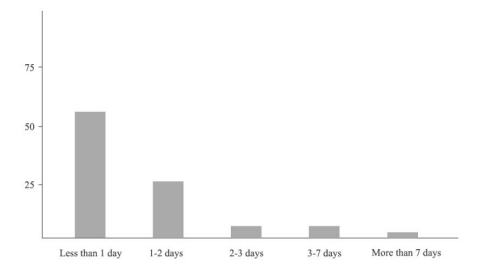
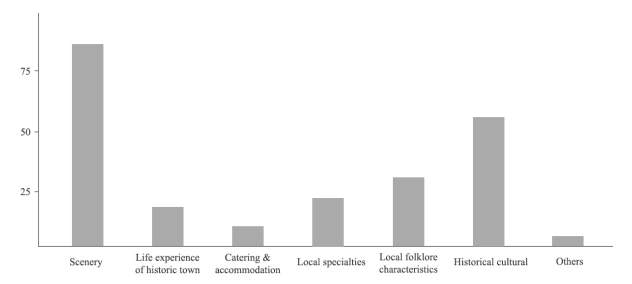
2. The development of tourism resources in Anju Historic Town is promising. Tourists in Anju are largely composed of short-term tourists (Table 5). 60% of tourists plan to travel less than one day, and 28% of tourists plan to travel for 1-2 days. When surveyed, tourists find the scenery, culture, and folklore beautiful. When asked about what is the most attractive aspect of historic towns (Table 6), nearly 90% of tourist respondents chose the option of "Historic Town Scenery", while 60% also chose "historical culture" and 31% chose "local folklore characteristics". Anju Historic Town retains many of its traditional buildings. Combined with its mountainous terrain, natural waterways, and sleek street design, the overall landscape is beautiful. The local Bashu culture is also attractive to tourists. However, when asked about what was an essential aspect of the town that could use improvement, interviewee A said that it was difficult to find an introduction to the historic town's traditions during the tour, and there was a lack of detailed introduction to several unique historical attractions. In short, there is a pervading feeling of "pointlessness" throughout their travel.
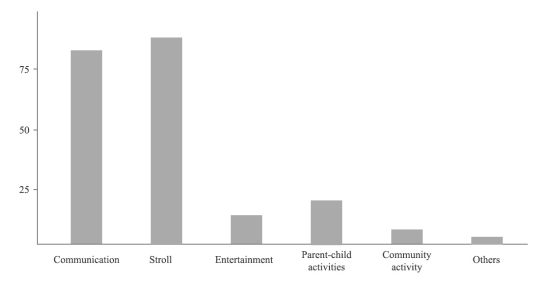
3. The life of the residents in Anju Historic Town is comfortable, and neighbors live together harmoniously. However, the residents' activities in the public space of Anju Historic Town are relatively simple. 84% of residents said that the activities in the public space in the historic town were centered on neighborhood exchanges, while 92% of residents said that walking was their main activity in public spaces (Table 7). In contrast, the residents who chose entertainment, family and community activities numbered less than 20%. Regarding their expectations for public space use in the historic town, many residents interviewed said that they needed more space for community activities, such as chess and card games. Still other residents with children also expressed their hope that there would be spaces for children to play safely. One of the staff B interviewed said that the characteristics of Anju Historic Town are challenging to display. There is a risk of losing history through the generations among residents, and tourists lack ways to gain access to understanding local history.
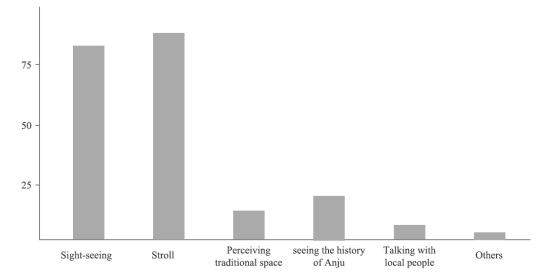
4. The activities of tourists in public space are singular. More than 90% of tourists said that the activities in Anju Historic Town's public space were focused only on landscape tours and photography (Table 8). When asked their opinions about public space in Anju, many tourists said that there was no space to sit and rest, or for laidback communication/interaction. interviewee C said that they wanted to find a place to experience the history, culture, and tradition of the historic town in-depth while traveling. Others felt that historic towns did not meet their expectations and expressed an interest in experiencing more. Some respondents wished to learn more about the platform of the historic town. And interviewee D expressed the hope that the tourist experience activities in the historic town can be more authentic, rich, informal, and full of fun, that could truly show the unique charm of the town itself.
5. Discussion
Introduction
This chapter will discuss the results of above research, combine this research with existing literature, and discuss the three directions in which protection and development of the public space in Anju Historic Town can move towards to fully realize its maximum value.
5.1. Overall evaluation of the protection and development of public space in Anju Historic Town
The Anju Town Government's protection strategy is complete and orderly, but is far from perfect. The existing protection strategies are mainly aimed at the protection of historic town buildings, the creation of a historic town atmosphere, and the development of tourism resources. However, based on existing protection strategies, it is clear that a number of issues remain with the protection and development of public spaces. The protection of public spaces in historic towns should not simply take on the form of renovated streets but also have in the re-development of spaces for public activity. The case of Anju shows a lack of focus on the creation of cultural heritage, shaping of distinctive local features, and the improvement of the quality of the local residents' living environment.
5.2. Combine the improvement of landscape quality with the protection and development of public spaces
The improvement of the human-made landscape in Anju Historic Town is dominated by historical buildings, giving full play to the historical architectural resources. In addition to this, though the streets and lanes were renovated, the road was intentionally renovated to appear as old as possible in order to maintain the “historic” atmosphere. In the protection and development of public space, landscape enhancement is also an important step. These all must properly integrate user experience in order to truly meet the different needs of both residents and tourists. In reviewing the data collected by our survey, it is clear that residents need a comprehensive living and interactive space, while tourists need comfortable rest sapce. It is particularly important to create a space for interaction that is inclusive of nature in the promotion of human-made landscapes. In order to allow residents to harbor a sense of security and comfort in an activity-centered space, it is imperative to activate the popularity and atmosphere of the region. In response to tourists' needs, the public space also should be equipped with both comfortable resting spaces and communication-oriented spaces.
Therefore, enhancing the landscape of public space can be done in such a way that it meets the needs of residents and tourists, and can also incorporate the unique architectural features of local homes as mentioned above. For example, one could consider building a pavilion with local architectural characteristics in a public space where residents can communicate or engage in various entertainment activities. Such public facilities could both shelter individuals from wind and rain and also provide residents with a more comfortable space for activity. Additionally, tourists can also rest here and use it as a platform for communication with residents to better authentically experience life in the historic town. Finally, the design of this rest space can also utilize the unique carving craftsmanship local to Anju. Current dull-looking seats can be turned into landscape sketches rich with depictions of the town, adding more visually interesting details to the space and increasing tourist interest in remaining outdoors.
5.3. Combine the cultural heritage with the protection and development of public spaces
Anju is rich with local flair, home to a variety of cultural activities, and intangible cultural heritages. Future development can focus on giving these aspects suitable space to flourish by combining them with public spaces so that tourists can truly experience Anju Historic Town's local charm. Different thematic cultural activities can be held, such as dragon boat competitions, dragon dances, or providing options to experience the production process of intangible cultural heritages such as wood carving, embroidery, and local cuisine. Visitors can watch and join in. Staff can offer simple courses to visitors, giving them a chance to complete these traditional activities with locals. By giving tourists a greater chance to participate and experience the charm of cultural heritage firsthand, they too can better understand and appreciate the locals' love for their town.
According to the questionnaire survey, many tourists found that they lacked an opportunity to learn more about historic towns. Although they know that Anju was a historic town with a rich history and culture, the lack of culturally-relevant displays and features prevented them from gaining a more in-depth understanding of the town.
Cultural offerings can utilize public spaces to further improve their range by setting up outdoor exhibitions that can reflect upon local history, culture, humanities and arts, folk customs, and local customs. Various characteristics of the historic town can be promoted according to different themes. Adding more informational stopovers can both attract and better inform tourists, giving them the opportunity to understand local history and context in greater depth. Alternatively, launch photography activities so that both residents and tourists can actively participate. The residents' understanding of the historic town can provide more tourists with tourist information points. The freshness of tourists to the historic town can also help residents discover local beauty.
5.4. Combine the development of historical and cultural tourism resources with the protection of public spaces
Anju has a wealth of tourism resources. However, without scientific and reasonable planning, the potential of the historic town remains untapped. Just as many historic towns give tourists the same impression, Anju, too, lacks distinctive local features. The cultural atmosphere remains weak, and the lack of a local spin on its tourism marketing and presentation make its development of future historical and cultural tourism resources unfavorable. In the Journal of Chongqing University of Science and Technology, Fu [2] posits that, in order to shape cultural themes and form a cultural industry chain, distinctive cultural themes are, without question, the face and “business card” of historic town tourism. Anju’s Tourism Bureau should comprehensively evaluate its cultural characteristics, combine it with characteristic handicrafts, form a cultural brand, and use TV and online advertising to promote these effectively. Next, they must then re-structure the business model and revitalize the service industry, allowing for the old street to transform into a commercial pedestrian street. The shops, service facilities, family hotels, and specialty restaurants will naturally pan out to enhance the economic vitality of the old street and increase the tourists’ expected duration of stay.
If this is done in combination with well-designed public space, one can obtain double the result with half the effort. Efforts should be made to improve the “guidance” function of public spaces. This can take the form of setting up simulation experience spots in public spaces with high traffic such as roads and squares. Make it an important node of characteristic tourist routes, and create characteristic tourist routes belonging to Anju Historic Town. Multiple spots and tourist routes can be designed with different characteristics. For example, one such idea could be to create an experience-based route for migrant culture, giving full play to the actual use value of "Nine Palaces and Eighteen Temples". One stop can include the stage of the Huguang Guild Hall, where a performance might be organized to explain the historical and cultural background of the palace temples, and show re-enactments of what life might have been like in the past. This would allow for a much more enriched tourist experience. It can also be combined with folklore activities in public spaces to create a tourist route for folklore experience, allowing tourists to experience the rich folklore culture of Anju Historic Town.
6. Conclusion
This paper looks to Anju Historic Town as an example, analyzes its characteristic cultural traditions and the shortcomings of its existing protection strategies. By collecting the views of local residents and tourists on the town’s use of public space, our paper then discusses how to develop and protect Anju’s public space. In the context of the booming “rejuvenation” economy focused on the protection and tourism development of historic spaces, it is important to re-center on meeting the needs of residents and tourists. To do so, future efforts should focus on combing the protection and development of public spaces with the development of tourism resources and the improvement of landscape quality. This would not only improve the overall quality of Anju Historic Town but also create a more distinctive tourist “business card”. Looking forward, exploring more comprehensive protection and development strategies would be imperative to finding applicable, appropriate ways to address the existing development model of public spaces in historic Chinese towns and helping them form unique characteristics.
References
[1]. Fu J., (2005). Explore the protection and development of ancient towns in China [J].China Economic Weekly, 000(003), pp. 20-24
[2]. Fu K., (2015). An Analysis of the Development Strategy of Cultural Tourism in historic towns--Taking Tongliang as an Example [J].Journal of Chongqing University of Science and Technology (Social Science Edition), 000 (010), pp.100-103
[3]. Gao J., Ren A., (2013). Discussion on strategies for protection and renewal of historic towns [J].Theoretical Research on Urban Construction (Electronic Version), 000 (008), pp.1-6
[4]. Habermas, J., (2015). The Structural Transformation Of The Public Sphere. [Place of publication not identified]: Polity Press.
[5]. He Z., (2016). Anju historic town [J].Red Rock Spring and Autumn, 000 (007), pp. 81
[6]. Li b., (2014). Research on the Function of Historic City from the Perspective of Public Space--Taking "Historic City of Qianyang" as an Example [J].Architecture and Culture, 000(010), pp.161-169
[7]. Li Y., Liu Q., and Zhai X., (2020). Research on the protection and renewal strategy of the public space of historical villages from the perspective of daily life: Taking Wulongpu Village in Yunnan as an example [J].Urban Architecture, 017(003), pp. 7-11
[8]. Liao K., (2015). Historic town Protection Theory and Requirements [J].Journal of Southwest University, 000 (009), pp.13
[9]. Oriental Morning Post, (2015). The status and model of the protection and development of ancient cities and towns in China. Oriental Morning Post.
[10]. Sun Y., (2006). Discussion on the protection strategy of historic towns [J].Science and Technology Information,000(011), pp.236, 167
[11]. Tang R., Tang C., (2009). Preliminary Study on the Protection Strategy of Ancient Chinese Houses [J].Decision and Information (first issue),000(003), pp. 87-94
[12]. Wang X., Xu T., (2017). Research on Space Reconstruction Based on Chongqing Bucket Building [J].Shanxi Architecture, 043(035), pp. 4-5.
[13]. Wei Y., Gao W., Lin C. and Luo H., (2012). An Analysis of the Protective Renovation Planning of the historic town Public Space—Taking Heping historic town as an Example [J].Fujian Architecture, 000 (006), pp.15-18
[14]. Wu W., (2009). Discussion on strategies for protection and renewal of historic towns [J].Small Town Construction, 000 (008), pp. 91-95
[15]. Wu Y., (2017). The evolution and status quo analysis of public space [J].Journal of Jixi University,017(001), pp. 44-49
[16]. Xiang x., Li L., (2011). Discussion on the Inheritance and Development Approach of historic town Scenic Spot [J].Chinese Gardens,027(002), pp. 78-81
[17]. Yang J., (2012). Thinking about the development and protection of historic towns [J].Journal of Jinzhong University, 029(002), pp.67-71
[18]. Yang Y., (2017). Research on Landscape Enhancement of Famous Historical and Cultural Towns—Taking Anju historic town as an Example [J].Journal of Chongqing University of Science and Technology (Social Science Edition),000 (007), pp.90-93
[19]. Zhang D., (2016). On the protection of ancient wooden structures [J].Full-text version: Engineering Technology,000 (005), pp. 102-102
[20]. Zhang L., (2016). Talking about the evolution of Chinese contemporary urban public space design concept [J].Construction Engineering Technology and Design, 000(011), pp. 608-609
[21]. Zhang X., (2017). The protection and development of historical cities and the development of Chinese cities [J].Oriental Collection,000 (003), pp. 7-7
[22]. Location map. Baidu Map. Javascript API, (2020). [EB/OL]. http: //lbsyun.baidu.com/index.php?title=jspopular3.0
[23]. Map of Anju Hitoric Town. Taken by the author in Anju Historic Town, 2020.
[24]. Anju Historic Town and surrounding areas. Baidu Map. Javascript API, 2020. [EB/OL]. http: //lbsyun.baidu.com/index.php?title=jspopular3.0
[25]. Traditional Festival Activities, Wang X., (2018), [EB/OL]. https: //www.meipian.cn/19zcd2yv, 2018.
[26]. Chinese style construction, Structure drawing, (2018). Detailed explanation of ancient building beam structure and common wooden structure, [EB/OL]. http: //www.360doc.com/content/18/0330/00/7872436_741399055.shtml, 2018.
[27]. Door panels, Taken by the author in Anju Historic Town, 2020.
[28]. Huguang Guild Hall Taken by the author in Anju Historic Town, 2020.
Cite this article
Zhang,X. (2025). The protection and development of public space in China historic town: taking Anju Historic Town as an example. Advances in Humanities Research,12(8),35-53.
Data availability
The datasets used and/or analyzed during the current study will be available from the authors upon reasonable request.
Disclaimer/Publisher's Note
The statements, opinions and data contained in all publications are solely those of the individual author(s) and contributor(s) and not of EWA Publishing and/or the editor(s). EWA Publishing and/or the editor(s) disclaim responsibility for any injury to people or property resulting from any ideas, methods, instructions or products referred to in the content.
About volume
Journal:Advances in Humanities Research
© 2024 by the author(s). Licensee EWA Publishing, Oxford, UK. This article is an open access article distributed under the terms and
conditions of the Creative Commons Attribution (CC BY) license. Authors who
publish this series agree to the following terms:
1. Authors retain copyright and grant the series right of first publication with the work simultaneously licensed under a Creative Commons
Attribution License that allows others to share the work with an acknowledgment of the work's authorship and initial publication in this
series.
2. Authors are able to enter into separate, additional contractual arrangements for the non-exclusive distribution of the series's published
version of the work (e.g., post it to an institutional repository or publish it in a book), with an acknowledgment of its initial
publication in this series.
3. Authors are permitted and encouraged to post their work online (e.g., in institutional repositories or on their website) prior to and
during the submission process, as it can lead to productive exchanges, as well as earlier and greater citation of published work (See
Open access policy for details).
References
[1]. Fu J., (2005). Explore the protection and development of ancient towns in China [J].China Economic Weekly, 000(003), pp. 20-24
[2]. Fu K., (2015). An Analysis of the Development Strategy of Cultural Tourism in historic towns--Taking Tongliang as an Example [J].Journal of Chongqing University of Science and Technology (Social Science Edition), 000 (010), pp.100-103
[3]. Gao J., Ren A., (2013). Discussion on strategies for protection and renewal of historic towns [J].Theoretical Research on Urban Construction (Electronic Version), 000 (008), pp.1-6
[4]. Habermas, J., (2015). The Structural Transformation Of The Public Sphere. [Place of publication not identified]: Polity Press.
[5]. He Z., (2016). Anju historic town [J].Red Rock Spring and Autumn, 000 (007), pp. 81
[6]. Li b., (2014). Research on the Function of Historic City from the Perspective of Public Space--Taking "Historic City of Qianyang" as an Example [J].Architecture and Culture, 000(010), pp.161-169
[7]. Li Y., Liu Q., and Zhai X., (2020). Research on the protection and renewal strategy of the public space of historical villages from the perspective of daily life: Taking Wulongpu Village in Yunnan as an example [J].Urban Architecture, 017(003), pp. 7-11
[8]. Liao K., (2015). Historic town Protection Theory and Requirements [J].Journal of Southwest University, 000 (009), pp.13
[9]. Oriental Morning Post, (2015). The status and model of the protection and development of ancient cities and towns in China. Oriental Morning Post.
[10]. Sun Y., (2006). Discussion on the protection strategy of historic towns [J].Science and Technology Information,000(011), pp.236, 167
[11]. Tang R., Tang C., (2009). Preliminary Study on the Protection Strategy of Ancient Chinese Houses [J].Decision and Information (first issue),000(003), pp. 87-94
[12]. Wang X., Xu T., (2017). Research on Space Reconstruction Based on Chongqing Bucket Building [J].Shanxi Architecture, 043(035), pp. 4-5.
[13]. Wei Y., Gao W., Lin C. and Luo H., (2012). An Analysis of the Protective Renovation Planning of the historic town Public Space—Taking Heping historic town as an Example [J].Fujian Architecture, 000 (006), pp.15-18
[14]. Wu W., (2009). Discussion on strategies for protection and renewal of historic towns [J].Small Town Construction, 000 (008), pp. 91-95
[15]. Wu Y., (2017). The evolution and status quo analysis of public space [J].Journal of Jixi University,017(001), pp. 44-49
[16]. Xiang x., Li L., (2011). Discussion on the Inheritance and Development Approach of historic town Scenic Spot [J].Chinese Gardens,027(002), pp. 78-81
[17]. Yang J., (2012). Thinking about the development and protection of historic towns [J].Journal of Jinzhong University, 029(002), pp.67-71
[18]. Yang Y., (2017). Research on Landscape Enhancement of Famous Historical and Cultural Towns—Taking Anju historic town as an Example [J].Journal of Chongqing University of Science and Technology (Social Science Edition),000 (007), pp.90-93
[19]. Zhang D., (2016). On the protection of ancient wooden structures [J].Full-text version: Engineering Technology,000 (005), pp. 102-102
[20]. Zhang L., (2016). Talking about the evolution of Chinese contemporary urban public space design concept [J].Construction Engineering Technology and Design, 000(011), pp. 608-609
[21]. Zhang X., (2017). The protection and development of historical cities and the development of Chinese cities [J].Oriental Collection,000 (003), pp. 7-7
[22]. Location map. Baidu Map. Javascript API, (2020). [EB/OL]. http: //lbsyun.baidu.com/index.php?title=jspopular3.0
[23]. Map of Anju Hitoric Town. Taken by the author in Anju Historic Town, 2020.
[24]. Anju Historic Town and surrounding areas. Baidu Map. Javascript API, 2020. [EB/OL]. http: //lbsyun.baidu.com/index.php?title=jspopular3.0
[25]. Traditional Festival Activities, Wang X., (2018), [EB/OL]. https: //www.meipian.cn/19zcd2yv, 2018.
[26]. Chinese style construction, Structure drawing, (2018). Detailed explanation of ancient building beam structure and common wooden structure, [EB/OL]. http: //www.360doc.com/content/18/0330/00/7872436_741399055.shtml, 2018.
[27]. Door panels, Taken by the author in Anju Historic Town, 2020.
[28]. Huguang Guild Hall Taken by the author in Anju Historic Town, 2020.