








1. Introduction
In recent years, the market scale of language learning apps has continued to expand with the deep penetration of mobile internet technology and the rapid development of the "Internet + Education" model. According to the "2023-2024 China Online Language Education Industry Operation Big Data and Development Outlook Report," China's online language education market reached 70.16 billion yuan in 2023, with over 109 million users. The market is projected to exceed 100 billion yuan by 2025 [1]. Against this backdrop, language learning apps—as key vehicles for online education—directly impact learning outcomes and user retention through their user experience and emotional design quality. Yet behind this market boom lies intensifying competition driven by product homogenization. Many applications still heavily concentrate their functional design on foundational aspects like vocabulary memorization and grammar exercises, with severely insufficient investment and research in user experience and affective design [2,3]. Users, during selection and usage, no longer settle for single-dimensional, tedious knowledge delivery functions. Instead, they increasingly seek affective experiences and personalized intelligent services that effectively stimulate learning interest, sustain motivation, and deliver pleasure and a sense of accomplishment.
Currently, scholars have explored language learning product design from multiple perspectives. Wang Haiyan et al. examined AI applications in language learning from a technical standpoint, focusing on the implementation of intelligent speech recognition and adaptive learning technologies [3]. Li Xiaohong analyzed interface usability issues in mobile learning platforms through user testing methods from an interaction design perspective, proposing optimization recommendations [4]. Regarding requirements analysis methods, Zhang Ming et al. applied the Kano model to online education product requirements analysis, validating its effectiveness in requirement classification [5]. Liu Qiang examined the user experience of educational products from an affective design perspective, emphasizing the importance of emotional factors in the learning process [6]. Existing research predominantly focuses on surface-level functional needs while neglecting users' deeper emotional needs and reflective-level experiences. Most studies apply the Kano model independently to functional requirement analysis, lacking systematic integration with affective design theory. This paper proposes an affective design methodology for language learning apps based on the Kano model. Through user interviews and questionnaires, it collects learners' needs across visceral, behavioral, and reflective levels. The Kano model classifies these needs into attributes, identifies key affective requirements, and generates corresponding design strategies for different demand types: For basic needs, ensure functional completeness and stability; for expected needs, optimize user experience; for exciting needs, emphasize innovation and emotional resonance. This approach provides design guidance for the affective design of language learning apps, enhancing users' learning experiences and emotional satisfaction.
2. Research methodology
2.1. Multi-level needs analysis based on emotional design theory
Emotional design theory, proposed by Donald Norman, centers on the idea that product design should satisfy user needs across three levels—visceral, behavioral, and reflective—transcending traditional functionalism to prioritize emotional experiences and psychological resonance [7]. This theory provides a crucial framework for user experience design in digital products. Luo Shijian et al. explored the specific manifestations of affective design across these three levels, arguing that the visceral level concerns sensory elements like product form and color; the behavioral level focuses on usage efficiency and human-computer interaction; while the reflective level involves users' emotional memories, cultural identity, and self-actualization [8]. This study analyzes language learning app needs across three hierarchical levels: visceral (interface, audio), behavioral (learning workflows, feedback), and reflective (achievements, community). This structured framework supports subsequent prioritization of user requirements.
2.2. User requirement attribute classification and screening based on the Kano model
The Kano model is a classic tool for identifying user demand attributes and revealing the nonlinear relationship between product performance and user satisfaction. It effectively distinguishes demand priorities and guides design resource allocation [9]. This model categorizes user needs into five types—Must-be Quality, One-dimensional Quality,Attractive Quality,Indifferent Quality,and Reverse Quality—through dual positive and negative questioning. Zhang Junxia et al. conducted Kano analysis on user needs for online education products, finding that "personalized learning content recommendations" typically fall under delight attributes, while "accuracy and synchronization of learning records" are considered must-have attributes [10]. This study utilizes the Kano model to categorize user needs from affective design, identifying basic, one-dimensional, and attractive attributes through quantitative analysis. This approach provides a factual basis for prioritizing design decisions.
2.3. Emotional design research methodology for language learning apps based on the Kano model
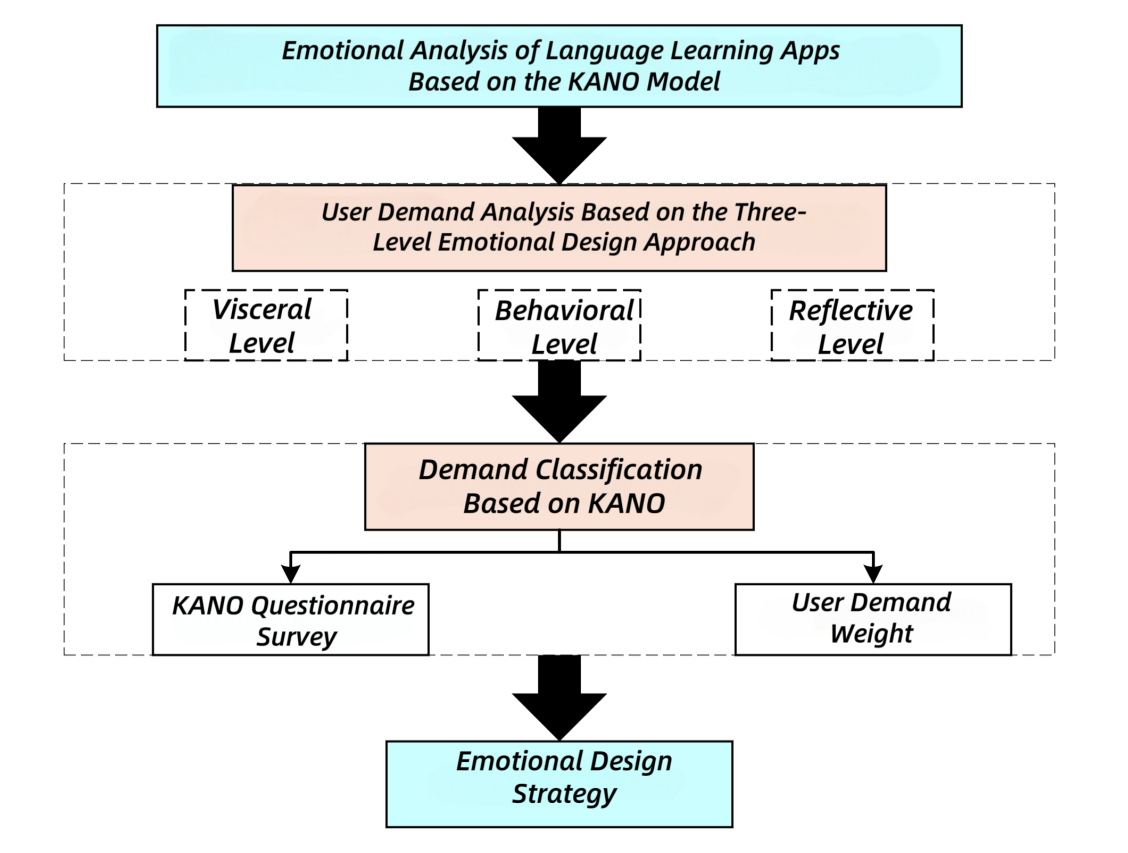
Through research on affective design theory, this paper establishes an affective design methodology for language learning apps based on the Kano model, as illustrated in Figure 1. Initially, user needs identified through surveys are preliminarily extracted using characteristics from the three levels of affective design. The Kano model then classifies and identifies needs across different levels. Based on the analysis results, differentiated design strategies are formulated to systematically guide the affective design of language learning apps.
3. Case studies
3.1. User research/competitor analysis—summarizing user needs
3.1.1. User profile analysis
Language learning apps rank among the most widely used online education products in China. According to the 2024 China Online Language Education Industry Research Report, China's online language education user base reached 67.8 million in 2023, with a market size of 57.2 billion yuan. Industry data indicates that the primary user base consists of individuals aged 22-40 residing in first- and second-tier cities, possessing higher education, and earning above-average incomes. Tencent Education's 2023 big data reveals that due to the practical and ongoing nature of language learning, users predominantly comprise college students, office professionals, and individuals with overseas needs. Gender distribution is relatively balanced, though differences emerge in usage patterns for speaking practice and exam-focused applications.
3.1.2. Competitor analysis
Duolingo, English Fun Dubbing, and Starry Sky occupy distinct positions in the language learning app market: Duolingo targets the mass market with gamified introductory content, English Fun Dubbing serves niche users through film-based speaking practice, and Starry Sky caters to professionals with AI-powered conversational drills. Their content strategies also differ—Duolingo provides standardized multilingual courses, English Fun Dubbing integrates K-12 and entertainment materials, while Starry Sky generates dynamic professional scenarios. Through differentiated technological and content approaches, these apps form a complementary ecosystem that collectively advances the language learning industry.
3.1.3. User interviews
To deeply explore core user needs and pain points during language learning app usage, this study employed semi-structured interviews with 28 users (aged 18-45, 12 male, 16 female) who had experience with language learning apps. In-depth discussions centered on learning motivation, usage habits, feature preferences, and personalized needs. The interviews authentically reflected users' language learning demands and experiential barriers across multiple scenarios.
Based on raw interview data, the study categorized user statements and initially identified 37 specific requirements. Through focused discussions, ambiguous, redundant, and non-universal demands were eliminated. After consolidation and linguistic normalization, 12 core user needs were finalized. The functional requirements for language learning apps are presented in Table 1.
|
No. |
User Requirement |
Requirement Description |
|
1 |
Systematic learning |
Tiered course system |
|
2 |
Personalized content |
learning contents based on user proficiency and goals |
|
3 |
Pronunciation correction |
Phoneme-level pronunciation assessment and feedback |
|
4 |
Conversation simulation |
Provides real-life scenario dialogues |
|
5 |
Progress visualization |
Learning progress illustration and competency maps |
|
6 |
Multi-modal interaction |
Supports multiple interactions including voice and touch controls |
|
7 |
Community interaction |
Community features like study groups and achievement sharing |
|
8 |
Scenario-based training |
Scenario-specific training for business, travel, exams, and more |
|
9 |
Review reminders |
Recommends review content based on the forgetting curve |
|
10 |
Multilingual learning |
Supports multilingual learning |
|
11 |
Timely feedback |
Provides immediate feedback after each learning task |
|
12 |
Attractive interface |
Employs visually appealing design aesthetics and layout |
3.2. User needs classification based on three levels of emotional design
User interviews were conducted to gather requirements from actual language learning app users. Participants included language enthusiasts, students, working professionals, and foreign language teachers—totaling 28 individuals. User needs identified through research were categorized based on the three levels of affective design.
3.2.1. Sensory needs at the visceral level
Visceral-level needs represent users' most immediate sensory experiences with a product and are key drivers of emotional engagement. These sensory elements manifest primarily through visual and auditory experiences, including: whether icon designs possess high recognizability; whether animations are smooth and natural, enhancing engagement without disrupting learning; and whether sound effects and voiceovers are clear and pleasant, with accurate pronunciation and moderate speaking pace. These sensory elements collectively form the user's initial emotional experience with the product.
3.2.2. Functional requirements at the behavioral level
Behavioral-level requirements focus on the product's functionality and usability. This level directly impacts users' learning efficiency and experience. Behavioral-level needs serve as the bridge between users and the product, encompassing requirements for language learning apps such as: comprehensive feature sets covering all aspects of listening, speaking, reading, and writing training; tiered course systems; simple and intuitive operational workflows; timely and accurate feedback mechanisms; and learning plans supporting personalized adjustments. These functional requirements directly influence users' learning outcomes and willingness for sustained use.
3.2.3. Reflective level experience requirements
Reflective-level needs encompass users' overall experience and feelings throughout the mini-program's usage journey. They foster lasting emotional connections and form the foundation for building enduring relationships between users and the mini-program. Reflective-level requirements for language learning apps include: establishing an achievement system with level badges and shareable certificates to enhance user accomplishment; creating a community learning ecosystem with language partner matching and interactive platforms to foster belonging; allowing users to create personalized avatars to boost immersion and identity; and providing periodic learning reports to reinforce perceived learning value. Through this three-tiered analysis of emotional design requirements, the essential elements users seek in language learning apps are identified, as shown in Table 2.
|
Emotional level |
Visceral Level |
Behavioral Level |
Reflective Level |
|
Required Elements |
Harmonious and unified Interface colors |
Comprehensive and targeted functionality |
Fostering a sense of accomplishment |
|
High icon recognition |
Systematic learning content |
Foster social interaction |
|
|
Vivid and fluid animations |
Comprehensive and effective feedback |
Enhances learning immersion |
|
|
Crisp and pleasant sound effects |
Simple and convenient operation |
Establish value Recognition |
|
|
Clear voice with Accurate Pronunciation |
Personalized learning plans |
||
|
Supports multiple languages |
3.3. User need classification based on the Kano model
This study applies the Kano model to identify user demand types. By incorporating fuzzy theory, a fuzzy Kano questionnaire was developed. Survey data was collected and demand importance calculations were performed to ultimately determine demand categories. This method balances qualitative judgment with quantitative analysis, enabling the prioritization of demands in product optimization.
3.3.1. Kano questionnaire design
The Kano model employs a questionnaire with both positive and negative statements to explore user reactions to the presence or absence of a feature. This categorizes needs into six types: Attractive Quality(A), One-dimensional Quality (O), Must-be Quality(M), Indifferent Quality(I), Reverse Quality(R), and Questionable Quality(Q). The questionnaire poses questions from two dimensions: "possesses this attribute" and "does not possess this attribute." Each question offers five options (corresponding to scores of 1–5 points): unsatisfied, tolerable, indifferent, natural, and satisfied.
3.3.2. Kano analysis results
This survey primarily targeted actual and potential users of language learning apps. A total of 200 questionnaires were distributed online, yielding 175 valid responses with an 87.5% recovery rate. Data statistics were conducted according to the Kano model classification criteria, as shown in Table 3.
|
Requirement Element |
Positive Questions |
|||||
|
Satisfied |
Natural |
Neutral |
Tolerable |
Dissatisfied |
||
|
Opposite Question |
Satisfied |
Q |
R |
R |
R |
R |
|
Natural |
A |
I |
I |
I |
R |
|
|
Neutral |
A |
I |
I |
I |
R |
|
|
Tolerable |
A |
I |
I |
I |
R |
|
|
Dissatisfied |
O |
M |
M |
M |
Q |
|
The Better-Worse coefficient analysis was introduced, where the Better value ranges from 0 to 1, reflecting the satisfaction gain when the feature is present, and the Worse value ranges from -1 to 0, indicating the satisfaction loss when the feature is absent. The Kano model analysis results are shown in Table 4. The Better-Worse coefficients are illustrated in Figure 2.
|
No. |
Feature |
A |
O |
M |
I |
R |
Q |
Better |
Worse |
Classification Results |
|
1 |
Harmonious and unified interface colors |
122 |
7 |
12 |
34 |
0 |
0 |
10.86% |
-73.71% |
Must-be Quality |
|
2 |
High icon recognition |
3 |
79 |
91 |
2 |
0 |
0 |
97.14% |
-46.86% |
Attractive Quality |
|
3 |
Vivid and fluid animations |
98 |
1 |
8 |
68 |
0 |
0 |
5.14% |
-56.57% |
Must-be Quality |
|
4 |
Crisp and pleasant sound effects |
90 |
1 |
8 |
76 |
0 |
0 |
5.14% |
-52.00% |
Must-be Quality |
|
5 |
Clear voice with Accurate Pronunciation |
171 |
0 |
2 |
2 |
0 |
0 |
1.14% |
-97.71% |
Must-be Quality |
|
6 |
Simple and convenient operation |
150 |
0 |
3 |
22 |
0 |
0 |
1.71% |
-85.71% |
Must-be Quality |
|
7 |
Systematic learning content |
35 |
70 |
31 |
39 |
0 |
0 |
57.71% |
-60.00% |
One-dimensional Quality |
|
8 |
Personalized learning plans |
6 |
95 |
72 |
2 |
0 |
0 |
95.43% |
-57.71% |
One-dimensional Quality |
|
9 |
Comprehensive and effective feedback |
143 |
2 |
11 |
19 |
0 |
0 |
7.43% |
-82.86% |
Must-be Quality |
|
10 |
Comprehensive and targeted functionality |
4 |
93 |
72 |
6 |
0 |
0 |
94.29% |
-55.43% |
One-dimensional Quality |
|
11 |
Supports multiple languages |
3 |
4 |
101 |
67 |
0 |
0 |
60.00% |
-4.00% |
Attractive Quality |
|
12 |
Fostering a sense of accomplishment |
4 |
89 |
79 |
3 |
0 |
0 |
96.00% |
-53.14% |
One-dimensional Quality |
|
13 |
Foster social interaction |
1 |
2 |
70 |
97 |
5 |
0 |
42.35% |
-1.16% |
Indifferent Quality |
|
14 |
Establish value Recognition |
19 |
70 |
41 |
45 |
0 |
0 |
56.57% |
-57.71% |
One-dimensional Quality |
|
15 |
Enhances learning immersion |
2 |
0 |
96 |
77 |
0 |
0 |
54.86% |
-1.14% |
Attractive Quality |
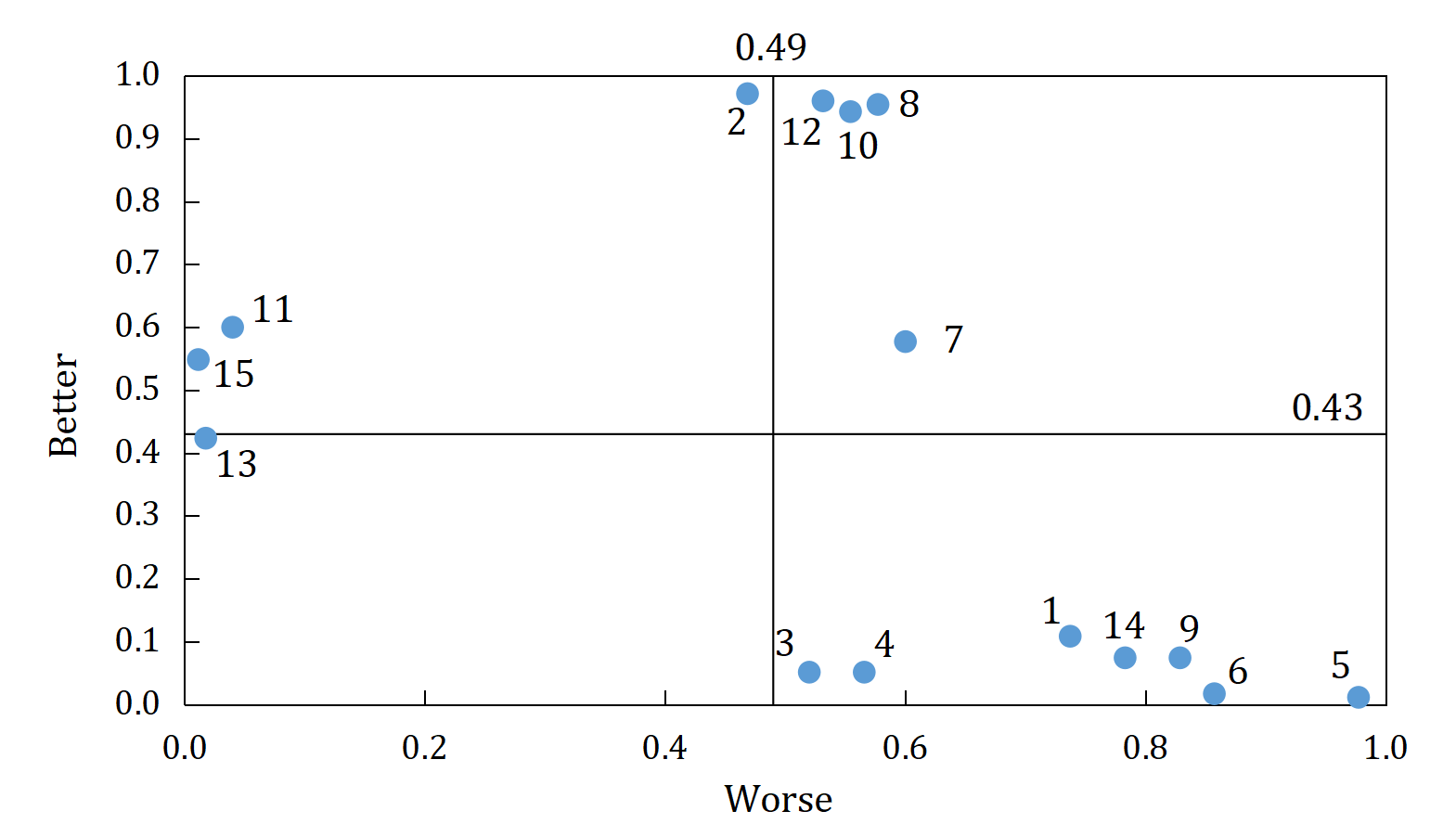
The Better-Worse coefficient diagram visualizes design metric attributes. The horizontal axis represents the absolute value of the Worse coefficient, reflecting user dissatisfaction when the metric is absent. Higher values indicate the element is more fundamental to basic needs. The vertical axis represents the absolute value of the Better coefficient, indicating the degree to which the metric enhances user satisfaction when present. Higher values signify a more pronounced role in improving the experience. First Quadrant indicators (7, 8, 10, 12) are one-dimensional qualities, exhibiting both high Better and Worse values, significantly boosting satisfaction. Second Quadrant indicators (2, 11, 15) are attractive qualities, featuring high Better values and low Worse values, offering appeal beyond user expectations. Fourth Quadrant indicators (1, 3, 4, 5, 6, 9, 14) are must-be qualities with high Worse values and low Better values, representing core product functionality whose absence causes significant dissatisfaction. Third Quadrant indicators (13) are indifferent qualities with minimal impact and can be disregarded in design.
4. Design strategies
Based on the Kano model's classification of user needs and the analysis of Better-Worse coefficients, this study integrates the three-level theory of emotional design with demand prioritization. It proposes the following four design principles to systematically guide emotional design innovation in language learning apps, aiming to strengthen product foundations, optimize user experience, and establish deep emotional connections.
4.1. Functional operation convenience principle
Among essential requirements, "simple and convenient operation," "clear voice and accurate pronunciation," and "comprehensive and effective feedback" form the foundational prerequisites for app usage. The absence of these features directly triggers strong dissatisfaction, while their implementation becomes the "default baseline" in user perception. Design must prioritize "lowering operational barriers and enhancing usage efficiency." In navigation design, core functions like course learning and review check-ins should be accessible within two clicks to avoid cumbersome multi-level transitions. Voice interaction must incorporate high-precision speech recognition technology, ensuring not only clear and accurate playback but also phoneme-level pronunciation assessment—accurately distinguishing easily confused sounds and providing textual correction suggestions. Feedback mechanisms must be instantaneous and multidimensional. Upon completing each learning task—such as a set of vocabulary memorization or a dialogue practice session—users receive immediate feedback combining accuracy statistics, highlighted knowledge gaps, and personalized next-step learning recommendations. This enables real-time progress tracking and prevents learning confusion caused by delayed or ambiguous feedback.
4.2. User experience optimization principles
Desired needs exhibit a linear growth relationship with user satisfaction—higher fulfillment leads to greater satisfaction. Analysis reveals that demands such as "systematic learning content," "personalized learning plans," and "building a sense of value recognition" possess high absolute values for both Better and Worse ratings, making them key differentiators in competition. These needs span both behavioral and reflective levels, directly impacting learning efficiency and deep motivation. Accordingly, design should focus on deep functional optimization and meticulous refinement of the experience. For instance, constructing a CEFR-standardized graded curriculum covering modules like listening comprehension, oral expression, reading analysis, and writing training, while dynamically adjusting learning paths and content recommendations based on user proficiency and goals. Generating visual learning reports (e.g., polygonal language proficiency analysis), competency maps, and shareable learning achievements (e.g., continuous learning badges) helps users clearly perceive progress and reinforces their sense of value in learning. Sustained investment in such features effectively boosts user retention and satisfaction.
4.3. Emotional resonance innovation principle
Charm-driven needs are key to surprising users and enhancing product appeal. When present, they significantly boost satisfaction; when absent, they cause no dissatisfaction. Examples include "high icon recognition," "multilingual learning," and "enhanced learning identity immersion" listed in Table 4. These needs often correspond to visual novelty at the visceral level or deep emotional appeals at the reflective level, serving as breakthrough points for achieving product innovation and emotional bonding. Design should dare to break conventions and pursue forward-thinking innovations. Strategies may include: designing unique, highly recognizable brand visual symbols like icons or IP characters to establish distinct product personalities; supporting flexible multilingual learning and switching to satisfy users' exploratory learning motivations; introducing features such as virtual avatar customization and scenario-based role-playing to enhance immersion and enjoyment during learning. Though non-essential, these elements form the core of building long-term product competitiveness and user emotional loyalty.
4.4. Sensory experience synergy principle
visceral needs like "harmonious and unified Interface colors," "vivid and fluid animations," and "crisp and pleasant sound effects" are key to boosting initial user affinity. While not directly determining learning outcomes, these sensory experiences influence learning motivation and focus. Design should prioritize "non-intrusive learning with enhanced sensory pleasure," achieving visual and auditory synergy. Visually, employ low-saturation soft color palettes (e.g., light blue, beige) as primary tones to prevent visual fatigue from high-saturation hues. Keep motion effects minimalistic, with 0.3-second smooth transitions during page shifts. Trigger minimal particle effects upon task completion to convey positive feedback without obscuring core content. Auditory design aligns with learning scenarios: correct answers trigger crisp "ding" sounds below 50 decibels, while errors use gentle "prompt tones" to prevent negative reactions. Users can independently toggle sound effects to accommodate diverse usage contexts.
5. Conclusion
Addressing issues such as severe homogenization, insufficient emotional engagement, and unclear priority of needs in language learning apps, this study proposes a product design analysis method integrating the three-level theory of emotional design with the Kano model. Through user interviews and surveys, this method systematically collects and analyzes user needs across the visceral, behavioral, and reflective levels. It then employs a fuzzy Kano model to categorize attributes and rank importance levels for each need, precisely identifying demand characteristics. Based on the Kano model's findings, it further proposes design principles. These principles provide clear guidance for formulating core design strategies, ensuring reliable foundational functionality while optimizing the core learning experience and creating delightful surprises that evoke emotional resonance. This methodology not only enhances user satisfaction and emotional engagement but also offers valuable theoretical references and practical pathways for future innovative designs in intelligent learning products.
References
[1]. iResearch Consulting. 2023-2024 China Online Language Education Industry Operation Big Data and Development Outlook Report [R]. Beijing: iResearch Consulting, 2024.
[2]. Guanyan Tianxia Information Consulting Co., Ltd. Analysis of Development Trends and Investment Prospects in China's Online Language Education Industry (2025-2032) [R]. Beijing: Guanyan Tianxia Information Consulting Co., Ltd., 2025.
[3]. Wang Haiyan, Li Meng, Zhao Yu. Research on the Application of Artificial Intelligence in Language Learning: Based on Intelligent Speech Recognition and Adaptive Learning Technology [J]. China Education Informatization, 2021 (12): 45-52.
[4]. Li Xiaohong. Research on Usability Optimization Design of Mobile Learning Platform Interfaces [J]. Packaging Engineering, 2022, 43 (8): 312-318.
[5]. Zhang Ming, Liu Chang, Chen Xi. Application of the Kano Model in Online Education Product Requirement Analysis [J]. Modern Education Technology, 2020, 30 (5): 89-95.
[6]. Liu Qiang. Emotional Design and User Experience Enhancement Strategies for Educational Products [J]. Educational Exploration, 2021 (7): 102-106.
[7]. Norman D A. Emotional Design: Why We Love (or Hate) Everyday Things [M]. New York: Basic Books, 2004.
[8]. Luo Shijian, Zhu Shangshang. Research on Emotional Design in Product Design [J]. Transactions of the Chinese Society for Mechanical Engineering, 2010, 46 (14): 123-128.
[9]. Kano N. Attractive Quality and Must-be Quality [J]. Journal of the Japanese Society for Quality Control, 1984, 14(2): 39-48.
[10]. Zhang Junxia, Liu Jia, Li Ming. Analysis of User Needs for Online Education Products Based on the Kano Model [J]. Computer Engineering and Applications, 2021, 57 (11): 263-269.
Cite this article
Jin,Z. (2025). Emotional Analysis of Language Learning Apps Based on the KANO Model. Communications in Humanities Research,100,14-23.
Data availability
The datasets used and/or analyzed during the current study will be available from the authors upon reasonable request.
Disclaimer/Publisher's Note
The statements, opinions and data contained in all publications are solely those of the individual author(s) and contributor(s) and not of EWA Publishing and/or the editor(s). EWA Publishing and/or the editor(s) disclaim responsibility for any injury to people or property resulting from any ideas, methods, instructions or products referred to in the content.
About volume
Volume title: Proceeding of ICIHCS 2025 Symposium: The Dialogue Between Tradition and Innovation in Language Learning
© 2024 by the author(s). Licensee EWA Publishing, Oxford, UK. This article is an open access article distributed under the terms and
conditions of the Creative Commons Attribution (CC BY) license. Authors who
publish this series agree to the following terms:
1. Authors retain copyright and grant the series right of first publication with the work simultaneously licensed under a Creative Commons
Attribution License that allows others to share the work with an acknowledgment of the work's authorship and initial publication in this
series.
2. Authors are able to enter into separate, additional contractual arrangements for the non-exclusive distribution of the series's published
version of the work (e.g., post it to an institutional repository or publish it in a book), with an acknowledgment of its initial
publication in this series.
3. Authors are permitted and encouraged to post their work online (e.g., in institutional repositories or on their website) prior to and
during the submission process, as it can lead to productive exchanges, as well as earlier and greater citation of published work (See
Open access policy for details).
References
[1]. iResearch Consulting. 2023-2024 China Online Language Education Industry Operation Big Data and Development Outlook Report [R]. Beijing: iResearch Consulting, 2024.
[2]. Guanyan Tianxia Information Consulting Co., Ltd. Analysis of Development Trends and Investment Prospects in China's Online Language Education Industry (2025-2032) [R]. Beijing: Guanyan Tianxia Information Consulting Co., Ltd., 2025.
[3]. Wang Haiyan, Li Meng, Zhao Yu. Research on the Application of Artificial Intelligence in Language Learning: Based on Intelligent Speech Recognition and Adaptive Learning Technology [J]. China Education Informatization, 2021 (12): 45-52.
[4]. Li Xiaohong. Research on Usability Optimization Design of Mobile Learning Platform Interfaces [J]. Packaging Engineering, 2022, 43 (8): 312-318.
[5]. Zhang Ming, Liu Chang, Chen Xi. Application of the Kano Model in Online Education Product Requirement Analysis [J]. Modern Education Technology, 2020, 30 (5): 89-95.
[6]. Liu Qiang. Emotional Design and User Experience Enhancement Strategies for Educational Products [J]. Educational Exploration, 2021 (7): 102-106.
[7]. Norman D A. Emotional Design: Why We Love (or Hate) Everyday Things [M]. New York: Basic Books, 2004.
[8]. Luo Shijian, Zhu Shangshang. Research on Emotional Design in Product Design [J]. Transactions of the Chinese Society for Mechanical Engineering, 2010, 46 (14): 123-128.
[9]. Kano N. Attractive Quality and Must-be Quality [J]. Journal of the Japanese Society for Quality Control, 1984, 14(2): 39-48.
[10]. Zhang Junxia, Liu Jia, Li Ming. Analysis of User Needs for Online Education Products Based on the Kano Model [J]. Computer Engineering and Applications, 2021, 57 (11): 263-269.